Deep dive
Jim Paulsen on What Happens If the AI Boom Slows
Keith Brown · Founding Partner, Outperform Ventures
Nov 5, 2026 · 6 min read
Jim Paulsen says AI is propping up a split US economy. Here is his case, the numbers behind it, and where other economists land.
I was ending my day in my office, finishing up emails, with CNBC's Fast Money on in the background. It's an easy way to close out a day, and I like the show's debate format. Jim Paulsen's interview was the best one I saw all day.
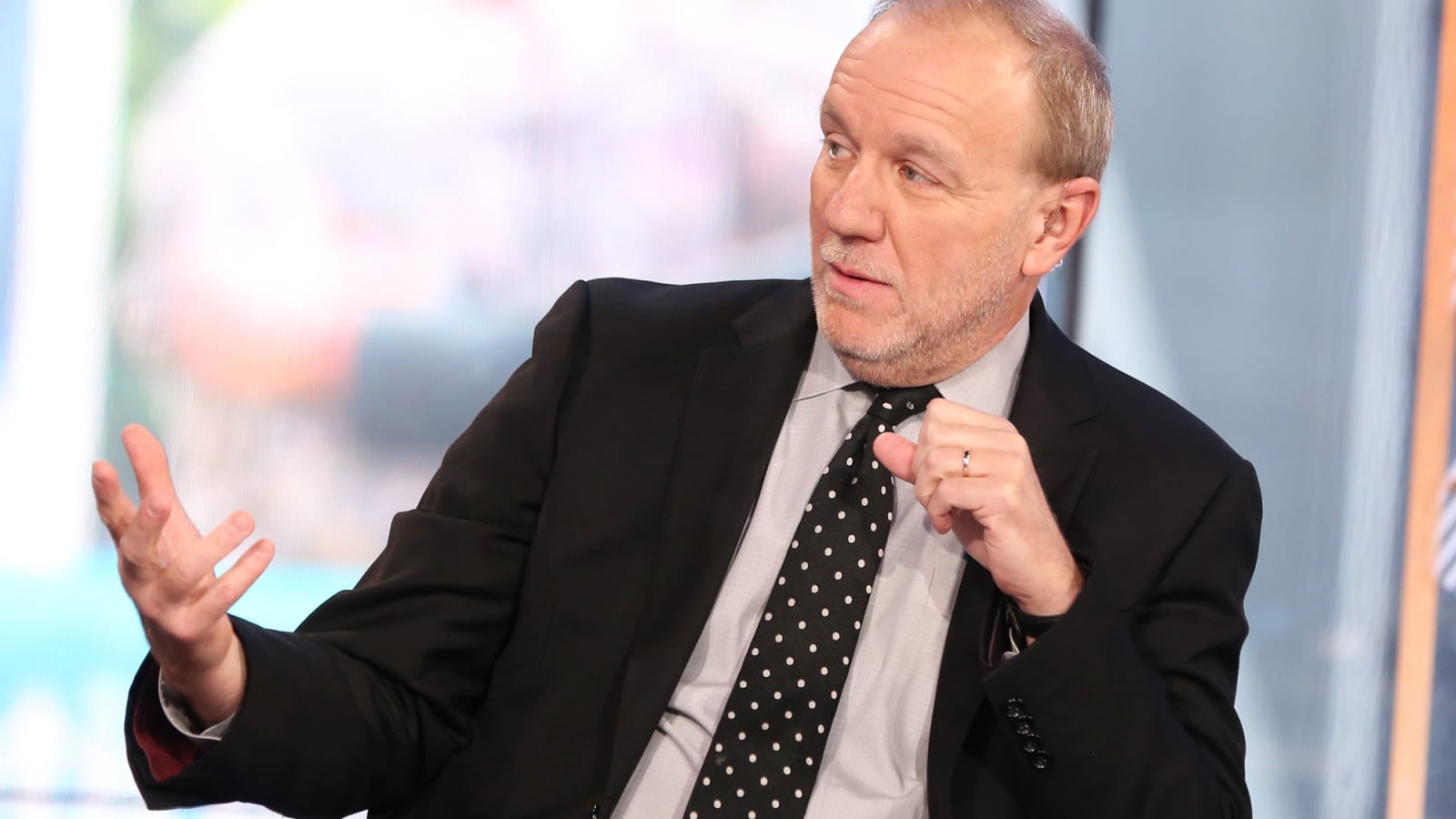
Paulsen's point is that the headline GDP number hides two very different economies, and AI is driving most of the gap. Paulsen, who writes Paulsen Perspectives, told Fast Money what the economy could look like if the AI build-out slows. I wrote last week about whether AI is propping up the economy, and about voters rejecting data centers, and about how the whole world is being reskilled. This article follows Paulsen's view, using his own posts and charts.
Who is Jim Paulsen?
Paulsen has studied the US economy and markets for more than four decades. He was chief investment strategist at Wells Capital Management and later at The Leuthold Group. Today he publishes his charts in Paulsen Perspectives on Substack and walks through them each month on The Jim Paulsen Show with Excess Returns.
What does Jim Paulsen see in the economy?
US real GDP grew at a 3.4% annual pace in the third quarter, up from 2.2% in the second, the AP reported. After the Fed's meeting, Chairman Warsh said "economic activity is expanding at a strong pace."
Paulsen isn't convinced. In his Nov. 2 post, he wrote that the US economy "is probably best described as a tale of two prominent themes – one small part of the economy is enjoying a massive boom while the much larger remaining portion of overall real GDP has been and continues to be stuck near recession-like conditions."
Economic performance within the U.S. economy is perhaps more bifurcated than it has been at any point in post-war history.
He calls the booming part the "New Era" economy and the rest the "Old Era" economy. The chart below shows his numbers for the past year.
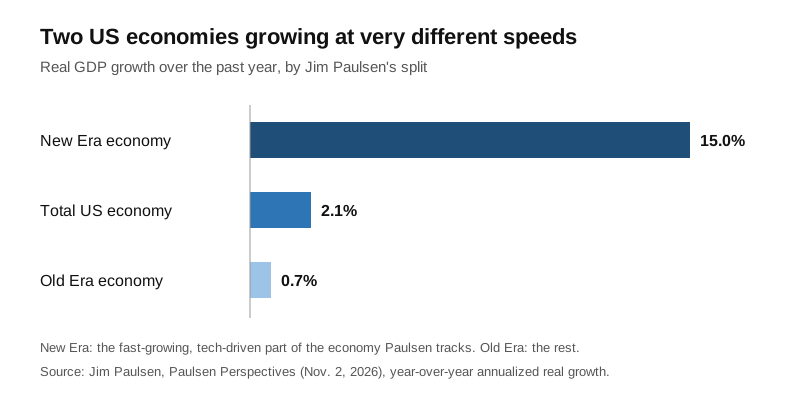
By his numbers, New Era real GDP grew 14.99% over the past year. Old Era real GDP grew 0.70%. Overall real GDP grew 2.07%.
Why can't the Fed fix a split economy?
Paulsen's point is that one interest rate has to serve both halves. "The Federal Reserve lacks the tools to simultaneously implement contractionary force on one part of the economy while adding accommodation for another part," he wrote.
His chart puts numbers on it. The New Era grew about 15% over the past year and the Old Era under 1%. A rate that cools the first half also holds back the second.
In September he listed economic warning signs, including that investment was "no longer creating Jobs." He also wrote that he did not expect a recession soon, "primarily because private sector balance sheets mostly remain healthy."
How much of US growth is AI?
Estimates of AI's share of US growth run from about 20% to about 75% of the total.
- Brad Gerstner of Altimeter Capital estimated on the All-In election-night show that about 75% of 2026 US GDP growth came from AI infrastructure, per the transcript. That is his forecast.
- ING's chief international economist James Knightley estimates AI contributes about one-third of US growth this year.
- J.P. Morgan Asset Management's Stephanie Aliaga estimates AI-related investment added 0.47 points to 2.1% growth over the past year, about one-fifth, after netting out imported hardware. Consumption contributed over three times as much.
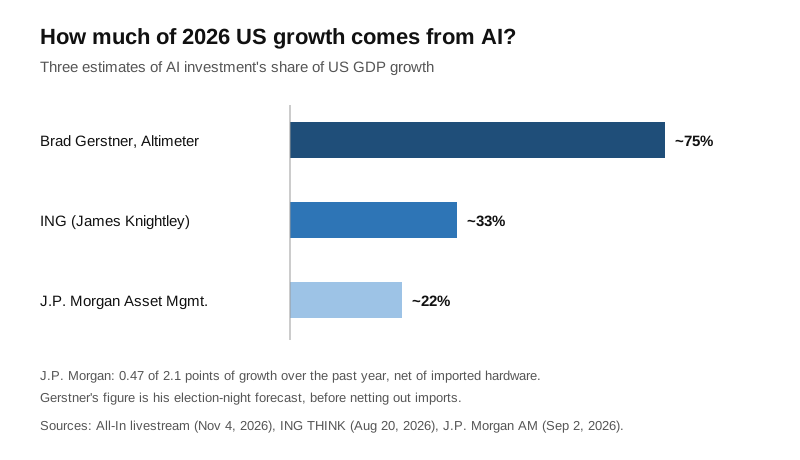
The gap comes from imports. Much of the hardware is built overseas, so it adds to investment and subtracts from trade. The St. Louis Fed tracks AI's contribution to GDP the same way, by component.
What do other economists see in the third quarter?
Carlyle's head of research, Jason Thomas, wrote that tech investment grew at a 61.2% annual rate in the third quarter and reached 24% of all US business investment. After inflation, fixed investment outside AI data centers was down more than 5% from a year earlier.
Thomas also found US capital goods imports up 77% in September from a year earlier, much of it hardware for the AI build-out.
Joseph Carson, former director of global economic research at AllianceBernstein, called the third quarter "impressive, but not repeatable." Real disposable income grew only 0.8% over the past year, he wrote, which makes the 3.8% pace of consumer spending hard to keep up.
What happens if the AI boom slows?
CNBC framed the interview around Paulsen's view that an AI pullback could help the economy avoid a recession. A slower build-out takes growth away from the booming part of the economy. It could also ease the pressure the boom puts on rates and power costs for everyone else.
In Paulsen's view, that could leave room for the Old Era economy, the much larger part, to recover.
He laid out the same path on The Jim Paulsen Show in October: slower growth, then lower inflation and lower bond yields, then a recovery. He was clear that his caution did not mean a recession call.
Morningstar's Preston Caldwell reached a similar conclusion on Nov. 5. He wrote that an AI spending crunch is unlikely to cause a recession, because the hit to demand should be small enough for the Fed to offset with lower rates. If a slowdown did come, he wrote, the worst case looks like the mild 2001 recession.
For the data-center side of this, voters in Ohio, Texas and dozens of towns rejected new projects on Nov. 3. I covered those votes in what happens next after voters rejected data centers.
Why is this different from the tariff shock?
The April 2025 tariffs were temporary. President Trump announced them on April 2, and on April 9 he paused most of them for 90 days. One decision in Washington put them in place, and one decision took most of them back.
The Nov. 3 results are structural. Of 38 counted ballot measures on data centers, 36 went against development: 15 bans and 21 restrictions. In Ohio, at least 14 towns passed bans or limits. Each one is a local law. Undoing it takes another vote or a court ruling in that town, not a single decision from the White House.
That matters for Paulsen's view. A pause that ends in a week changes little. Local laws that stay on the books slow the AI build-out for years, which is the slower New Era growth he says could leave room for the Old Era economy to recover.
What should leaders take from this?
If you sell to restaurants, contractors, clinics or local services, Paulsen's numbers say your customers are growing near 1%, not 3.4%.
Plan your 2027 around your own customers' numbers. The GDP headline averages them with the boom. I wrote about that in Plan 2027 Around Your Vision.
If you sell into the AI build-out, your 2026 has looked very different. Watch how many of the projects you're counting on still get built after this week's votes.
For the full picture, watch Paulsen's Fast Money interview, read Paulsen Perspectives and catch The Jim Paulsen Show each month. This is not financial advice. I'm sharing his views on the economy, not on any investment.
Related reading
Follow what I'm building and backing
I post on LinkedIn and X about the companies I back and the products I build.
Join 2,310 people following along.