Deep dive
The Whole World Is Being Reskilled in Real Time
Keith Brown · Founding Partner, Outperform Ventures
Nov 3, 2026 · 6 min read
Companies are cutting domain experts right as AI makes it easy for anyone to build. Many will go after the problems they saw every day at their old jobs.
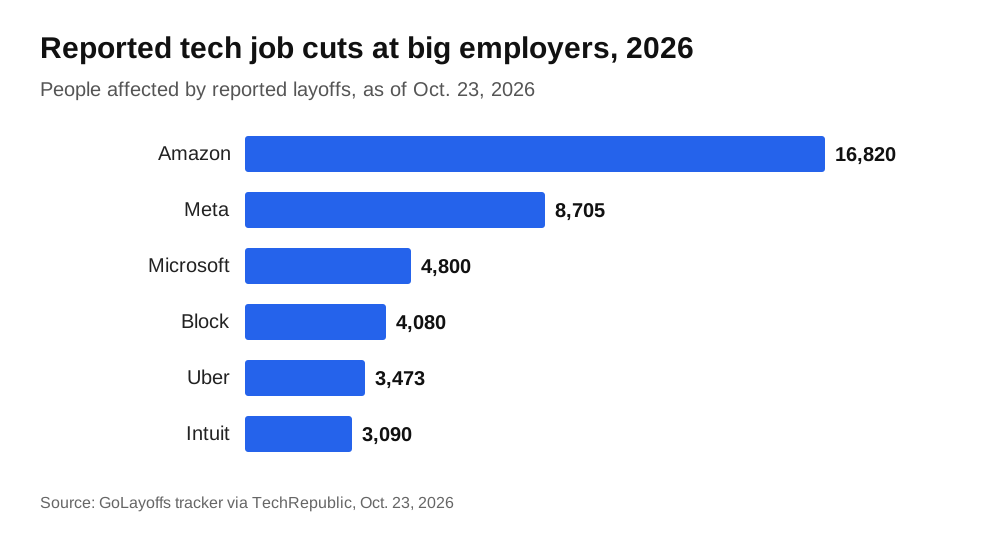
On October 26, Microsoft offered a voluntary exit to eligible employees in the US, Canada, India and the UK. Earlier this year it cut 4,800 roles. Its chief people officer, Amy Coleman, wrote that "the roles eliminated today are not being replaced by AI," and also that "AI is changing how work gets done," InformationWeek reported.
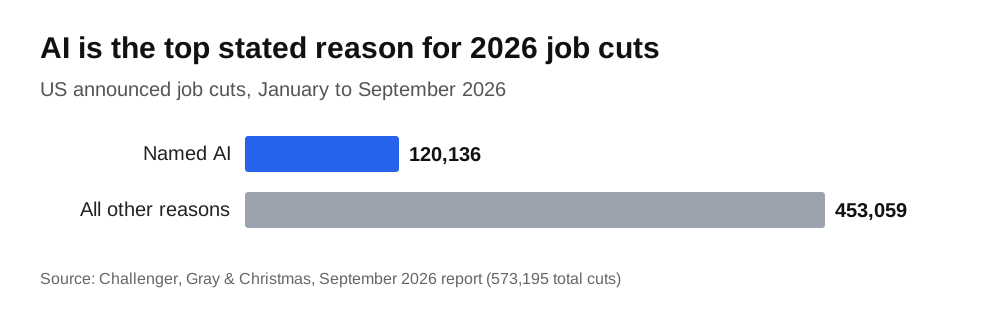
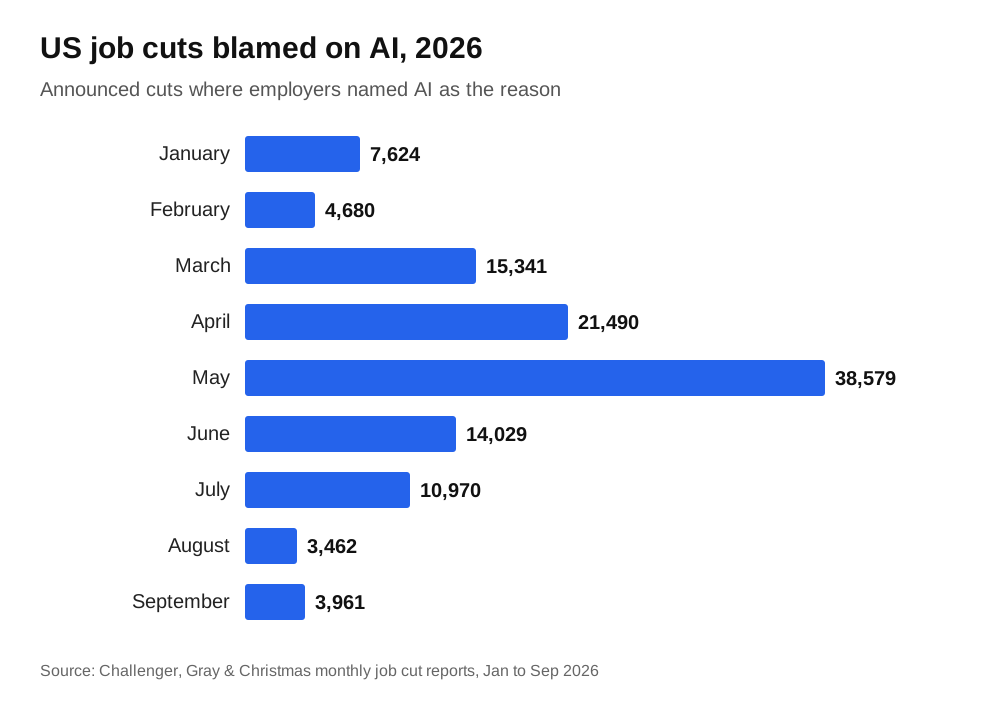
Through September, US employers announced 573,195 job cuts in 2026, and they named AI as the reason for 120,136 of them, according to Challenger, Gray & Christmas. That makes AI the top stated reason this year.
I think 2027 is going to be a wild year. Corporations will let go of hundreds of thousands of talented people, maybe millions, most of them non-technical and some technical. They will do it right as Claude, Grok and ChatGPT make it easier than ever for anyone to build anything.

Aren't the people let go just the weak performers?
Some readers will say the people being let go were the poor performers, and that I'm giving them too much credit. Some of them were. The ones who win won't be picked by their last review. They'll be the ones who spend time in the real world, talking to people who build every day.
For decades, building was gatekept by technical people. Every visionary needed a technical co-founder. Now a domain expert can build almost anything on their own.
Stripe's data shows the shift. Stripe Atlas reported that 20% of its 2025 startups landed a first paying customer within 30 days of incorporating, more than double the 2020 rate, even as the share of funded Atlas startups fell. Delaware C corporations grew an average of 41% a year over the six months Stripe measured.
You still need a team. One person can build alone at first, but founders naturally hire as they scale. My prediction is that teams end up about 50% smaller, with 10 times more companies out there, maybe 100 times.
Who is getting reskilled?
Everyone. The people being let go are domain experts. They know the customers, the workflows, the complaints and the workarounds. Now each of them can learn to build software in a few weekends.
You're not going to lose your job to an AI, but you're going to lose your job to somebody who uses AI.
If they're smart, they will go right after the domain they were just let go from. I wrote about why the old setup is breaking in the new model for employment. This article is about what happens when the people leaving can compete on day one.
What if 60,000 ex-Microsoft employees went after every complaint?
Picture 60,000 laid-off Microsoft employees armed with AI, each one fixing something a Microsoft customer complained about. That is a scenario, not a forecast. Microsoft's reported cuts this year are smaller. The point is what each of those people knows.
A support engineer knows which admin screens confuse IT teams. A seller knows which licensing questions stall deals. A program manager knows the feature requests that sat in the backlog for years. Each of those is a product someone can now build in weeks.
You could run this same exercise for nearly every big company that cut people this year.
How could big layoffs bite back?
Three more examples, all scenarios built on real 2026 cuts:
- Amazon: about 16,820 reported cuts. Former staff know what independent sellers struggle with: listings, returns, fees and inventory. Expect small tools that solve one seller pain each.
- Intuit: about 3,090 reported cuts. Former staff know where small business owners get stuck on books, payroll and taxes. A former product lead can build a focused tool for one trade, like restaurants or contractors.
- Oracle: about 21,000 jobs cut over the past year, by its own filing, which said AI adoption has resulted in workforce reductions. Former consultants know every painful implementation. Some will build lighter custom systems for the same customers.
None of these people need venture capital to start. They need a laptop, an AI subscription and the customer relationships they already have.
Is this already happening?
Yes. I'm seeing it every day now. A friend quit his job after four years a few months ago. He has already made more in the last 90 days than he did in a full year, building custom platforms in the same industry.
Another friend was let go from a big CRM company. He just closed his first $50,000 custom CRM build.
Here is a third, as an example only. Picture a claims adjuster let go by an insurer in March 2027. She knows exactly why claims stall. By June she has built a simple intake tool for body shops, and her first customers are the shops she used to call every week.
Leaders now run a training org
I've hired hundreds of people in my career and, unfortunately, had to let a few go along the way. I never worried that someone would take the domain knowledge, leave and immediately profit from it. The gap between knowing a problem and shipping a fix was too wide.
That gap is closing. Whether you like it or not, you're now running a training org more than you're writing SOPs for established practices. Every person you teach to use AI on your customers' problems is being reskilled on your time, and that skill leaves with them.
| Before AI | Now | |
|---|---|---|
| What leaves with an employee | Know-how and contacts | Know-how, contacts and the ability to build |
| Time to a competing product | Years and a funded team | Weeks and one person |
| What a manager hands out | SOPs for known work | Training for work that changes monthly |
| Risk of a departure | A gap on the team | A new vendor selling to your customers |
Why the old employment model won't hold
The model we had assumed a company owned the tools and the employee rented them. AI hands the tools to everyone. I wrote about where that money goes in third-party to first-party software, and about the builders who sit with customers in forward deployed engineers.
That's the core issue I see. The employment model we had won't work in the future, because the people you let go can now sell directly to your customers.
What should leaders do before 2027?
- Treat every exit as a possible competitor or partner. Ask what they'd build, and whether you'd rather be their first customer.
- Fix the complaints your own team already knows about. Your support and sales teams have the list.
- Back your internal builders with time and budget before they leave to do it on their own.
- Part ways generously. People remember how they left, and some will be selling to your customers next year.
This week, ask your support lead for the ten complaints customers repeat most, and decide which ones your team will fix before someone who used to work for you does.
Related reading
Follow what I'm building and backing
I post on LinkedIn and X about the companies I back and the products I build.
Join 2,219 people following along.