Deep dive
We Need a New Model for Employment
Keith Brown · Founding Partner, Outperform Ventures
Oct 19, 2026 · 8 min read
The 40-hour week was built for factories. With AI working around the clock, I think companies will keep a small full-time core and pay a wider circle of people for the results, IP and value they create.
Early one morning, I was driving through East Texas as the sun came up. The road ran wide open ahead of me, all the way to the horizon. I realized how much I love that view.
Most people do. We want to know what's ahead. That's the challenge with work right now, because AI is changing what's ahead faster than most of us can plan for.

Full-time employment is going away for a lot of people. When AI can work 24 hours a day, 365 days a year, the 40-hour week stops being a useful way to measure work. We need a new model for employment, one built on results.
Companies are already reorganizing around AI. Through September, US employers cited artificial intelligence in 120,136 announced job cuts this year, about 21% of all cuts and the top reason given, according to Challenger, Gray & Christmas. I wrote about one of them in Kroger's 3,000 corporate cuts.
Most of those decisions assume there are only two settings for a person: 40 hours or zero. I think that assumption is the thing that's broken.
The 40-hour week was built around machines
Henry Ford moved his plants to a five-day, 40-hour week in 1926. In an interview with World's Work that year, he explained the math behind it. His machines could run all day and night. His people couldn't.
Expensive tools cannot remain idle. They ought to work twenty-four hours a day, but here the human element comes in.
A hundred years later, the tools still run all day, and now they do knowledge work too. Researchers at METR found the length of tasks AI agents can finish on their own has been doubling about every seven months since 2019.
When AI can do in 60 seconds what used to take a person 40 hours, counting hours tells you very little. What matters is the outcome.
Smart people already do more than one thing
I don't know anybody smart who's doing one thing anymore. People build apps on their lunch break. They run small companies on the side with agents doing most of the work. Some of them are full-time employees somewhere else.
The official numbers miss most of it. The government's monthly survey counts about 9 million Americans with more than one job, or 5.5% of everyone employed. That survey depends on people telling an interviewer about every job they hold, and most people with a second full-time job don't admit it.
We know the survey runs low. When Census Bureau researchers counted from payroll records instead, they found 7.8% of workers held more than one job, roughly half again what the survey showed at the time.
How many people secretly work two jobs?
Then there's a growing group of people who hold two or more full-time jobs at once, often without telling either employer. The r/overemployed community on Reddit has more than 673,000 followers. Its tagline says it plainly: "Work multiple jobs during the same 40 hours, reach financial freedom."
Here's what members have posted in the past few weeks:
- "For the first time I'm starting a fourth job."
- "[My second job] is the one I actually care about because I get paid more with less work."
- "It's [working two jobs] but it's also not because it's not a secret. I don't have to hide anything from either employer." That member is a senior IT director at $250,000 plus bonus, with a $120,000 Salesforce admin contract on the side, and was starting a third job.
- "Considering [taking a second job], has anyone [used AI] to automate most of their work?"
- "[Working multiple jobs for] 4.5 years! Done. $325k saved."
Surveys of remote workers point the same way. In a ResumeBuilder survey of more than 1,000 fully remote workers, 36% said they currently held at least two full-time jobs. A Monster survey the same year put it at 37%, Fortune reported. Online surveys aren't a perfect sample, and some researchers think the true share is far smaller. Even so, it's a long way from what anyone admits to the government.
My rough math
In September 2026, about 12.1 million people in management and professional jobs worked fully remote. If just 1 in 10 of them holds a second full-time job, that's about 1.2 million white-collar workers. If the surveys are close, it's more than 4 million.
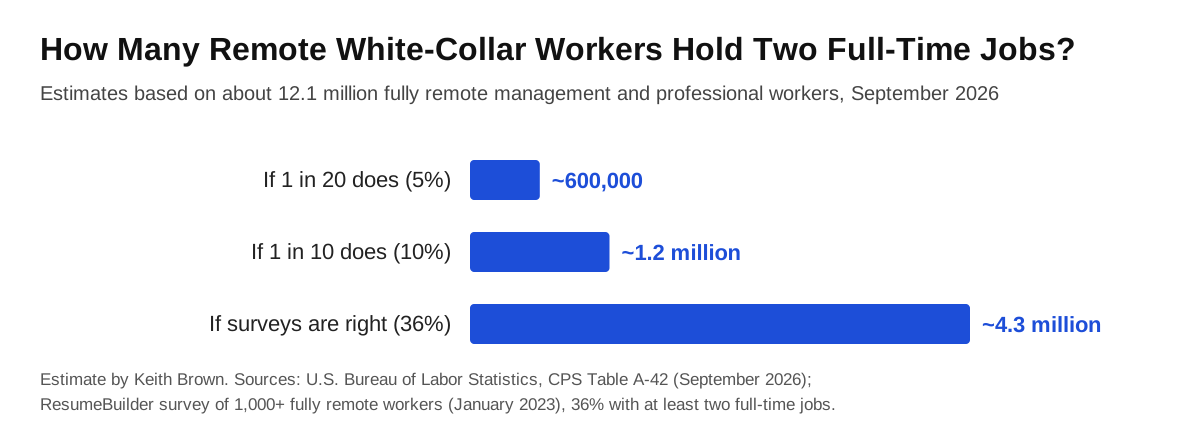
I think the real number is much higher than anyone reports. Either way, the one-person, one-job model is already gone for a lot of high performers.
They keep it quiet because employers assume a person can only do one job. WIRED profiled one engineer working four jobs in secret for a combined $680,000 a year. With AI, that assumption holds even less.
Everyone is chasing top performers
Look at what the biggest companies are paying for. Meta spent $14.3 billion on a stake in Scale AI and brought in its founder, Alexandr Wang, to run its superintelligence lab. It offered some researchers pay packages as high as $100 million, the New York Times reported.
The frontier labs are doing the same. They're paying for output, because one great person with the right tools can do what used to take a team.
A top player can already handle several things at once. With AI, that person can handle ten times as much. Once that's true, the old idea of full-time work and human output goes away. You're chasing outcomes.
Full-time is a lie
I know what some of you are thinking. Meta, Anthropic and tons of other companies still hire full-time employees. They do. I still think full-time is a lie.
Everyone has a side hustle or a side idea. Most people have something they're working on, or thinking about, outside the job on their badge. That has always been true. The difference now is how easy it is to act on it.
AI has made that 100 times easier. A side idea used to need a developer, a designer and a lot of late nights. Now one person with the right tools can build it, launch it and run it. So the full-time employee on your org chart may also be a founder, a freelancer or an investor somewhere else.
Old ways of working, poured into something new
There's an old saying about not putting new wine into old wineskins. The new wine stretches, and the old skins burst. That's what we're doing with work. We're forcing the old ways of working into a world that has already changed.
Here's how I see the shift:
| The old model | The new model | |
|---|---|---|
| How work is measured | Hours at a desk | Results |
| Who you work for | One company | Several, openly |
| How you get paid | A salary for your time | Pay tied to the IP and value you create |
| Extra work | Called a side hustle or moonlighting | A normal part of a career |
| When a company needs less | 40 hours or zero | Turn the work up or down |
The goal is to pay people more for what they create, and to stop building companies around a setup that no longer works.
Pay people for what they create
Engineers should probably get paid from the IP they create. We do this at Outperform Ventures. Growth marketers should probably get paid from the value they create.
This idea has been building for a while. In 2013, LinkedIn co-founder Reid Hoffman, Ben Casnocha and Chris Yeh argued in Harvard Business Review that the old promise of lifetime loyalty was gone. They proposed "tours of duty," where a company and a person agree on a mission for a set time and both come out ahead.
AI pushes that further. If someone builds a product, they can share in what it earns. Equity is one way to do it, and I explain how to think about it in what your stock options are worth.
A small nucleus, with many people in orbit
I think the companies of the future will have very small groups of full-time W-2 employees at the heart of them. Think of them as a nucleus.
Around that nucleus, you'll have dozens, hundreds, maybe thousands of people. It's close to how Palantir uses forward-deployed engineers, who work inside customers' businesses. The Wall Street Journal reported that the model is now spreading through AI startups, and companies like OpenAI, Anthropic and Ramp have built teams this way.
You won't assume those people only work for you, because they don't need to. You'll expect them to create value on par with what you pay them. The agreements will still cover things like non-competes and confidentiality.
As a business, you simply have to create gravity to keep people in your orbit.
The largest star has the most planets around it. Companies with a clear mission, good people and fair pay will pull the best talent toward them. How many people are on the payroll will matter a lot less.
I've written about how this changes leadership in the end of management as coordination and about the smaller teams at the top in what the AI-native executive team looks like.
Fewer people doing more things
You're going to have far fewer people doing more things. That's hard to hear, and it's already happening, especially for entry-level jobs.
People will need an easy way to find work and get paid from several places, without anyone calling it moonlighting. In-person time is flourishing, even as companies need fewer people on the payroll. A new model should make room for both.
It should also give companies more choices than firing or promoting. A person can do more for you one quarter and less the next, and stay close to the company either way.
Where to start
We have to rethink this from the ground up. I'd start with four questions.
- Where are we today?
- What does output look like today?
- What are people's biggest challenges?
- How do we connect businesses and people?
If you lead a company, pick one role and write down the outcome you're paying for. Then ask whether the person in that role could share in the value they create. If you're the person, write down what you've created this year, in results, and talk about it that way.
I think the answers to those questions will shape a model of work that works for everyone. It will reward value creation and ownership, and pay people fairly, without assuming everyone has to either be fired or promoted.
Related reading
Get my monthly newsletter
One email a month with what I'm writing and working on.
One email a month. Unsubscribe anytime.