Prediction
What Are My Stock Options Worth?
Keith Brown · Growth & Leadership
Oct 22, 2026 · 5 min read
Your stock options are only worth something if the company is. If it isn't growing fast and profitable, or on a real path to profit, your equity is likely worth zero. Spend less energy on strike prices and percentages and more on helping the company grow.
Your stock options are only worth something if the company is. Before you ask what your options are worth, ask what the company is worth. If you can't answer that, you'll never know what your equity is worth.
Leaders ask me about equity all the time. It's one of the hardest things I have to explain. It's like describing kids to someone who's never had kids, or climbing a mountain to someone who's never climbed one. There are dozens, if not hundreds, of possible outcomes for any person holding shares in any private company.
I'll try to boil it down to what you need to know as a leader. This article covers what makes a company valuable, why investors and buyers pay for one, the terms people get stuck on and what to focus on instead.
Profitable companies always have value
Start with the difference between a profitable company and one that isn't. A profitable company always has value. It doesn't matter if it makes $5,000 a year. It's worth something.
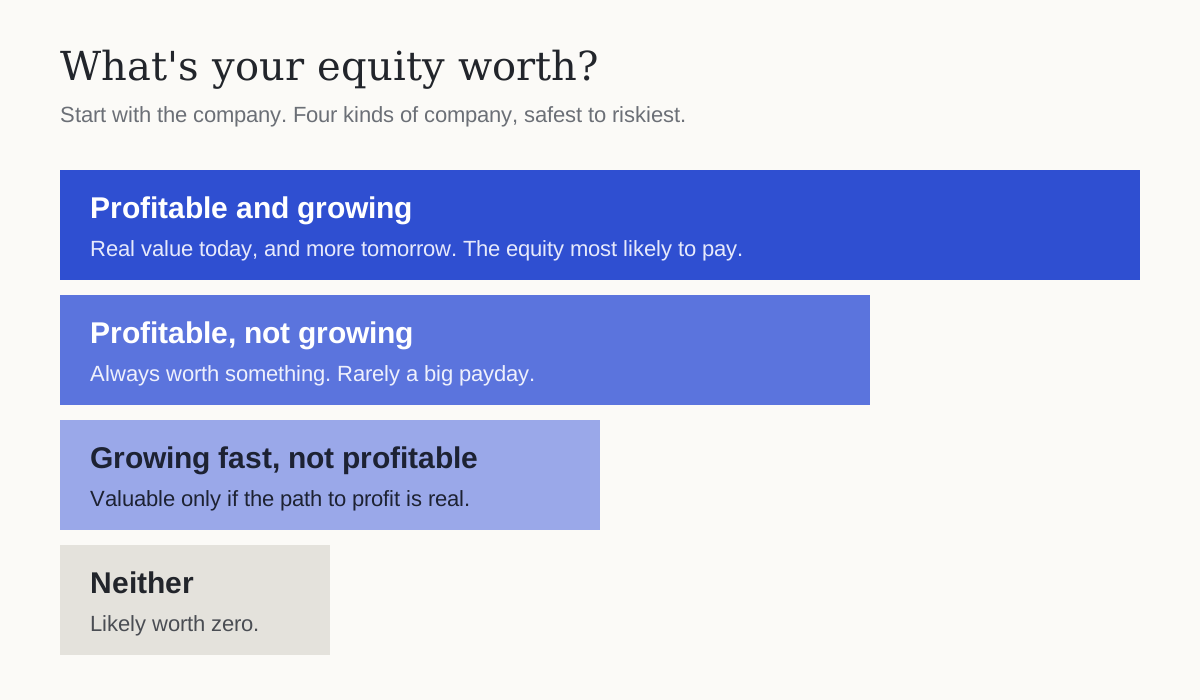
From there, think about risk as a ladder.
- Profitable and growing. The safest place for your equity.
- Profitable, not growing. Always worth something, but rarely a big payday.
- Growing fast, not profitable. Valuable only if the path to profit is real.
- Not profitable and not growing. The riskiest of all. You can't forecast earnings or cash flow, so you don't really have a company.
What makes a company worth something
Equity represents shares in a company that will be valuable at some point. So the first thing to understand is what makes a company valuable.
Having options doesn't mean you'll get a payday. In some cases they're more like a lottery ticket. Whether the ticket hits depends on growth, profit and whether anyone will ever pay for the business.
If you want a rough number for your own company, try the company valuation tool or read what is my company worth?
Price is what you pay; value is what you get.
Buffett was talking about stocks, but it fits options too. Your strike price is what you pay. The company's growth and profit decide the value.
Why investors invest
Investors put money into a company to get a return. They don't throw money around for fun.
They get that return when a company is growing incredibly fast, or growing and throwing off profit. Think of it as a barbell, with growth on one end and profit on the other. Most of the value sits at the ends.
If you've never done due diligence on a company or looked under the hood of one, this is hard to see from the inside. The same reasons investors invest are the reasons someone would buy a company.
What a buyer looks at
People don't buy companies for no reason. They buy for strategic fit, and they check everything first.
- The team and the leadership.
- The P&L. Where the money comes from and where it goes.
- Growth and profitability.
If a buyer doesn't have confidence in the leadership or the growth rate, or the company isn't growing, they won't buy it. Companies don't waste money. I wrote more about how buyers think in the spreadsheet PE firms.
The terms matter less than you think
There's a lot of terminology around stock options. Here are the ones people ask about most, in one line each. If you want the longer version, Union Square Ventures' Fred Wilson wrote one of the clearest explainers on how options work.
- Strike price: what you pay per share to turn an option into stock.
- 409A: an outside valuation of the common stock that sets the strike price for tax purposes.
- Vesting: you earn your shares over time, usually four years with a one-year cliff.
- Liquidation preferences: investors get their money back before common shareholders see anything.
People spend way too much time and energy on these. What's my option worth? What percentage of the company do I own? None of that matters if the company isn't growing fast and either profitable or on a path to profit.
The data backs this up. Carta found that over 70% of vested options went unexercised in 2025 when employees left their companies. Many of those employees simply didn't think the equity would be worth much.
If the vast majority of startups don't end up working, it follows that the vast majority of startup equity isn't worth much.
If your company isn't growing quickly, or isn't profitable, or worse, both, your equity is likely worth zero. If you want to see how preferences eat into a payout, play with the Exit Math tool.
Why the rules feel built against you
Equity is confusing. It's a system built to reward the people who own companies, and it keeps most of the people who don't in the dark.
Most of that comes from protections that only make sense once you've been the founder. Picture it. You own 100% of your company. You give a cofounder 30% upfront. Two weeks later they walk out. Now you do 100% of the work for 70% of the upside.
That's why vesting, cliffs and buybacks exist. Until you've given away part of your company, you'll think the rules are trying to screw you over. Once you have, you understand why they're there.
What to do instead
The only way to really learn this is to go through it. The best way to go through it is to help your company have the best chance at an exit.
Spend less time worrying about options and more time on your company's growth rate and profitability. Learn what good, bad and uninvestable growth look like. If you're growing 10% or 20% a year, it's very hard to raise money, and few people will buy you.
The best way to get acquired is to grow incredibly fast with a path to profit, or to have incredible technology. If you're deciding whether to join a startup at all, the Founder or Employee tool is a good place to start.
If you're a leader trying to make sense of an equity offer, let's connect on LinkedIn.
Related reading
Get my monthly newsletter
One email a month with what I'm writing and working on.
One email a month. Unsubscribe anytime.