Prediction
The End of Management as Coordination
Keith Brown · Founding Partner, Outperform Ventures
Mar 2, 2026 · 4 min read
The gap between a high performer and an average one went from ten times to something closer to a hundred. That breaks the job of management as coordination. You cannot manage your way through this shift; you have to build your way through it.
I have managed hundreds of people over my career. The companies I’ve worked for have had nearly 100,000 employees combined. I know corporate, I know startups, mostly, I just know people.
I know the weight of that responsibility. I know the late nights spent worrying about career paths, interpersonal friction, and the general health of a large organization. It is a role built on empathy and coordination. However, the fundamental nature of that work has shifted in a way that we can no longer ignore.
In 2025, we talked about high performers being 10 times more valuable than the average employee. By 2026, that gap has widened to 100 times. This is not hyperbole. It is a mathematical reality driven by the shift from human capital to agentic systems.
Management as a coordination layer
We are witnessing the end of management as a coordination layer. When I say “management” I am talking about the idea that executives exist to manage people, their emotions, their expectations, and their games.
For decades, middle management was the glue. These were the people who translated strategy into tasks. They could be “fake” and bring drama into the workplace.
They were the essential filter between the vision and the execution. Today, that filter has become a bottleneck. Data from early 2026 indicates that 70 percent of traditional coordination tasks are now handled by autonomous agents. Scheduling, status updates, and resource allocation no longer require a human translator.
Now, before you push back because legacy companies aren’t even using AI yet, I’m not talking about laggards. I’m using early adopters as a predictor of where things are going. As long as you are ok living a few years in the future, read on.
So, back to the mandate I’m seeing more and more each day. It’s about building systems not managing people.
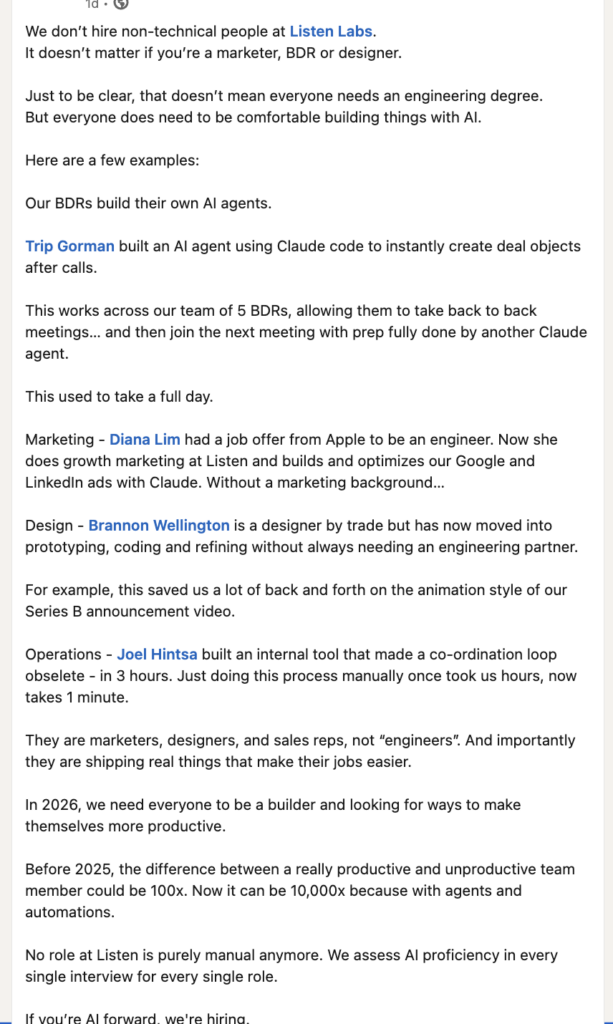
Let me say that again, the new mandate for leadership is not to manage people. It is to architect systems. Companies like Listen Labs are already setting the standard by refusing to hire non-technical staff. It does not matter if the role is in sales or design.
Every hire is a builder
Every hire must be a builder. Their BDRs are not just making calls. They are building the AI agents that automate their own lead generation and deal creation. They have moved from being supervisors to being architects.
This shift feels brutal, but it is actually about clarity. The CEO Genome Project, a ten-year study of 17,000 executives, found that high-performing leaders are twelve times more likely to succeed because they are decisive.
They do not wait for consensus. In a world of agentic workflows, consensus is often just a polite word for stagnation. If you are waiting for a technical support team to validate an idea or a designer to build a prototype, you are a passenger. In a world where agents can build and iterate in minutes, waiting for a human translator is a competitive disadvantage.
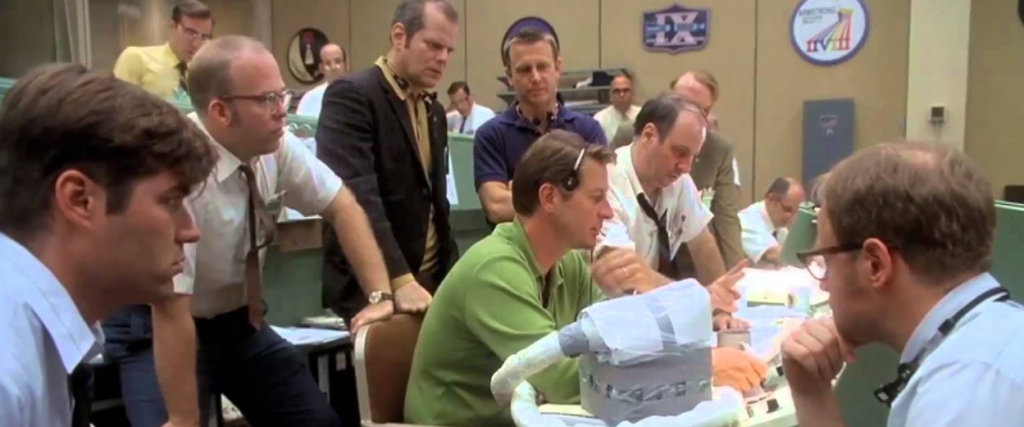
Think of the scene in Apollo 13 where the engineers dump a box of parts on a table. They have to fit a square peg in a round hole with only what is in front of them. The managers are the ones looking for a requisition form to buy a new filter. The builders are the ones grabbing the duct tape. In 2026, if you are not grabbing the tape, you are taking up oxygen.
The hardest part of the job
Transitioning people out is the hardest part of the job. I have been in that seat. It feels like a failure of the culture you worked so hard to build. But keeping a passenger on a ship that requires every hand on a tool is a failure to the mission.
What good managers will still do
None of this means people stop needing leaders. Gallup's research has found that managers account for about 70% of the difference in engagement between teams. A great manager still changes how a team performs.
What changes is where their time goes. Less time passing messages between levels. More time setting clear goals, coaching people and building the systems the team runs on.
- Set the goal and how it will be measured.
- Remove blockers that tools can't remove.
- Coach people through hard decisions.
- Build and improve the workflows the team and its agents run on.
- Have the hard conversations early.
This is a harder job than coordination. It asks managers to be good at people and good at systems. The ones who can do both will be some of the most valuable people in any company.
How to start the shift
- List every recurring meeting and status update. Ask which ones a shared dashboard or agent could replace.
- Give every manager one system to build or improve this quarter.
- Measure teams on results shipped, as I wrote in the illusion of output.
- Hire for the bottleneck, as covered in hiring for the problem slowing you down.
The managers who make this shift will run smaller, faster teams. The ones who don't will find there's less to coordinate every quarter.
You cannot manage your way through an AI revolution. You have to build your way through it. If your team is waiting for technical support to start, you have already lost. The future belongs to the architects who can look at a box of parts and build a solution before the clock runs out.
Related reading
Get my monthly newsletter
One email a month with what I'm writing and working on.
One email a month. Unsubscribe anytime.