Deep dive
Software Dollars Are Moving From SaaS to Custom
Keith Brown · Founding Partner, Outperform Ventures
Oct 31, 2026 · 4 min read
Companies are starting to own their software instead of renting it. The implementation money follows, and most teams aren't set up to catch it.
This is where the future of software is going. Companies are moving from third-party SaaS they rent to first-party software they own, built for how they work.
I think software dollars will flood out of enterprise SaaS and into custom software. I've seen it up close. I moved this site off WordPress and onto software I own, and I wrote about what happened to my search traffic after the move.
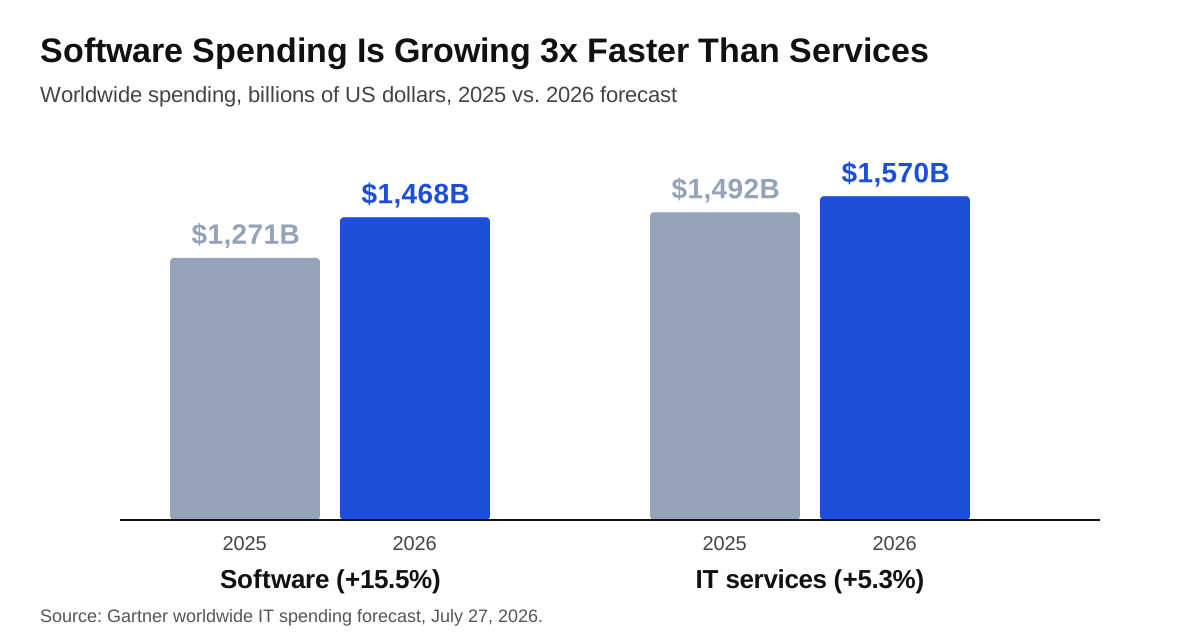
The money involved is huge. Gartner expects companies to spend $1.47 trillion on software and $1.57 trillion on IT services worldwide in 2026, according to its July forecast. A big share of that services number is people paid to set up, connect and run software someone else built.
Software is eating the world.
Fifteen years later, AI is writing much of that software, and companies can build tools they used to buy.
What's the difference between third-party and first-party software?
Third-party software is rented. You pay a vendor per seat, per month, and you work the way their product works. Your data lives on their servers, and their roadmap decides what you get next.
First-party software is owned. Your team, or a partner you hire, builds it for your workflow. You decide what it does, where the data lives and when it changes.
- Rent: fast to start, price goes up at every renewal, you adapt to the tool.
- Own: slower to start, cost drops once it's built, the tool adapts to you.
For twenty years renting won because building was too expensive. AI coding tools changed that math. A small team can now build in weeks what used to take a department a year.
Where does the implementation money go?
Every big SaaS rollout comes with an army. Consultants, integrators and admins configure the product, move the data and train the staff. Gartner counts application implementation and managed services inside its IT services total, which it put above $1.87 trillion in its April forecast.
My estimate is that around a million engineers work on this side of the business today, configuring and connecting third-party tools. I can't point to an official count. That's my read from almost twenty years in SaaS.
Those same engineers are the ones who will build first-party software. The customer's budget for implementation doesn't disappear. It moves from configuring someone else's product to building the company's own.
Why most implementation teams aren't ready
The work is changing faster than the teams doing it. Most implementation shops are built to bill hours on someone else's product, and custom software needs a different setup.
- They bill by the hour. AI cuts the hours, so the same project earns less unless they price the result.
- They don't have product people. Configuring Salesforce is a different job from deciding what a CRM should do for one company.
- They don't plan for maintenance. Owned software needs someone to fix, update and secure it after launch.
- They're tied to one vendor. Many partners earn referral fees and certifications from the platform they're replacing.
I wrote about one answer in forward-deployed engineers. They sit with the customer, learn the work and build what the business needs.
Why this transition is so hard
Legacy SaaS moving to custom is almost as hard as any transition I've seen. Contracts run for years, and the data is spread across dozens of tools. The people who run those tools every day have built their careers on them.
My own move off WordPress took planning. Every page, redirect and link had to come across, and I checked search traffic for months after. A company with fifty systems has fifty of those projects.
Vendors know this, and many are expanding to cover more of the stack before customers leave. I covered that pattern in Anthropic and the enterprise blind spot.
What does free software cost a small business?
If you're a small business without a budget, software is starting to be free. The vendor still has to make money, and the business model is your data.
The free tool collects the data. The vendor learns how businesses like yours run, then sells paid custom services and implementation on top. You get the software for nothing, and your data becomes their value.
That can still be a good deal. Before you sign up, ask four questions:
- Can I export all my data in a format another tool can read?
- Does the vendor use my data to train models or build products for others?
- What does the paid tier cost once I depend on it?
- Who owns the custom work if I pay for it?
What leaders should do now
- Audit your seats. List every SaaS tool, its cost and how many people use it each week.
- Pick one system to own. Start with a tool that's expensive, used daily and specific to how you work.
- Get your data out first. Make sure you can export everything before you build or renew.
- Price implementation as a product. If you sell services, charge for the outcome so AI speed helps your margin.
- Staff for maintenance. Name the person who owns the software after launch.
Not sure where to start? The AI-Proof Test shows which parts of a software business are easiest to replace.
When buying still makes sense
Some software should stay rented. Payroll, tax filing and security tools carry compliance rules and liability that most companies shouldn't take on. Email and video calls are cheap and work the same everywhere.
Own the software that makes your company different, and rent the rest. That's the same reason most AI apps don't make money: the winners solve a real problem a business pays for every day.
Related reading
Follow what I'm building and backing
I post on LinkedIn and X about the companies I back and the products I build.
Join 2,219 people following along.