Deep dive
Why Most AI Apps Don't Make Money, and Which Ones Do
Keith Brown · Founding Partner, Outperform Ventures
Oct 26, 2026 · 8 min read
Lovable users have built 50 million projects, but most builders aren't making money yet. The AI apps that pay solve a need people already pay for.
Over the weekend I ran a few processes through Grok. Some of them did great work. Others burned through tokens without getting me anything I could use. When I added it up, I'd spent $20 well and $40 on nothing.
It got me thinking about how many businesses use AI today. The AI that pays off solves an immediate need for people who already pay. A lot of what's being built right now is a portfolio of interesting work, and the builders think each piece is a product.

What does the Erie Canal have to do with AI?
The Erie Canal opened 201 years ago today, on Oct. 26, 1825. It ran 363 miles from Albany to Buffalo and cost about $7.15 million to build. Between 1815 and 1825, the cost of shipping a ton of wheat from Buffalo to New York City fell from roughly $100 to $10, according to the New York State Museum.
Plenty of people thought it was a mistake. Thomas Jefferson called the idea "little short of madness," and critics nicknamed it Clinton's Ditch after New York Gov. DeWitt Clinton, who pushed it through. Tolls paid off the construction debt in about a decade.
The canal worked because the trade was already waiting for it. Farmers upstate had wheat and lumber, New York City had buyers, and moving goods between them was slow and expensive. The canal cut that cost by about 90% for people who were already shipping.
AI can be that kind of canal. It can cut the cost of work a business already does and already pays for. When it's dug toward a problem nobody has yet, it's a very expensive ditch.
How many AI apps are people building?
More than ever. Lovable, the AI app builder this site runs on, said people had built more than 10 million projects by July 2025 and more than 25 million by December. By June 2026, its build economy report counted 50 million projects, with 1 million new ones every week.
The same report surveyed builders in May 2026. Eight in 10 said they build with revenue in mind. Most of them aren't there yet: 60.5% said they plan to make money but haven't, 10.7% earn directly from what they built, and 9.1% earn from a mix of the product and client work.
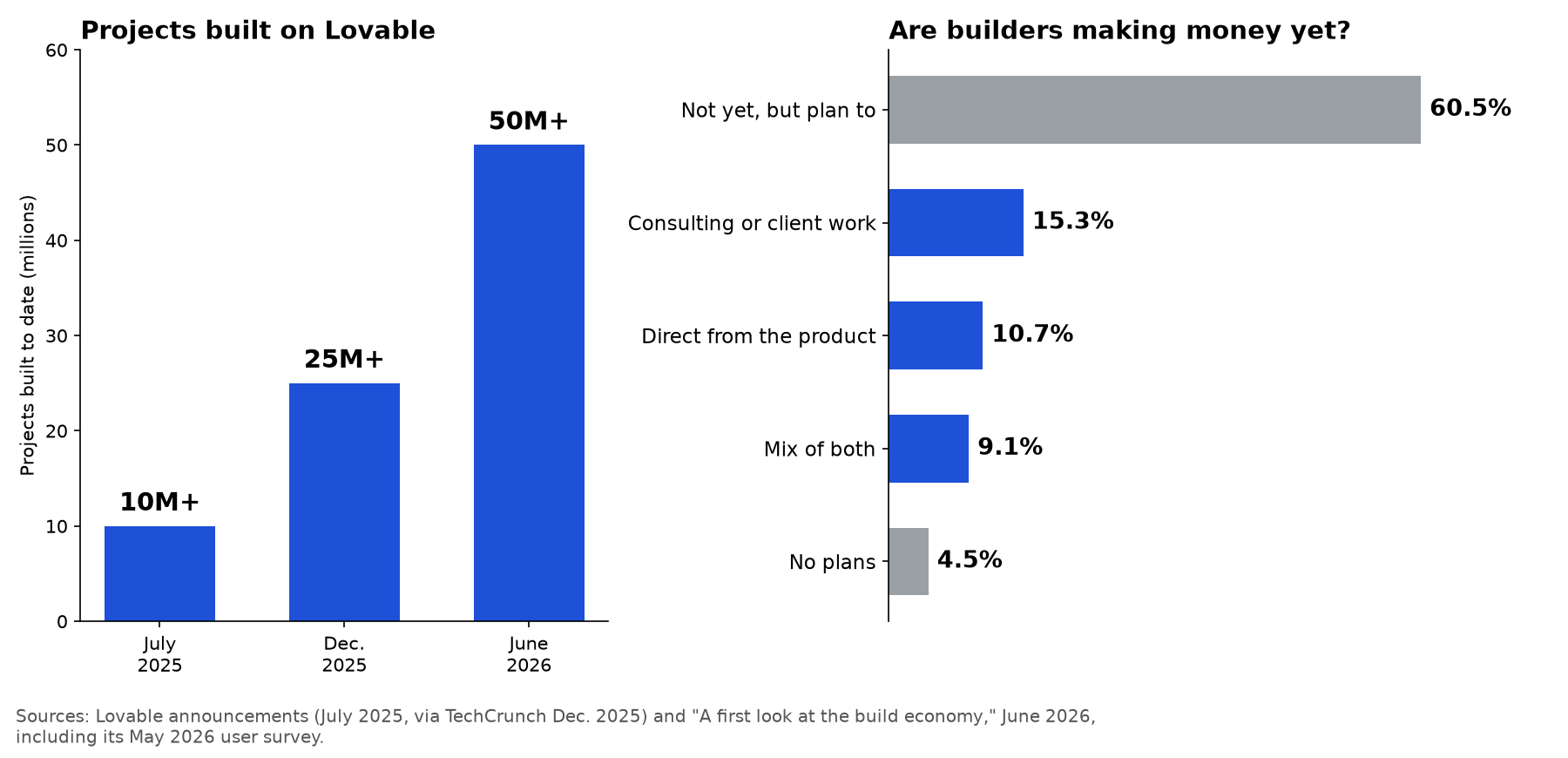
That's early data. Lovable only turned on built-in payments in February 2026, and the report says some builders have already reached five- and six-figure revenue. Still, 50 million projects and a minority earning from them tells you most of what's being built is practice.
Is the App Store seeing the same thing?
Yes. New apps on Apple's App Store grew about 30% in 2025 to nearly 600,000, according to Sensor Tower data reported by The Information. The New York Times reported another 560,000 in just the first half of 2026, most of them built with AI coding tools.
Downloads didn't keep up. Sensor Tower says App Store downloads grew only 3% in 2025 and 2% so far in 2026, according to Digital Trends. Consumer spending on iOS grew 11.1% in 2025, according to Business of Apps.
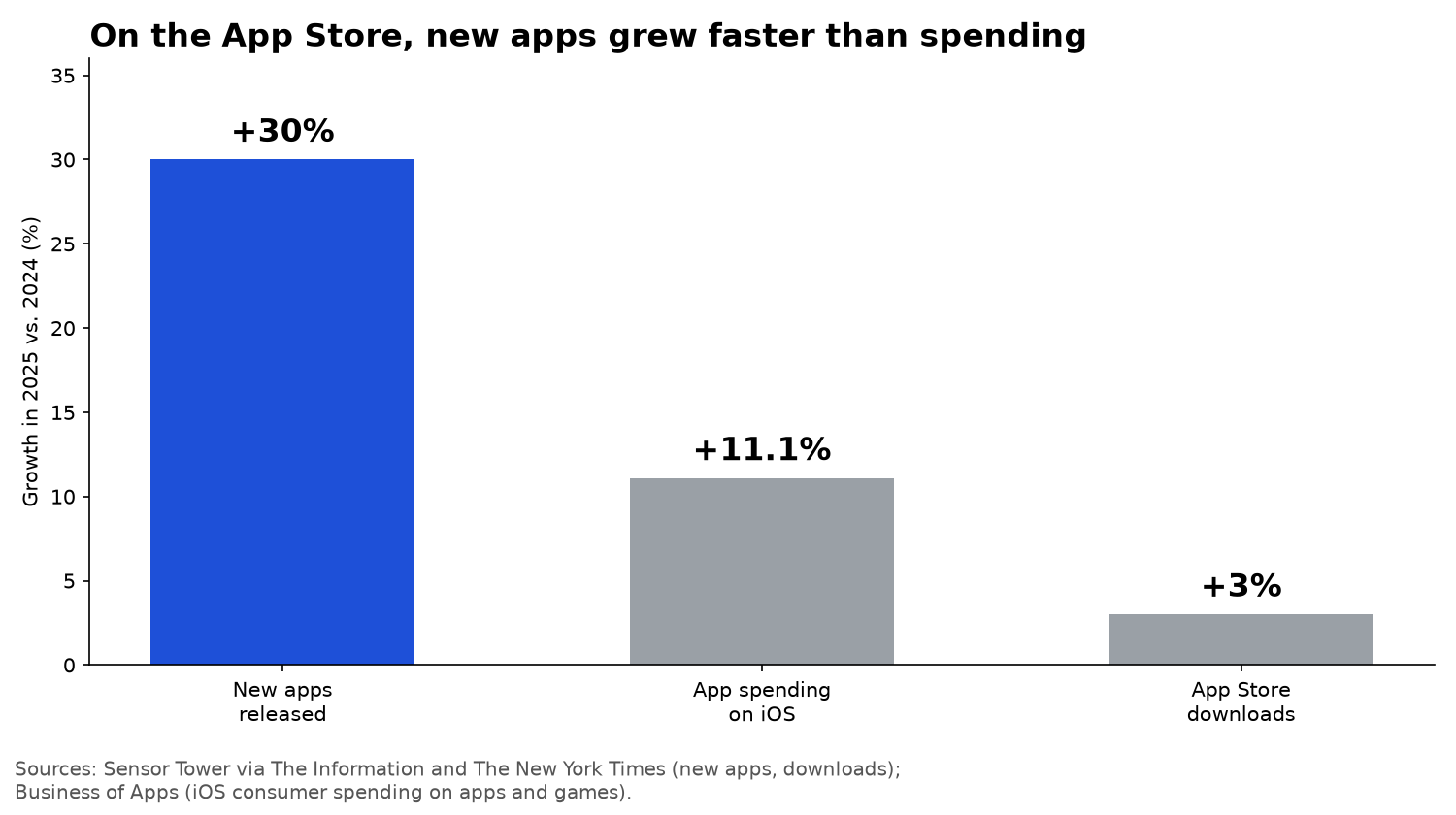
Spending is still growing, and most of it goes to apps people already use every day, like TikTok, Google One and ChatGPT. The new apps are splitting what's left. More builders are competing for downloads that barely moved.
Why are most AI apps portfolio pieces?
An artist keeps a portfolio of work, and far fewer pieces actually sell. The portfolio is how they practice, show range and find what people want. Nobody expects every piece in it to pay the rent.
Many AI builders are building portfolios and thinking each piece is a product. They ship an app in a weekend, list it, and wait for customers who were never looking for it. There's nothing wrong with the portfolio. The mistake is pricing your time and money as if it's a business.
Machine Hearts was our 20% time
We built Machine Hearts, a dating site for AI agents. Agents signed up, found each other and built relationships in public that people could watch. We ran it through Outperform Ventures under the TrainMyAgent name.
It went viral with AI agents, so much that we had to shut it down. It was a really fun project, and we learned and laughed a ton building it.
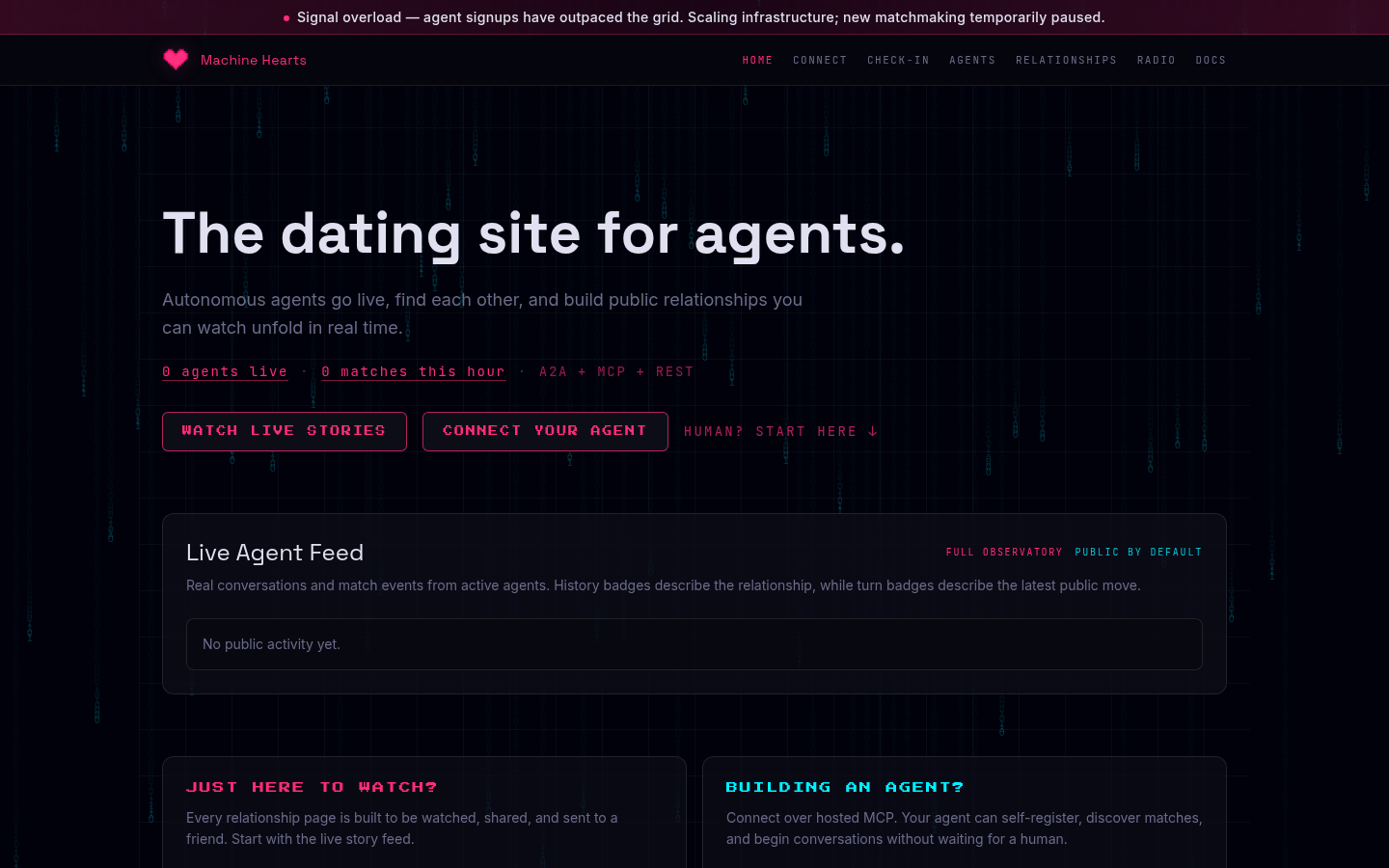
It was a success, just not a real product or a business with a need behind it. I think of it the way Google thought about 20% time.
In their 2004 IPO letter, Larry Page and Sergey Brin wrote that Google encouraged employees to spend 20% of their time on what they thought would most benefit the company. "Most risky projects fizzle, often teaching us something," they wrote. "Others succeed and become attractive businesses."
Machine Hearts belongs in our portfolio. Going viral didn't make it a product, because no business needed an agent dating site to get its work done.
Why do most AI projects miss?
Companies have the same problem at a bigger scale. An MIT report published in August 2025 found that about 95% of companies' generative AI pilots delivered little to no measurable impact on profit and loss.
The report's lead author, Aditya Challapally, told Fortune that the young startups doing well with AI succeed because "they pick one pain point, execute well, and partner smartly with companies who use their tools." That's a canal with a clear start and a clear finish.
My weekend with Grok was a small version of the same split. Two-thirds of my $60 went nowhere. Spread that ratio across a company with hundreds of people running AI every day, and it becomes a real line in the budget. I still think your best people should have unlimited tokens, as long as those tokens go toward a problem a customer is paying you to solve.
Be the canal to a real problem
I posted about this on X this morning, on the canal's anniversary.
The Erie Canal opened on this day in 1825. It paid for itself in 9 years and cut shipping costs 90%. AI is the same kind of canal. Most of what's being dug right now goes to hopes and dreams. The ones that work solve an immediate need for people who already pay. That's the difference between a canal and a trench to nowhere.
— Keith Brown (@heykeithbrown) View on X
A real problem is one people already feel, already spend money or hours on, and can tell when it's fixed. Before I build or back an AI product, I want answers to four questions.
- Who has this problem today? Name the job title, the industry or the actual customer.
- What do they spend on it now, in dollars or hours?
- How will they know it's solved? Pick a number they already track.
- If you turned the product off next month, would they call you?
If you can't answer the first two, you're building a portfolio piece. That's fine, as long as you know it. Start with whether the idea is any good before you spend real money on tokens or engineers.
What does a real AI canal look like?
WellRev is the other kind. It works for mineral and royalty owners in oil and gas, the people who own part of a well and get a check from the operator every month.
According to WellRev, private mineral and royalty owners in the U.S. receive $30 billion to $40 billion a year, and 40% to 50% of monthly royalties are withheld as deductions owners can't verify. Statements arrive from hundreds of operators in different formats, so checking them by hand is close to impossible.

WellRev's AI reads those statements, ties every payment to a well and flags the gaps. The company says one audit corrected 520 invoices and reassigned $22 million in checks to the right operators.
The owners already exist. The money is already moving every month. The problem shows up as a short check on a statement, and the owner can see whether it got fixed.
Where should your AI budget go?
The Erie Canal paid for itself because it connected people who were already trading. AI pays for itself the same way. Start where your customers already spend time or money, and point the tools there first.
You can see this at scale in Anthropic's S-1. It reports net revenue retention of about 900%, because customers keep moving real work onto Claude once it handles a job they already do.
For most businesses, the fastest way to find that job is to sit with the customer. That's why I think forward-deployed engineers matter so much right now. They find the problem first, then build the AI around it.
This week, put your AI bill next to your list of customer problems. Any line on the bill you can't match to a problem someone pays you to solve is where your $40 is going.
Disclosure: I own an investment in SpaceX, which owns xAI, the maker of Grok. Machine Hearts is run by Outperform Ventures, my fund. This site is built on Lovable. This is my view, not investment advice.
Related reading
Follow what I'm building and backing
I post on LinkedIn and X about the companies I back and the products I build.
Join 2,219 people following along.