Deep dive
Anthropic Hits $6.6 Million in Revenue per Employee
Keith Brown · Founding Partner, Outperform Ventures
Oct 26, 2026 · 7 min read
Anthropic's S-1 reports over $6.6 million in revenue per employee. I told a room of executives a good number was $1 million. Here's what founders should plan for in 2027.
Last week I was talking through 2027 planning with a group of executives. Revenue per employee came up, and I said a good number now was $750,000, maybe even $1 million.
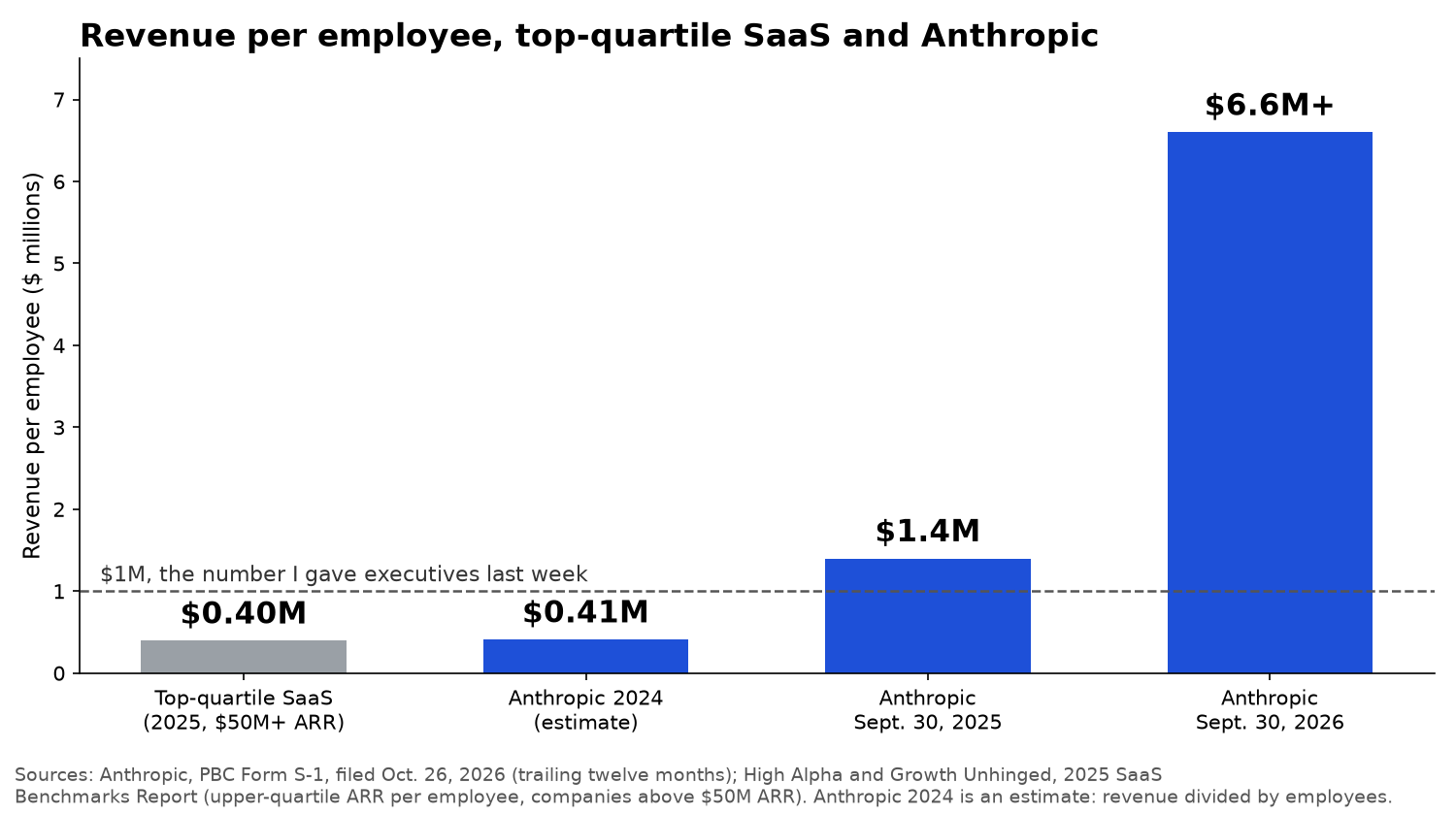
I was way off. This morning Anthropic filed its S-1 with the SEC, and it reports trailing twelve-month revenue per employee of over $6.6 million as of Sept. 30, 2026. A year earlier the same number was $1.4 million. Founders planning 2027 should build their hiring plans against that new bar.
What does Anthropic's S-1 show?
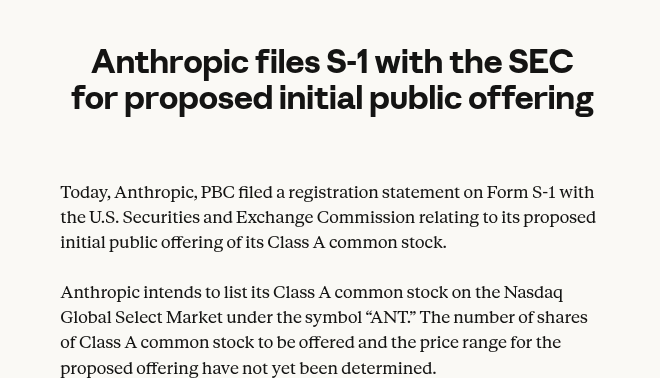
Anthropic plans to list on the Nasdaq under the symbol ANT. The share count and price range haven't been set yet.
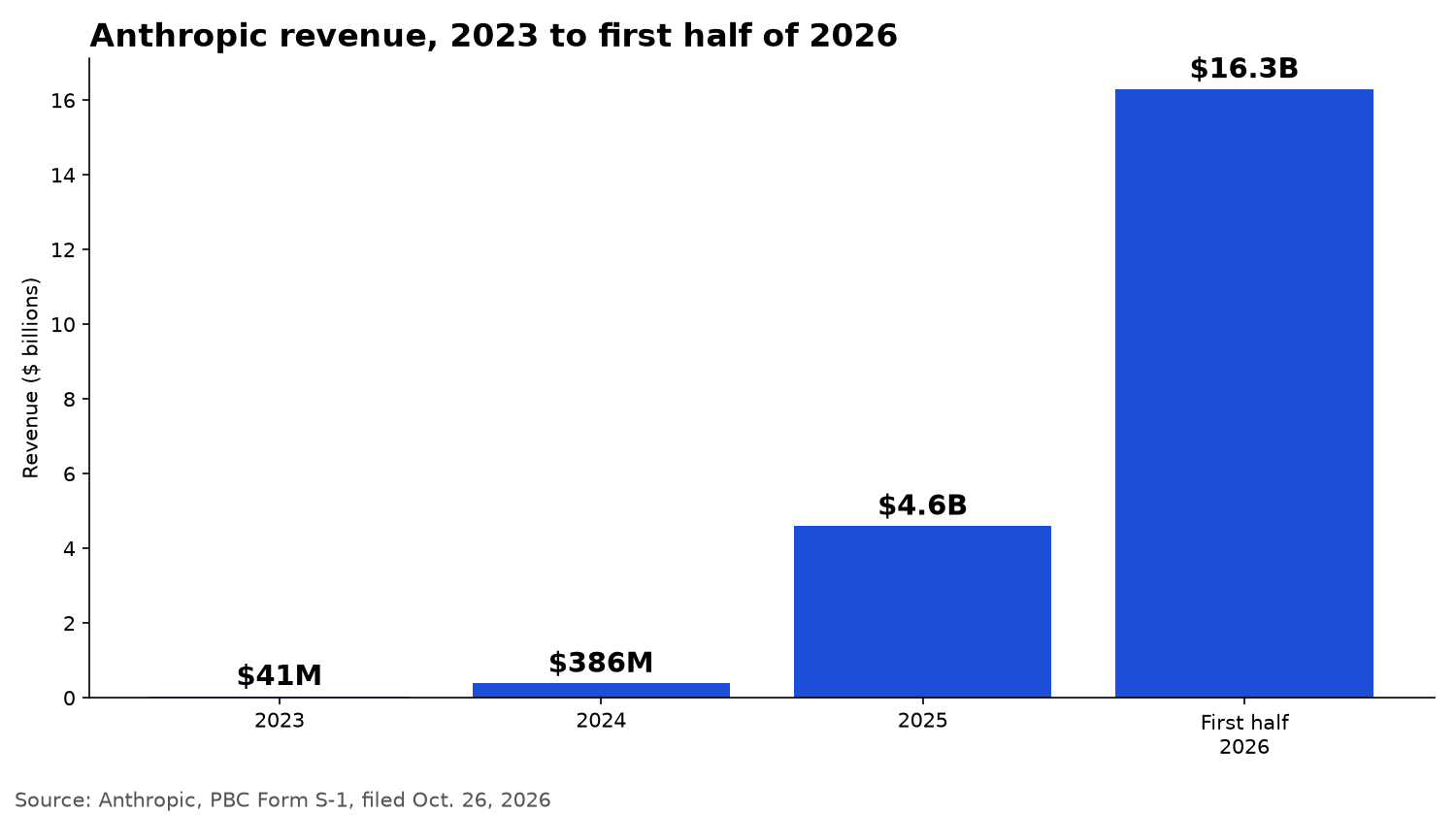
The filing says revenue was $41 million in 2023, $386 million in 2024 and $4.6 billion in 2025. In the first six months of 2026 it was $16.3 billion, up 1,300% from the same period a year earlier. The company had about 5,300 employees as of Sept. 30.
Founder and investor Greg Isenberg posted his takeaways on X this morning: "3 years ago this company did $41M in revenue. In the first six months of 2026, it did $16.3 billion. I don't think anyone has a mental model for that curve yet, I sure don't."
The S-1 also warns that Anthropic doesn't expect revenue to keep growing at these rates. Its operating loss was $693 million in the first half of 2026. The company is still spending heavily on compute. I wrote about where I'd put money instead of the Anthropic IPO, and this article looks only at what founders can learn from the filing.
What revenue per employee should you plan for in 2027?
I don't think most companies will reach $6.6 million. Anthropic sells the AI itself, and very few businesses will ever look like that. The jump inside one year is the part I'd pay attention to.
| Benchmark | Revenue per employee |
|---|---|
| What I told executives last week | $750,000 to $1 million |
| Anthropic, Sept. 30, 2025 | $1.4 million |
| Anthropic, Sept. 30, 2026 | Over $6.6 million |
Source for Anthropic's figures: Form S-1, trailing twelve months. The first row is my own estimate from that conversation.
The filing gives a reason for the jump. It credits "how extensively our teams leverage Claude in their work." Anthropic's own research on its workforce found that by August, hours worked by AI agents outnumbered employee hours six to one.
So the question for a 2027 plan changes. Before you add a role, ask what the person and their AI tools will produce together. I made the case for giving your best people unlimited AI tokens for this reason.
Why do Anthropic's customers spend nine times more?
The S-1 reports net revenue retention of about 900% as of Sept. 30, 2026. That means customers who were paying a year earlier now pay about nine times as much. Strong SaaS companies have usually been proud of numbers around 120%.
Customers spend more because they move more work onto Claude over time. The filing also says its newest model cut customer cost per task by about 40%, and lower costs led customers to use it for more tasks.
Most founders can learn from this. Price so customers can start small, and make each added use cheaper for them. Your growth then comes from customers finding more work for your product.
Sell where the budget already lives
About 48% of Anthropic's revenue in the first half of 2026 came through cloud marketplaces such as AWS, Google Cloud and Azure. In 2023 that share was 11%.
Large companies already have budgets committed to those clouds. Buying through a marketplace lets them spend money they've already approved, without a new vendor review.
If you sell to enterprises, find out where your buyers already spend. Getting listed on the marketplace they use can be faster than hiring more salespeople.
How did Anthropic get from $1.4 million to $6.6 million?
The filing breaks the jump down. From Sept. 30, 2025 to Sept. 30, 2026, trailing twelve-month revenue grew about 1,200% while headcount grew about 170%. Anthropic kept hiring. Revenue grew about seven times faster than the team.
The longer view is even steeper. Anthropic had about 940 employees at the end of 2024 and about 5,300 by Sept. 30, 2026, a little over five times as many. Revenue for the quarter ended Sept. 30, 2026 was 86 times the revenue for the last quarter of 2024.
The filing credits Claude for most of that leverage. Over 90% of the code contributed to Anthropic's codebase in September 2026 was written by Claude. The average engineer contributed over 45 times as much code per day as the average in 2024.
It also describes each employee working with "a team of agents in their daily work." Their engineers now direct Claude and review its work rather than write code line by line, according to the filing.
What did lean look like before AI?
At Aha! we ran lean, and I loved it. That was before AI could write code.
For most software companies, the bar has been far lower than Anthropic's. The 2025 SaaS Benchmarks Report from High Alpha and Growth Unhinged surveyed more than 800 private software companies. Top-quartile companies above $50 million in revenue brought in about $397,000 per employee, and the median public SaaS company was about $393,000.
Anthropic's $6.6 million is more than 16 times that top-quartile mark. Running lean is the same idea behind my piece on how to plan 2027 around your vision: grow from what the business earns. Anthropic shows what that kind of efficiency looks like once AI does most of the work.
Can other companies follow that curve?
Most won't reach the same height. Anthropic sells the model, so every gain in Claude shows up in its own revenue first. A software company or a services firm pays for those tokens as a cost.
The shape of the curve is the part I'd copy. Anthropic's revenue per employee grew almost five times in one year while its own teams moved most of their work onto AI. Any company can measure that ratio every quarter and see whether its AI spending is moving it.
Start by tracking two numbers side by side: revenue per employee and AI spend per employee. If the second goes up and the first doesn't move, the tools are being used for work that doesn't reach customers.
The new math for annual run rate
Anthropic publishes how it calculates run-rate revenue. It takes usage fees from the last 28 days and multiplies by 13, then adds monthly subscription fees multiplied by 12.
Most of Anthropic's revenue is usage, not subscriptions. That's the shift I wrote about in why ARR is over. If your revenue comes from usage, report it the way Anthropic does and explain the formula to your board.
Who closes the gap for small businesses?
One line in the filing stood out to me. Anthropic says "the gap between what Claude can do and how broadly it is used represents one of our largest growth opportunities."
Isenberg read it the same way. In his words, "someone has to close that gap for dentists, landlords, and plumbers." Those owners won't set up AI agents on their own.
That's the opening for founders. Teams that sit with customers and build the workflows for them, the way forward-deployed engineers do, will be the ones who close it.
What I'd change in a 2027 plan
- Set a revenue-per-employee target above what you thought was good a year ago, and plan headcount from it.
- Track revenue per employee next to AI spend per employee every quarter.
- Budget for AI tools as part of each person's cost to work, alongside salary.
- Price so customers can start small and grow their usage.
- List your product on the cloud marketplace your largest buyers already use.
- If your revenue is usage-based, show your board how you calculate run rate.
I went into that executive conversation thinking $1 million was ambitious. I'll be using a higher number for my own planning now. My piece on how to plan 2027 around your vision covers the rest of how I'd build the plan.
This article is not investment advice.
Related reading
Follow what I'm building and backing
I post on LinkedIn and X about the companies I back and the products I build.
Join 2,219 people following along.