Deep dive
Why ARR Is Over in the Age of AI
Keith Brown · Founding Partner, Outperform Ventures
Oct 20, 2026 · 5 min read
Companies spend on AI in bursts, a heavy build followed by light upkeep. A flat yearly renewal no longer matches that, and neither does a metric built around it.
Last week I saw a post on X from a founder who had launched his app the week before. A few customers had signed up for 30-day trials. He took the tokens they'd used, multiplied by 30 to get a month, then by 12 to get a year, and posted it as his ARR.
It wasn't ARR. It was the most flattering number he could find.

That founder is an extreme example of something bigger. I think ARR is over. AI spend isn't annual, it isn't predictable and it isn't recurring, so a metric built on all three stops telling you much.
Even Salesforce is moving. In 2025 it launched Flex Credits, which it calls "a consumption-based model that aligns cost with jobs to be done." In the same announcement, it raised list prices on its Enterprise and Unlimited editions by an average of 6%, its first increase since 2023 and only the second after seven years of steady prices.
Long ago, Ben Graham taught me that "Price is what you pay; value is what you get."
I first wrote about this in February in the rise of Hollow ARR. Since then, I've become more convinced it's bigger than a few founders inflating numbers. It's how every company buys technology.
What ARR was built to measure
I've spent most of my career chasing recurring revenue, and I explained why it's the holy grail in recurring revenue is about to get a lot less recurring. ARR assumes one simple thing. The customer who paid you this year will pay you about the same next year.
For classic SaaS, that was mostly true. A vendor built the platform once, sold seats and renewed them every year. The customer's needs didn't change much, so neither did the bill.
Technology budgets grew up around that kind of spend: linear, repeatable and recurring. I don't think that's how most companies will budget for technology from here. AI breaks the pattern on both sides of the deal, for the buyer and for the vendor.
AI spend comes in bursts
If you've used AI to build things, you know there's nothing predictable or recurring about it.
You may burn through a ton of tokens in 24 hours to solve a problem, then spend a few days on minor tweaks. You may spend a lot of time, energy and capital building an internal platform, then spend far less maintaining it.
Here's how I see the difference:
- SaaS spend: the same seats, the same price, renewed every year, often with an increase.
- AI spend: a heavy build, a long stretch of light upkeep, and another burst when the next problem shows up.
- SaaS budget: an annual line item that rarely gets questioned.
- AI budget: closer to a project, with a build phase and a run phase.
The price of the tokens doesn't hold still either. Andreessen Horowitz found that for an AI model of the same quality, the cost has been falling about 10 times every year. GPT-3 cost $60 per million tokens in 2021. Three years later, a model with the same benchmark score cost six cents.
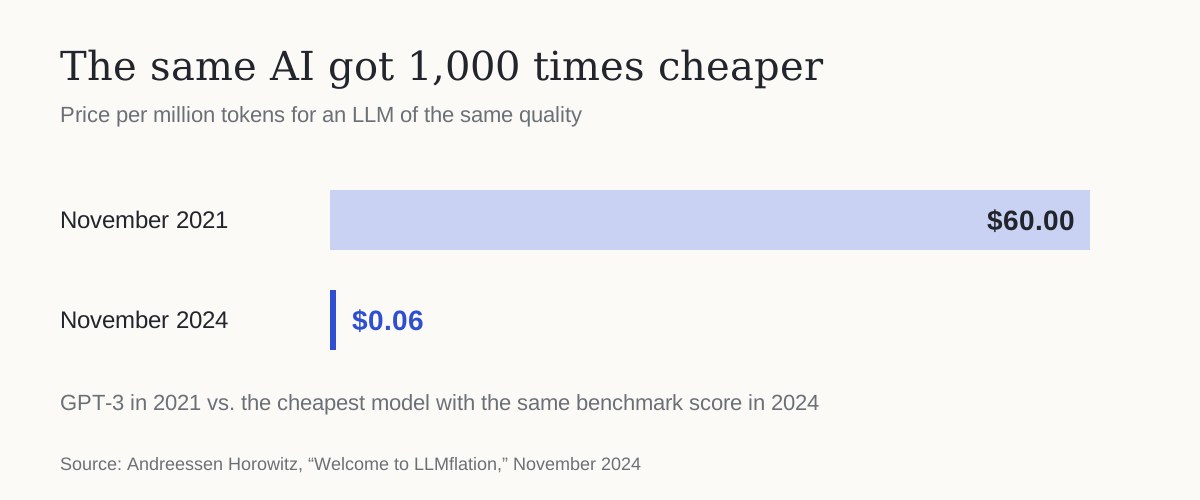
That's good news for buyers. The same work costs less every year, so a budget built on last year's bill will usually overpay.
So when that founder multiplied his first month by 12, he assumed his customers would keep doing the same work at the same price for a year. Neither is likely.
Who a flat renewal pays for
Now look at the other side. When you pay Salesforce the same amount every year, it's like you're subsidizing someone else's business model.
Salesforce doesn't spend the same amount to maintain you every year. They've already built the platform. Their margins get better over time.
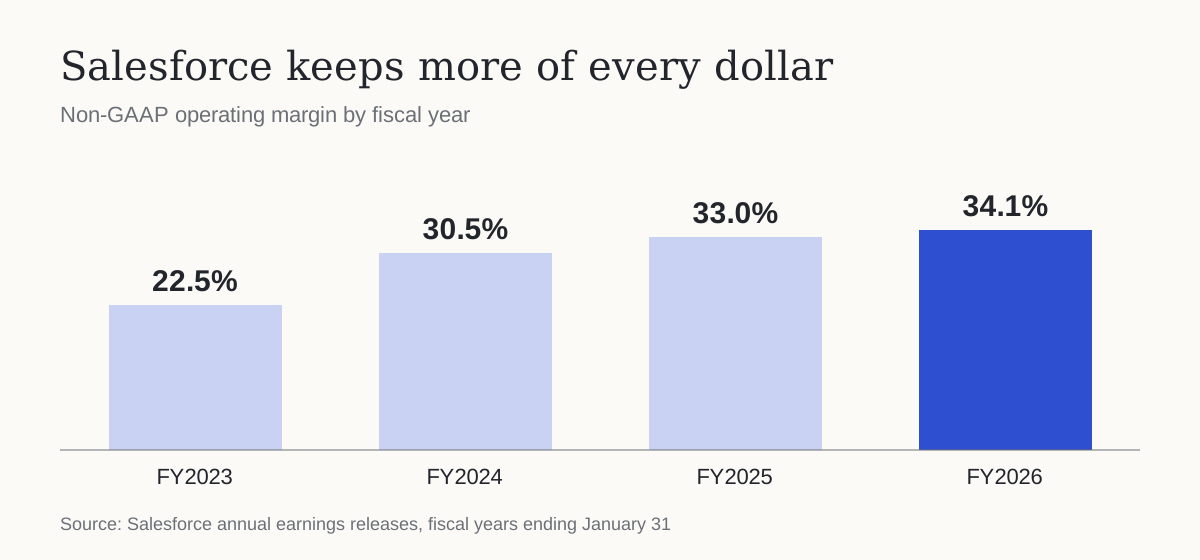
The numbers show it. Salesforce's non-GAAP operating margin went from 22.5% in fiscal 2023 to 34.1% in fiscal 2026, on $41.5 billion in revenue. That's a well-run company, and I respect the discipline behind it. It also means customers are paying a steady price for something that costs less to deliver every year.
That's the other equation I think is going to break. Once a company can build what it needs, then pay a lot less to run it, a flat annual bill starts to look like a choice it no longer has to make.
Is ARR dead for every company?
No. Contracts still renew, and plenty of customers sign for years at a time. Salesforce reported $72.4 billion in remaining performance obligations, money already under contract and not yet recognized. That's real.
Vendors are also working hard to keep AI recurring. Salesforce sells Agentforce add-ons starting at $125 per user per month, with unmetered use for licensed employees. It reports Agentforce and Data 360 as ARR, up 200% in fiscal 2026. Wrapping usage inside a seat makes the bill look steady. It doesn't change how the work underneath gets done, in bursts.
What's changing is how much of a company's revenue deserves to be called recurring. A contract with a fixed fee and a long history of renewals is one thing. Usage from a trial, multiplied by 12, is another.
It matters most when someone puts a price on the business. Buyers and investors pay a multiple of recurring revenue because they expect it to keep recurring, as I explain in what is my company worth?. If the revenue comes in bursts, the multiple shouldn't look like the old one. Berkshire's move into software says something similar, which I covered in what Berkshire's Bending Spoons bet says about software.
What to measure instead
The founder I saw on X had a good start. A few real customers tried his product in its first week. He could have said exactly that, and the people who matter most to him, his next customers and investors, would have trusted him more.
None of this means revenue matters less. It means you have to describe it honestly.
- Founders: split your revenue into contracted, usage and one-time. Never annualize a trial. Show how each month's customers spend over the next 90 days.
- Buyers: at your next renewal, ask what it costs the vendor to serve you today compared with three years ago. Budget AI work like a project, with a build phase and a run phase.
- Investors: ask for usage by customer group over time. A steady line is worth more than a big first month.
If you want to see how that revenue mix changes what a company is worth, try my valuation tool.
Next time someone shows you an ARR number, ask how they got it. If the answer starts with last week's trial, you already know.
Related reading
Get my monthly newsletter
One email a month with what I'm writing and working on.
One email a month. Unsubscribe anytime.