Deep dive
What Is My Company Worth?
Keith Brown · Founding Partner, Outperform Ventures
Jan 22, 2025 · 5 min read
A private company is worth what a specific buyer will pay on a specific day, so any honest valuation is a range. Where you land inside it depends mostly on three things: how predictable your revenue is, how concentrated it is, and how much of the business runs without you.
I led M&A for a billion-dollar company. Buyers don't price a company on a formula. They price it on how sure they are.
There is no single number
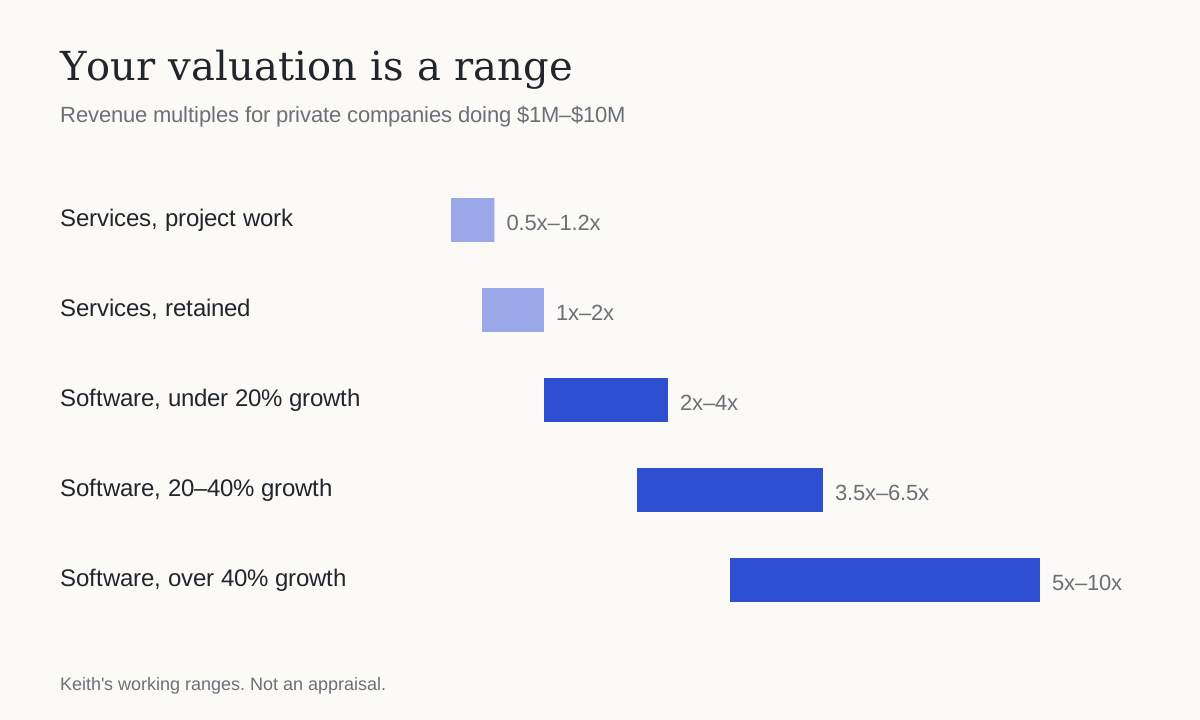
Founders want one number. Buyers never give one, because there isn't one.
Two buyers looking at the same company will price it differently. One sees a platform. The other sees a cleanup job.
Where the range comes from
Most companies between $1M and $10M in revenue are priced as a multiple of revenue or of owner earnings. The full breakdown, with bands by business type, is in What is my company actually worth?
The short version:
- Software with recurring, retained revenue trades on a multiple of annual recurring revenue.
- Services businesses trade closer to one times revenue, or a multiple of owner earnings.
- Everything else lands somewhere between, depending on how the revenue behaves.
The three levers that move you inside the range
- Predictability. Revenue that renews on its own is worth far more than revenue you have to win again every year.
- Concentration. If one customer is a big share of revenue, the buyer prices in the day they leave.
- Dependence on you. If the business stops when you stop, a buyer is purchasing a job, not a company.
Retention moves your value most
Founder dependence quietly costs more than any other factor. If you're the main salesperson, the key relationship and the final decision-maker, a buyer has to discount for the risk that you leave.
The fix takes time, which is why it matters years before a sale. The founder is the bottleneck covers how to get out of the way.
Common mistakes
- Anchoring on a headline multiple from a public company or a press release.
- Counting revenue that hasn't renewed yet as if it will.
- Ignoring how the deal is paid. A higher price with most of it deferred can be worth less than a lower price in cash.
- Waiting until a buyer calls to start fixing the levers.
When the range doesn't apply
A strategic buyer who needs your technology, team or customers can pay well above any band. That's real, but you can't plan on it. Build for the range, and treat a strategic premium as upside.
Price and value are different numbers
Warren Buffett has quoted his teacher Ben Graham on this for decades. He repeated it in his 2008 letter to Berkshire Hathaway shareholders:
Price is what you pay; value is what you get.
For a founder, the price is the number in the offer letter. The value is what the business will produce for its next owner. A buyer is trying to pay a price well below the value they see. Your job is to make the value obvious and hard to argue with.
What buyers check first
A buyer's first questions are rarely about the product. They're about how sure they can be of the numbers.
- Clean books. Monthly financials that tie out, with revenue recognized the same way every month.
- Retention. How much of last year's revenue came back this year, by customer.
- Customer list. The share of revenue from the top five and top ten customers.
- Contracts. Whether key customer agreements can be transferred to a new owner.
- The team. Who stays after the deal, and who holds the key relationships.
Every gap on that list becomes a discount, a holdback or a longer earn-out. Fixing them before a buyer shows up is the cheapest way to move up the range.
How to raise your number over two years
- Move customers to contracts. Annual or multi-year agreements make revenue more predictable.
- Spread the revenue. Win enough new customers that no single one is a big share of the total.
- Hire a leader under you. Someone who can run sales or operations without you in the room.
- Get your books reviewed. Outside accountants catch problems before a buyer's team does.
None of this is fast, which is why the best time to think about valuation is years before a sale. If you're not sure what's holding the business back, start with what is capping your growth.
Talk to more than one buyer
The surest way to find where you sit in the range is to have more than one serious buyer at the table.
One buyer sets the price. Two or three buyers set a market. Even an informal conversation with a second party can change how the first one negotiates.
That's why many sellers hire a banker or broker for larger deals. A good one runs a process, keeps buyers on a timeline and makes sure the offers can be compared side by side.
Don't wait for the phone to ring
Most founders start thinking about value when someone calls with an offer. By then, the levers above are hard to move quickly.
A better habit is to estimate your range once a year, the same way you'd check your personal finances. Look at what changed: retention, customer concentration, how much depends on you. Each of those is something you can work on long before a sale.
Treat the number as a scorecard for how well the business runs without you. If it isn't moving, the reasons are usually the same ones that are capping your growth.
How to move your number
Three things move a valuation more than anything else: faster growth, more recurring revenue and less dependence on the founder. Pick the one you can improve most in the next year and work on that first. When you're ready to think about a sale, read what you take home when you sell.
See your range with the tool
The Valuation tool gives you a low, middle and high number from a few inputs, and shows which of the two biggest levers would move it most. Once you have a number, find out what you'd actually take home.
The short answer: What is my company worth?
Related reading
Follow what I'm building and backing
Updates on the companies I invest in, the products I build and what I learn along the way.
- New companies I'm backing through Outperform Ventures
- Products I'm building, as they launch
- What's working and what isn't, as it happens
Unsubscribe anytime.