Deep dive
Berkshire's Bending Spoons Bet Shows Software Is Becoming a Commodity
Keith Brown · Founding Partner, Outperform Ventures
Oct 19, 2026 · 8 min read
Bending Spoons buys software brands cheaply and runs them for profit, and the market values it at about four times what typical SaaS gets. Next to services companies selling for 20 times EBITDA, it shows where software value is moving: to brands and to businesses that are hard to copy.
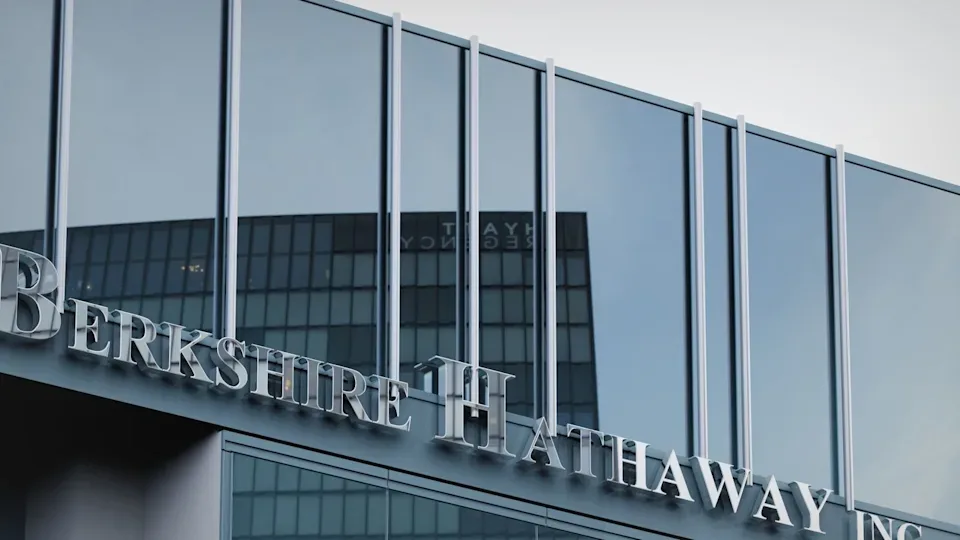
Berkshire Hathaway's investment in Bending Spoons proves a thesis I've had for a while. I just hadn't been able to put it into words. Software and technology are becoming a commodity, and when software is a commodity, the brand is what matters.
On October 14, Berkshire put another $330 million into Bending Spoons, bringing its stake to 4% after the $600 million it invested at the July IPO. Bending Spoons shares jumped 41% that day, CNBC reported. Greg Abel now runs Berkshire after taking over from Warren Buffett at the start of the year, but this bet reads like Buffett's playbook.
The single most important decision in evaluating a business is pricing power.
It's the same reason I won't invest in the Anthropic IPO, which I explained in where I'd put money instead. When the cost to build software keeps falling, code stops being the moat. The brand and the customers who trust it are what's left.
What Bending Spoons is really buying
Bending Spoons owns Evernote, Vimeo, WeTransfer, AOL, Eventbrite, Tractive and, since last month, Airtable. On paper it's a software company. I think it's buying brands.
Think about what it would take to rebuild Evernote today. A small team with AI could copy most of the features in a few months. It couldn't copy nearly two decades of people trusting it with their notes, or the habit of opening it every morning.
Those users stick around. Bending Spoons said it had 500 million monthly active users as of March 2026, PitchBook reported from its IPO filing. Subscriptions made up 84% of its revenue last year, according to TechCrunch.
It also doesn't pay up for them. One independent research firm, Aardvark Labs, estimates Bending Spoons buys these businesses at roughly 1.2 to 3.5 times revenue. Then it rebuilds the product, cuts the cost to run it and raises prices.
They're buying what you can't recreate.
Berkshire has made this bet before
Berkshire made a version of this bet in 1972, with candy. It bought See's Candies for $25 million. By 2007, See's had produced $1.35 billion in pre-tax earnings while needing only $32 million more in capital, Buffett wrote in his 2007 letter to shareholders.
Boxed chocolate isn't a growth industry. See's sales grew about 2% a year. What See's had was a name people trusted and kept paying more for. Buffett called it a durable competitive advantage.
Bending Spoons looks like the software version of See's. Evernote and WeTransfer aren't growing fast either. Their users already trust them, and that trust is what gives an owner pricing power.
Bending Spoons is repricing software
Here's what got my attention. Bending Spoons is a collection of software companies, the same kind of companies the market has been marking down all year. But it runs them incredibly profitably, and investors pay a premium for that.
In the second quarter, it reported $704 million in revenue, up 126% from a year earlier, and $240 million in operating income. That's a 34% operating margin. On its adjusted measure, operating income was $381 million, or 54% of revenue.
At its October 16 close, Bending Spoons had an enterprise value of about $32 billion, per StockAnalysis. That's roughly 16 times its revenue over the last twelve months. The median public cloud software company trades at 4.2 times next year's revenue, and slower growers at 3.3 times, according to Clouded Judgement data from September 25.
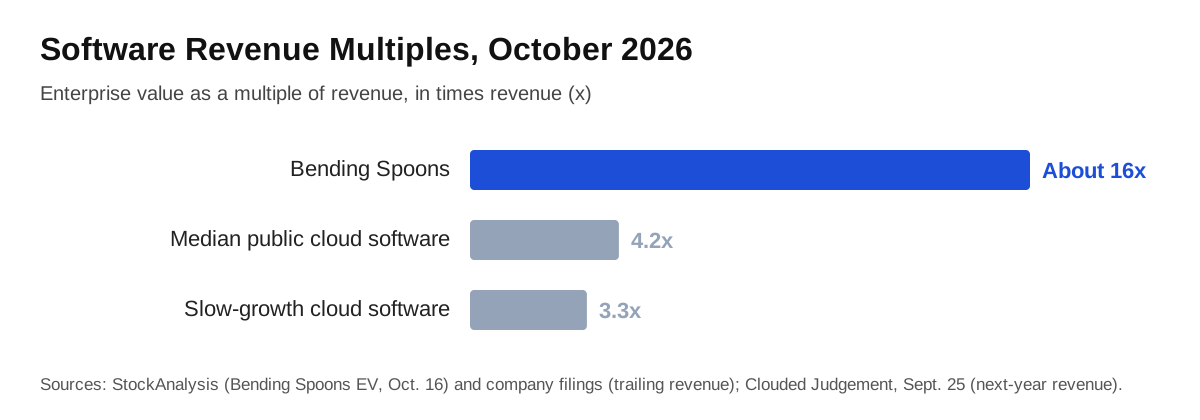
So the same market paying 3 or 4 times revenue for typical SaaS pays about 16 times for a company that buys SaaS at 1 to 3 times and runs it lean. That gap is the story. The value sits in the brand and in how the business is run. The code underneath is the cheap part.
Services businesses are getting software multiples
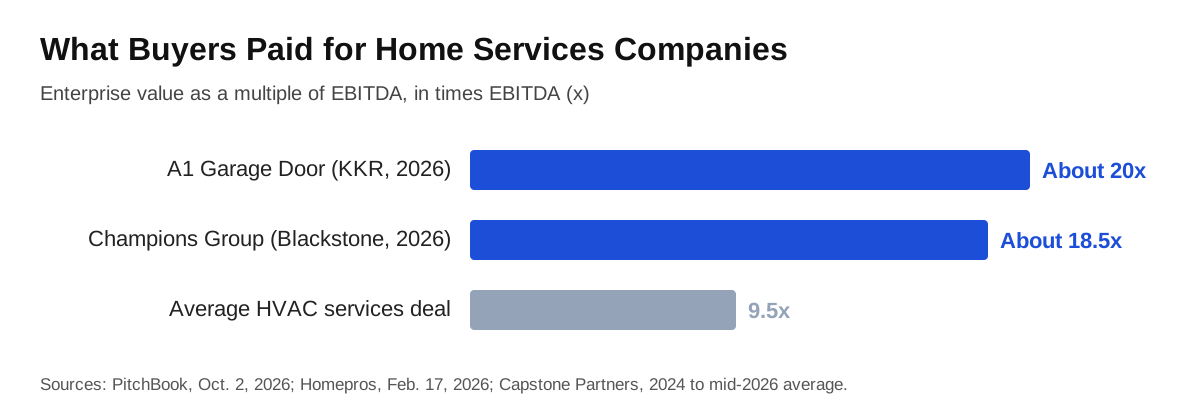
Now look at the other side of the market. In September, KKR agreed to buy A1 Garage Door Service for about $2 billion, Reuters reported. PitchBook says KKR paid about 20 times EBITDA and called it a "SaaS-like multiple" for a garage door company.
A1's EBITDA grew from $27 million in 2022 to about $100 million this year, largely by buying local operators. Private equity firms did 21 garage door deals worth $4.2 billion through late September, more than any year in the past decade except 2021.
It isn't only garage doors. In February, Blackstone agreed to buy Champions Group, a heating, plumbing and electrical company, at about 18.5 times EBITDA.
To be fair, the average deal hasn't gone up. Capstone Partners puts the average HVAC services deal at 9.5 times EBITDA since 2024, down from 13.3 times in 2021 to 2023, as Kadenwood summarized. The best services platforms are the ones getting record prices. They have strong local brands, their own trucks and their own technicians.
A garage door technician can't be replaced by a prompt. Neither can a local name with thousands of five-star reviews. I made the same point about energy in why I own tankers and oil companies instead of SaaS.
Why SaaS multiples keep compressing
Public SaaS has been repricing all year. The median public SaaS company fell to 3.3 times revenue at the end of March, from 6.2 times at the end of 2024, according to PitchBook data cited by Windsor Drake. About $1 trillion of software market value disappeared in that quarter.
I don't think this is a temporary disruption. It's the underlying unit economics of a technology company. The cost to develop software is falling as the cost of AI tokens falls.
Epoch AI found that the cost of reaching a given level of AI performance has fallen about 47% per quarter since 2023, or about 13 times per year. That's faster than computing power, DNA sequencing or batteries ever got cheaper.
When software gets cheaper to build every day, revenue from software gets less durable every day. More companies build what they need in-house. I wrote about where that leads in the beehiiv article. The first version is easy to build. Running it well for years is the business.
You could probably put a price on what it costs to build a piece of software today. Someone should build a "what does it cost to build software" index and update it every quarter. I think it would explain SaaS valuations better than most models do.
Few buyers, and one hungry one
This is happening while most buyers have stepped back. Bain named the AI-driven "SaaSpocalypse" as one of three shocks that cut private equity dealmaking in the first half of 2026. North American buyout volume fell 21% from a year earlier, according to Mergermarket.
In that quiet, Bending Spoons is taking aggressive bites at great brands. It closed its $759 million Tractive deal in May and agreed to buy Airtable at a $1.29 billion enterprise value over the summer. With the new Berkshire money, co-founder Francesco Patarnello said its acquisition pipeline "remains strong."
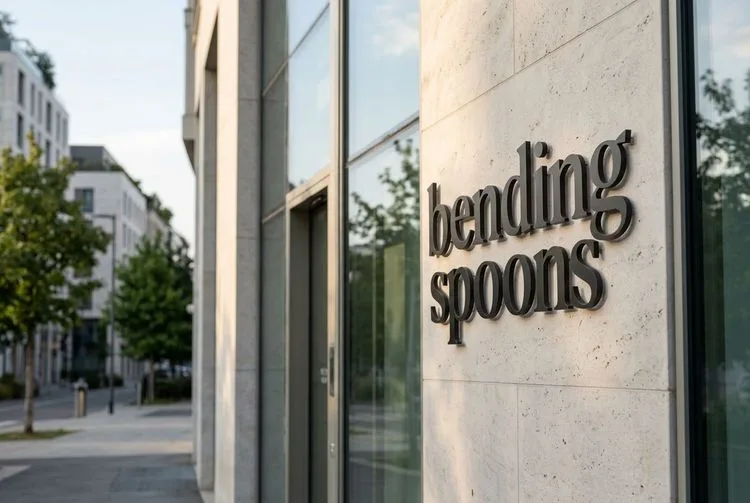
When few people are buying and one well-funded buyer keeps buying, I pay attention to what it picks. It picks brands with loyal customers that it can run for far less.
SaaS isn't dead, but it's changing
I've spent almost 20 years in SaaS. I don't think software is going away. I think the way a software company makes money is being reset.
For a software company to work from here, I think it has to do five things:
- Build cheaply. Small teams, with AI writing much of the code.
- Drive faster loops. Ship, learn from customers and ship again in days instead of quarters.
- Create incredible customer happiness at a lower cost. Support and onboarding that make people stay.
- Earn higher margins. Profit is what buyers pay for now, more than revenue.
- Own a brand. A name customers trust is the part no one can rebuild over a weekend.
That's what Bending Spoons does with old software. I wrote about how lean it runs in Bending Spoons shows SaaS doesn't need 5,000 engineers. Any founder can do the same with new software, before a buyer like Bending Spoons does it for them.
What this means if you own or invest in software
If you run a software company, ask yourself an honest question. If a competitor rebuilt your product with AI next quarter, would your customers leave? If the answer is yes, your revenue is less durable than your valuation assumes.
If they'd stay because they trust your name, your support and the work they've already put into your product, you have a brand. That's what buyers are paying for now. You can see how a buyer might look at your revenue with my free Valuation tool.
For investors, I'd watch where the multiples go. Money is moving toward businesses that are hard to copy: services with real people and equipment, physical assets and software brands run for profit. It's moving away from software priced on revenue alone.
Berkshire bought into a company that buys brands people already trust and runs them better than their old owners did. I think that's the clearest clue yet to where software is going.
Disclosure: I don't own Bending Spoons stock. I own Chevron and other energy companies, Tesla and Meta stock and an investment in SpaceX. This is my view, not investment advice.
Related reading
Get my monthly newsletter
One email a month with what I'm writing and working on.
One email a month. Unsubscribe anytime.