Prediction
Bending Spoons Shows SaaS Doesn't Need 5,000 Engineers
Keith Brown · Founding Partner, Outperform Ventures
Oct 14, 2026 · 5 min read
Bending Spoons runs Evernote, Vimeo, AOL and now Airtable with small teams and AI. Like X before it, it shows software can run with far fewer people than most companies carry, and Berkshire is betting on it.
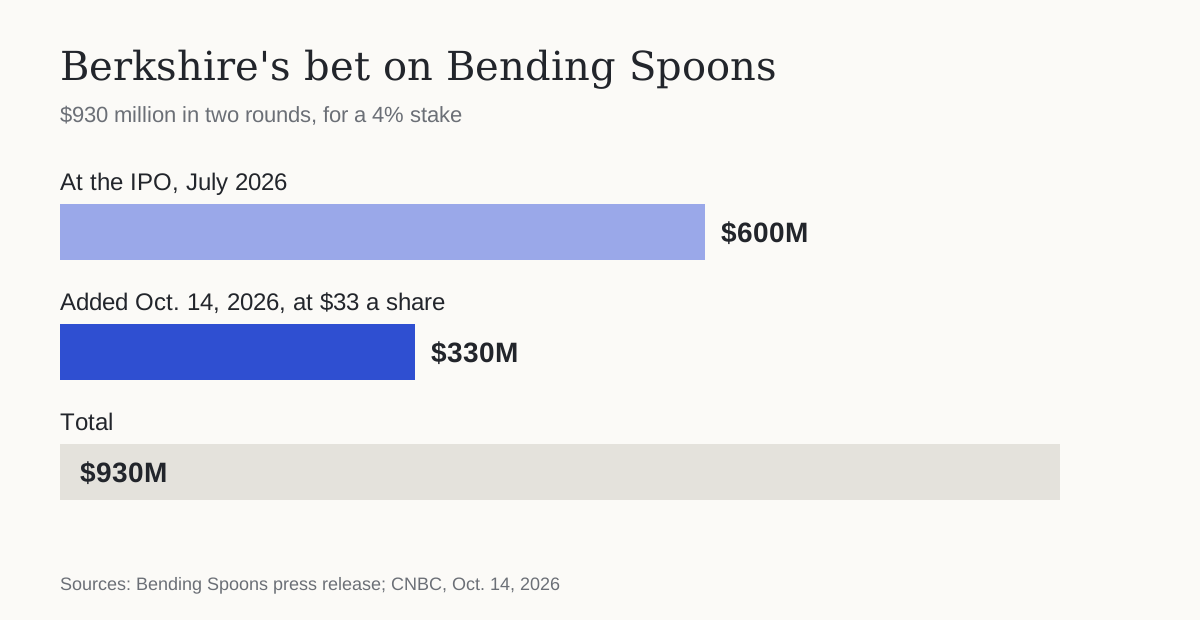
Berkshire Hathaway just put another $330 million into Bending Spoons, CNBC reported today. That's on top of the $600 million it invested at the July IPO, for a 4% stake. The shares jumped 35% on the news.
Bending Spoons owns Evernote, Vimeo, WeTransfer, AOL, Eventbrite and, as of last month, Airtable. It runs all of them with small teams and AI. To me it's the clearest proof yet of how lean SaaS can run. I've written that legacy SaaS is worth its data. Bending Spoons shows it doesn't need thousands of people to keep it going.
Valuations in SaaS were unreasonably high and had been for probably a decade.
What Bending Spoons does
Ferrari once described the company as "like private equity had a baby with Google," Fortune reported. It buys apps that have stopped growing, rebuilds the technology with its own engineers and keeps them. Since 2013 it has bought more than 50 businesses.
The playbook is simple. Find a product with loyal customers. Cut the team to the people who matter. Rebuild the product on its own platform. Raise the price.
The pace is fast. About a month after closing its $1.28 billion Airtable deal, it laid off a large part of the Airtable team. Federico Simionato, who leads product at Bending Spoons, announced it on X on October 12.
This is not a reflection of their work but a reflection of our deep belief that small teams ship more and better.
He said the new core team had already shipped more than 30 customer requests in three weeks. He also asked anyone hiring to call the people leaving. Not everyone liked how it was framed. The top reply, "Celebrating layoffs is not a flex," got more than twice the likes of the post itself.

Both things can be true. Small teams do ship faster. And the people on the other end of that decision deserve care in how it's told.
Why Berkshire is buying in
Berkshire likes businesses with loyal customers and steady cash. That's what old software is. People don't leave Evernote or WeTransfer because switching is a hassle. Their files are there.
The price is right too. Software stocks fell more than 25% in early 2026 before recovering, Market Briefs noted. In its IPO filing, Bending Spoons said it had found more than 1,000 possible targets with close to $400 billion in yearly revenue, per PYMNTS.
Warren Buffett has said for years, "Price is what you pay. Value is what you get." Bending Spoons pays for customers and data, then cuts the cost of serving them.
AI makes the model work
Ferrari says AI writes at least 90% of the company's code. It also helps design products, set prices and screen job applicants. That's how a small team can run a dozen big products.
This is the same thing I wrote about with Kroger cutting 3,000 corporate jobs. Companies are getting leaner. Bending Spoons is the extreme version, built from day one to run with as few people as possible.
It also fits the Integration Wars. When software can be rebuilt fast and cheap, the product is no longer the moat. The customers are.
X showed how lean software can run
We've seen this before. After Elon Musk bought Twitter in 2022, he cut the company from about 8,000 people to roughly 1,500, he told the BBC in 2023. Many people said the site would fall over. It didn't. X is still running, still shipping and still one of the most used apps in the world.
You can argue about how it was done. I would have done it with more care. But it proved that a big software product can run with a fraction of the people. Bending Spoons has turned that into a repeatable business.
Why this is the future for a lot of software
Most SaaS companies grew their teams in the years of cheap money. Hiring was how you showed growth. Many of them still carry those teams today, with products that have stopped growing.
Those companies have three choices. Find growth again. Run lean on their own. Or get bought by someone who will run them lean for them. Bending Spoons is now a public company with Berkshire money behind it, so the third option is getting more common.
If you work at a software company that stopped growing
This news is hard if your company looks like a target. Be honest with yourself about where it stands. Flat growth and loyal customers is exactly what buyers like this look for.
- Know your numbers. Growth, retention and cost to serve a customer. That's what a buyer looks at first.
- Be the person who ships. Bending Spoons keeps people who build fast and cuts layers. Learn the AI tools and use them every day.
- Stay close to customers. The relationship is the asset. People who own it are harder to replace.
- Run lean before someone makes you. If a buyer can cut half the cost, leadership can too, and keep the savings.
Not sure where AI stands on your team? Try the AI Check.
What founders and investors should take from it
A buyer like Bending Spoons pays for loyal customers and cash flow, not headcount or roadmap. If you want to know what your company would bring, run it through the Valuation tool, then see what you'd take home with Exit Math.
Bending Spoons is also a new kind of exit. Ten years ago, a flat software company had few buyers. Now there's a public company with Berkshire money whose whole job is to buy it.
For investors, the lesson is the one I keep coming back to in where I'd put money instead of the Anthropic IPO. Code is getting cheap. Customers, data and distribution are not.
Where this goes in 2027
I think by 2027 most SaaS companies won't need 5,000 engineers. Most won't need 500. A small team with AI writing most of the code can run a product millions of people use.
That's the honest lesson from Bending Spoons. SaaS can be run far leaner than most companies run it today. Every leader gets to choose whether to make that change themselves, or wait for someone to buy the company and make it for them.
I don't own Bending Spoons stock. If you want my monthly thoughts on where business is headed, subscribe below or connect on LinkedIn.
Related reading
Get my monthly newsletter
One email a month with what I'm writing and working on.
One email a month. Unsubscribe anytime.