Deep dive
Why Forward-Deployed Engineers Are the Future
Keith Brown · Founding Partner, Outperform Ventures
Oct 23, 2026 · 5 min read
Forward-deployed engineers sit between businesses that need help adopting AI and people who need new skills. SaaS, consultancies and dev shops used to fill that spot. They can't anymore.
Most businesses I talk with don't need another AI model or another software license. They need someone who can take the tools they already have, messy systems and all, and make AI work inside their day-to-day operations. That person is a forward-deployed engineer, and we need far more of them.
Andreessen Horowitz called it the hottest job in startups, and the comparison its partner Joe Schmidt used fits what I see with the companies I work with.
Enterprises buying AI are like your grandma getting an iPhone: they want to use it, but they need you to set it up.
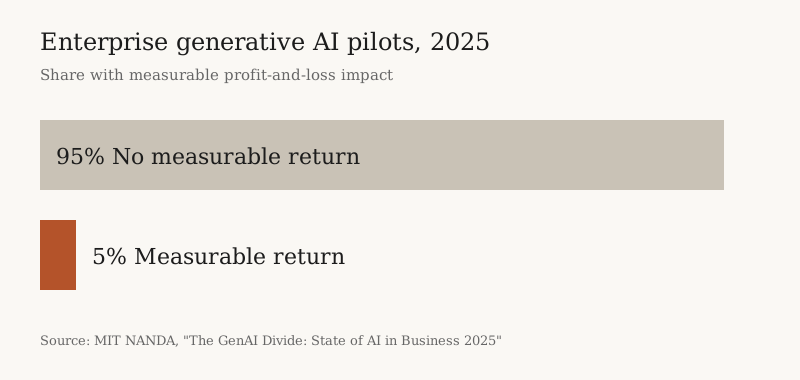
The gap shows up in the data. MIT's 2025 study of enterprise AI, reported by Fortune, found about 95% of generative AI pilots produced no measurable impact on profit and loss. The models are capable. The breakdown happens when a company tries to fit them into how its people work every day.
The future is already here. It's just not very evenly distributed.
That describes AI today. A few teams are moving ten times faster while most are still stuck in pilots. I wrote about how work itself is changing in we need a new model for employment. This article is about who closes the gap.
Two groups that need each other
Businesses everywhere need help putting AI to work. At the same time, hundreds of thousands of people, and possibly millions, will need new skills as AI changes or replaces the work they do today.
The World Economic Forum's Future of Jobs Report 2025 found employers expect 39% of workers' core skills to change by 2030. Many talented builders and growth marketers are already retraining on their own, a shift I wrote about in everyone's job is changing at once. Demand is high on both sides.
What's missing is a good way to connect them. Someone has to play matchmaker.
Who used to fill that role
For the last two decades, businesses handed most of their building to outside companies. I spent years inside that SaaS era. Engineers moved in-house at software companies, some with thousands of them, to build large platforms that customers rented by the seat.
Agencies, dev shops and big consultancies covered whatever the platforms didn't. That arrangement is breaking down because the platforms are no longer cooperating with each other. I covered that shift in welcome to the integration wars.
Why SaaS is turning on itself
Take a group of ten tools that integrate well today. Each one has investors expecting it to grow many times over, and the fastest path is to build what the other nine already do. Partners slowly become competitors.
Staying put won't keep a company safe. Salesforce keeps expanding into everything around it, most recently with Agentforce AI agents, and Mailchimp is moving into CRM. Every vendor is racing to become the whole stack. I wrote more about where that leads in ARR is over and legacy SaaS.
That's why the matchmaker can't be another software company. Traditional consultancies like Deloitte or Virtusa don't fit either, and neither do dev shops. The problems are too messy for their playbooks and their implementation timelines.
Every company will rebuild its stack
Whether they plan to or not, most companies will rebuild their technology stack over the next few years. The tools they rely on are changing underneath them.
Where this ends is businesses owning more of what they need in-house. Building custom software gets cheaper every month, while hiring great people keeps getting more expensive, and many of those people are already working more than one job. That combination favors small, embedded teams that build exactly what the business needs. I made the case for that kind of team in is every hire a builder or a grower?.
McKinsey's State of AI survey shows most companies now use AI in at least one part of the business, yet far fewer report it changing their results. Having the tools isn't the same as rebuilding the work around them.
What a forward-deployed engineer does
Support reps, implementation specialists and solutions engineers all work for the software vendor. A forward-deployed engineer works for the business. They embed with the team, learn how the work gets done and build what's needed, so they feel like a colleague rather than a contractor.
The idea isn't new. In 2011, Palantir renamed its solutions and integration engineers "forward-deployed engineers" and sent them to work inside customers. Andreessen Horowitz now reports that job postings for the role are up hundreds of percent as AI companies copy the model.
| Who helps | Who they work for | How close to the work | Speed |
|---|---|---|---|
| Support rep | The software vendor | Answers tickets | Days per issue |
| Implementation specialist | The software vendor | Sets up the product | Months, on the vendor's plan |
| Sales or solutions engineer | The software vendor | Demos and scopes | Until the contract is signed |
| Dev shop or agency | Its own client list | Works from a brief | Weeks between handoffs |
| Forward-deployed engineer | The business itself | Sits inside the team | Daily, inside the growth loop |
The biggest change is access. A company that bought Salesforce never spoke with the people building it. Today, leaders can work directly with the engineer doing the work, which cuts delays and speeds up every growth loop. I wrote about why those loops matter in AI-native loops.
What makes this model hard
- Access. Many leaders have never worked side by side with an engineer, and it takes practice.
- Belonging. An embedded builder has to be part of the team, with the same context and goals as everyone else.
- Timelines. Software rollout timelines don't apply. The work moves in days, and the plan changes as the team learns.
These problems won't be solved with old assumptions. Leaders will need fresh thinking about what employment looks like, who their partners are and what their technology stack should be.
How we're approaching it
This is the model we're building at Outperform Ventures. It isn't an agency or a dev shop, and there's no client list. The problems are too complicated and nuanced for that, so we put builders inside the business instead. You can read more about the fund on my Outperform Ventures page.
Where to start
If you run a business:
- Pick one messy process that costs your team time every week, rather than a big AI initiative.
- Pair a builder with the people who do that work, and let them talk directly.
- Measure progress in weeks instead of a year-long rollout plan.
- Decide what you'd rather build than rent. My AI-Proof Test is a quick place to start.
If you're building new skills:
- Build real things for real businesses, even small ones.
- Spend time with operators and understand the work before you write code.
- Show results people can see and use.
Businesses need help, and talented people are ready to build. The more forward-deployed engineers we have connecting the two, the faster both sides grow.
Related reading
Get my newsletter
My newest articles and projects, once a month.
Unsubscribe anytime.