Legacy
Everyone's Job Is Changing at Once
Keith Brown · Founding Partner, Outperform Ventures
Oct 21, 2026 · 5 min read
From the PE firm to the intern to the high school student, every role is changing at the same time. When knowledge becomes a commodity, people become the bottleneck, and we have to measure output instead of hours.
Everyone's job is changing at once. The PE firm, the VC, the LP. The CEO, the executive team and the intern. The college student, the high school student, the parent and the teacher.
That's what makes this moment different. In past shifts, one industry changed while the rest of us watched. Now it's everyone at the same time. The World Economic Forum's Future of Jobs Report 2025 found employers expect 39% of workers' core skills to change by 2030.
The illiterate of the 21st century will not be those who cannot read and write, but those who cannot learn, unlearn, and relearn.
When knowledge becomes a commodity, the skills and outputs change. I wrote about what that means for how people get paid in we need a new model for employment. This article is about something bigger. It's how every role changes, all at once, and what leaders should do about it.
What private equity is hearing
Mark Ajzenstadt recently shared what came out of 47 calls with private equity teams since May. He talked with operating partners, value-creation leads and portfolio company CEOs and CTOs. Adoption and change management came up as the bottleneck in 16 of those 47 calls.
One fund's AI lead told him, "Change management is the name of the game a lot of times with these things." That fund grew its team to put people on site at its companies and help staff change how they work.
A value-creation lead looking at a company with about 500 engineers said the teams were too big. He couldn't push for smaller teams without first showing an improvement in productivity. A CTO on another call had already decided: "I would probably rather triple our output than scale down."
Mark's biggest takeaway matched mine. Everyone's role is changing at the same time. The operating partner has to prove the gains. The CEO has to make clear that using AI is part of the job. The CTO has to run smaller teams with less ceremony.
How every role is changing
Here's how I see it across the people I talk with:
| Role | What used to matter | What matters now |
|---|---|---|
| PE firm, VC, LP | Picking companies and adding capital | Proving AI gains inside the companies they own |
| CEO | Setting strategy and hiring | Making AI part of every job, starting at the top |
| Executive team | Managing large teams | Running smaller teams that ship more |
| Intern | Learning the basics by doing them | Judging and improving what AI produces |
| College student | Memorizing what's on the test | Building things and showing the results |
| High school student | Finding the right answer | Asking better questions |
| Parent | Helping with homework | Teaching judgment and curiosity |
| Teacher | Delivering information | Coaching how to think |
None of these people can wait for the others to figure it out. That's the hard part. The student is changing while the teacher is changing, and the CEO is changing while the investor is changing.
When knowledge becomes a commodity
For most of my career, knowing things was valuable. The person who knew the system, the numbers or the history got promoted. Now anyone can get a good answer in seconds.
When everyone has the answers, the value moves to what you do with them. Judgment, taste, decisions and follow-through matter more. So does the ability to work with people. I wrote about that in why companies should double down on humans.
That's true for a ninth grader and for a managing partner. The skill is the same. Can you take what's available to everyone and turn it into something that works?
Humans are the bottleneck
AI doesn't sleep, take vacations or sit in meetings. People do. That means people are now the bottleneck in most companies. And when humans are the bottleneck, meetings and calendars are the bottleneck. Vacations are the bottleneck.
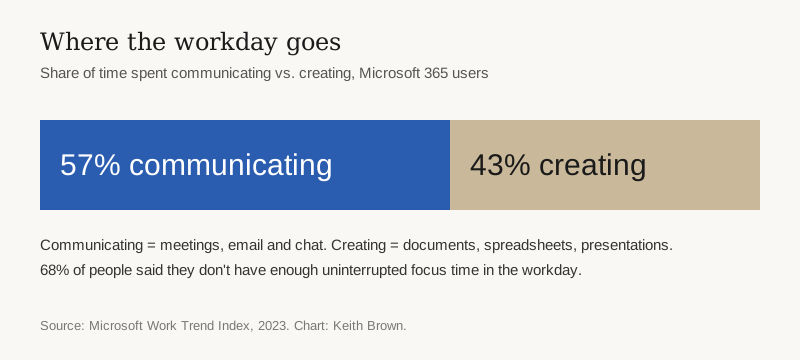
The data shows how much of the day goes to coordination. Microsoft's Work Trend Index found people spend 57% of their time communicating in meetings, email and chat, and only 43% creating. And 68% said they don't have enough uninterrupted focus time.
If the AI can finish a task overnight but the decision waits a week for the next meeting, the company moves at the speed of the meeting. I covered this in bottlenecks and in the end of management as coordination.
This isn't an argument against rest. People need time off, and good leaders protect it. It's an argument for designing work so one person's calendar doesn't hold up everyone else.
Measure output, not 40-hour weeks
We have to start measuring for outputs, not 40-hour work weeks. Hours made sense when the work was tied to a person sitting at a desk. They make far less sense when a person with the right tools can do a week's work in an afternoon.
Measuring output is harder. You have to decide what a good result looks like before the work starts. You have to look at the work itself, not how busy someone seems. That's uncomfortable for a lot of managers, because busy is easy to see.

It also changes how you hire. I'd look for people who multiply a team, which I wrote about in hire multipliers, not headcount, and for executives who already work this way, in what the AI-native executive team looks like.
Where to start
Mark suggested five questions every company should answer before starting with AI:
- Fewer people, or more output from the same people?
- Which team goes first?
- What number proves it worked?
- Who owns the AI after the pilot?
- What does it cost to run at full usage?
I'd add a few for leaders, whatever your role:
- Pick one result your team delivers, and measure it before you change anything.
- Look at your calendar. Find one recurring meeting that only exists to pass along information, and replace it.
- Write down who has to approve what. Remove one approval step this month.
- Use AI yourself, every day, so you know what you're asking of your team.
- Talk with your kids or the young people you mentor about how they're learning. They're changing too.
Everyone has work to do. The people and companies that accept that early will have a head start. The ones waiting for someone else to change first will wait a long time.
Related reading
Get my monthly newsletter
One email a month with what I'm writing and working on.
One email a month. Unsubscribe anytime.