Deep dive
Anthropic and the Enterprise Blind Spot
Keith Brown · Founding Partner, Outperform Ventures
Oct 27, 2026 · 9 min read
Pharma brought Claude inside to speed up drug discovery. Now Anthropic is discovering drugs itself. Here's what that means for every industry that let AI in.
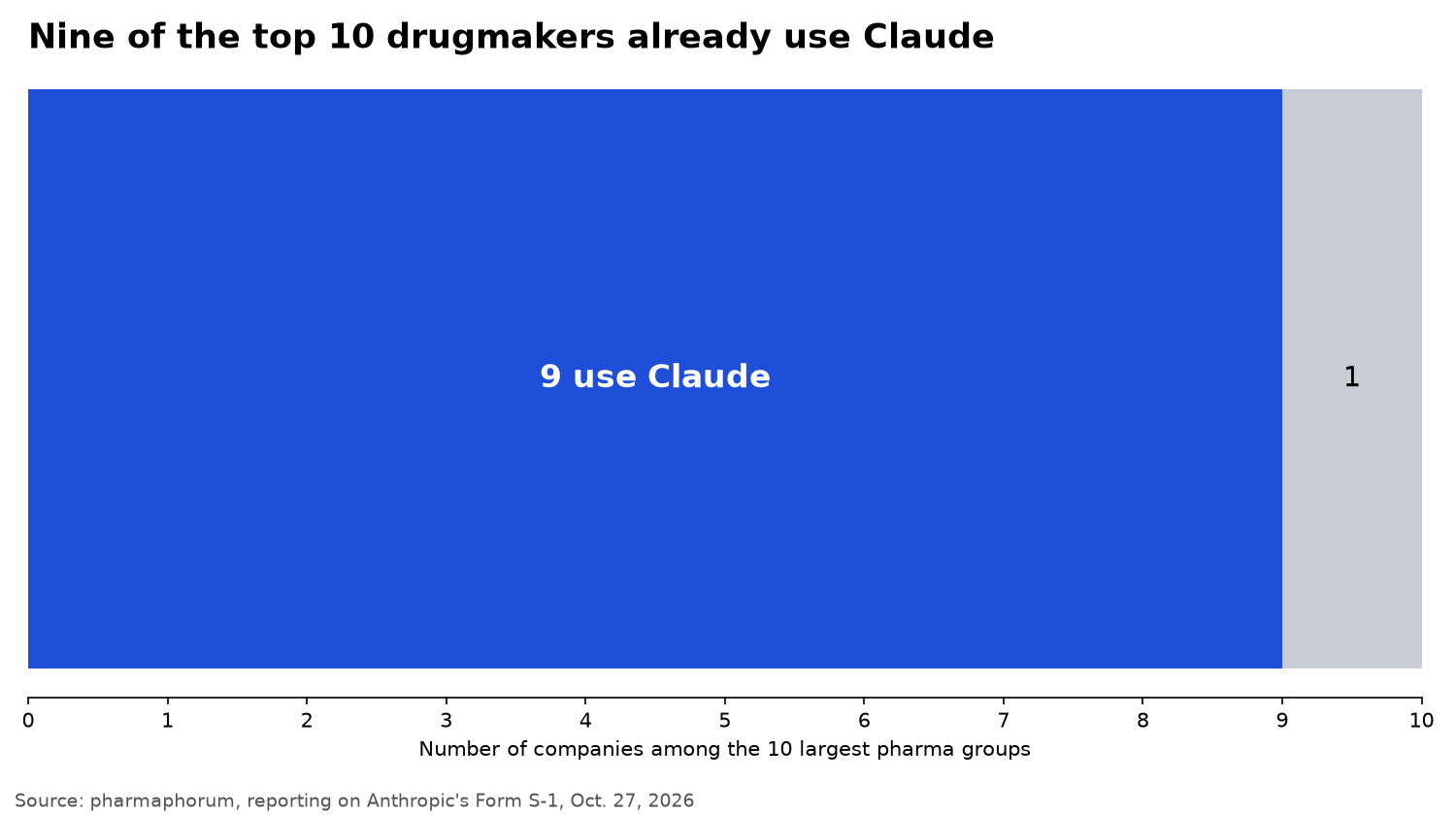
Anthropic's IPO filing lists the biggest companies paying it at least $100,000 a year. They include nine of the 10 largest pharmaceutical companies, the 10 largest banks and eight of the 10 largest healthcare companies.
A day after the filing went public, Anthropic said it has started drug discovery efforts of its own, including programs for rare childhood forms of muscular dystrophy "where Claude handles much of the scientific and operational work." The filing says it has hired industry experts, built its own molecular biology lab and bought a company called Coefficient Bio.
I saw the news first in a post from Polymarket. Big pharma has been paying Anthropic to help it find drugs, and now Anthropic is finding drugs on its own.
That is the story of Troy. Every business is the city, and Claude is the horse we wheeled inside. Software was the first industry to feel it, and I think nearly every public company is next.
Virgil wrote the warning more than 2,000 years ago. In the Aeneid, the priest Laocoön begs the Trojans not to bring the horse inside: "Do not trust the horse, Trojans. Whatever it is, I fear the Greeks, even when bearing gifts." They brought it in anyway. I wrote yesterday about Anthropic's $6.6 million in revenue per employee. This article is about where that revenue goes next.
What did Anthropic announce in pharma?
Anthropic has worked with six drug developers, including Bristol Myers Squibb and Generate Biomedicines, and says it plans to "scale this work up substantially from here." The filing also describes a Model Hardware Standard that lets Claude run lab equipment such as microscopes, liquid handlers and robotic arms.
pharmaphorum walked through those biopharma plans the day the filing came out. The filing puts global pharmaceutical spending above $2 trillion in 2026. Anthropic already sells to that market, and with its own drug programs it now competes in it.
Axios framed it as competition for small AI drug startups. I think the bigger question is for the drugmakers themselves. Does big pharma own data centers that run frontier models? No. It pays Anthropic for the models, and Anthropic just opened its own lab.
How did the horse get inside?
Nobody snuck Claude past the walls. We invited it in, and we paid for it. Every company that bought seats, ran pilots and built agents on top of the models helped fund the next model.
We also showed it how our work gets done. Customers connected Claude to their files, their data warehouses and their workflows. Model makers sent their own engineers to sit with customers and learn the job. I wrote about that model in why forward-deployed engineers are the future.
To be fair to Anthropic, its enterprise terms say customer data isn't used to train its models by default, according to its financial services launch. Anthropic doesn't need your private files to learn from you. Usage across its customers shows which tasks matter, which tools people use and where companies spend money.
Are customers paying for their own competitor?
The quarterly numbers in the filing show how fast this flipped. In the first quarter of 2025, Anthropic brought in $376 million and spent $944 million on compute. By the second quarter of 2026, revenue was $11.6 billion, compute was $5.6 billion, and Anthropic made its first quarterly operating profit, $974 million.
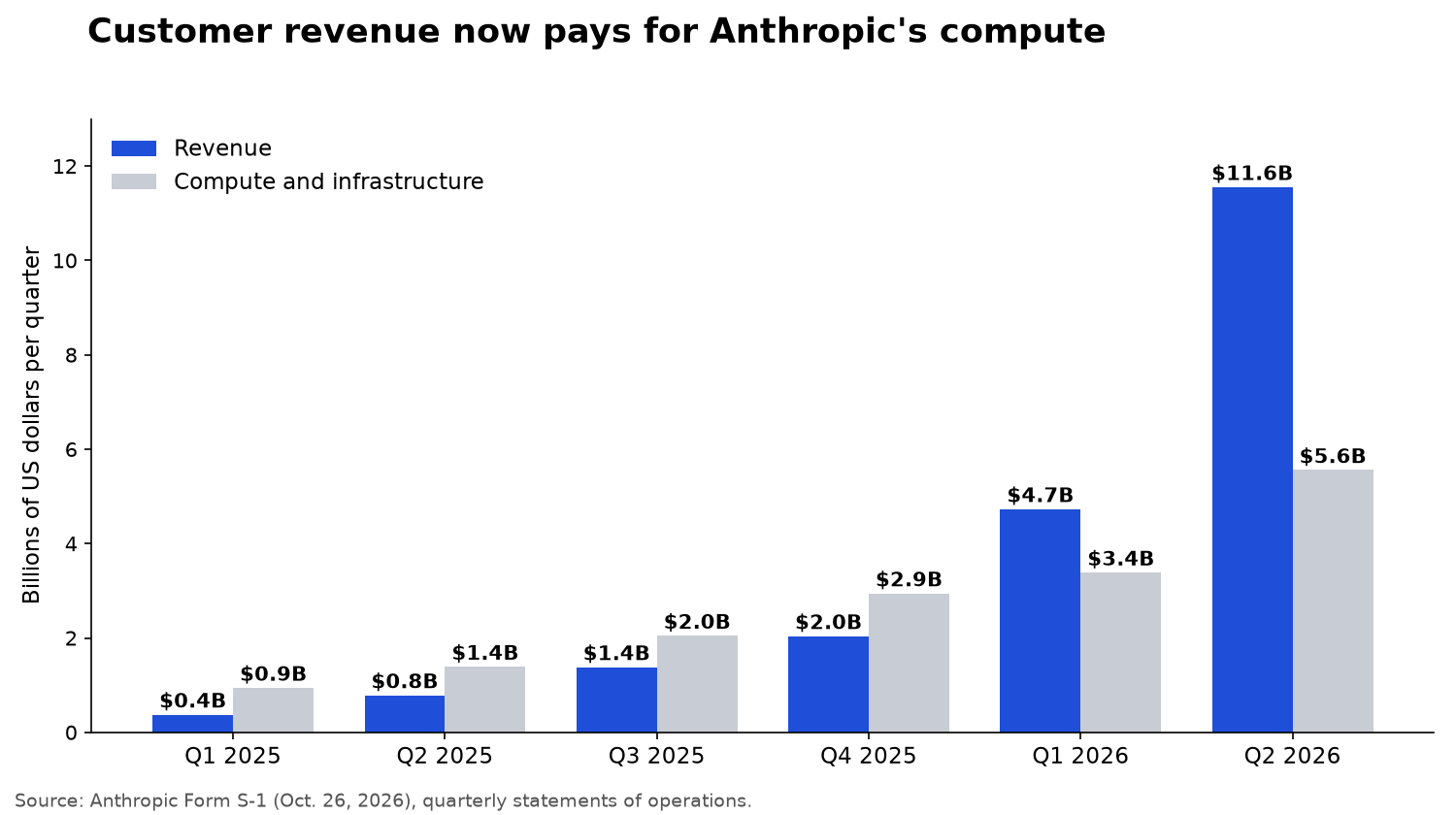
Customer payments now cover the compute and leave money over for the lab, the Coefficient Bio deal and the next model. The filing lists about $417 billion in future payments for compute and data centers, plus another $125 billion to $150 billion for capacity arriving between 2028 and 2031.
A drugmaker pays Anthropic to speed up its research. That same money helps pay for the compute behind Anthropic's own drug programs.
The filing also shows how much room is left. Revenue from its Fortune 500 customers averages less than 0.1% of those companies' total expenses, and Anthropic calls this the early stages of its expansion inside them.
Why is this bigger than the SaaSpocalypse?
In February, Anthropic released industry plugins for its Claude Cowork agent covering legal, finance, sales and marketing. Bloomberg reported a $285 billion rout across software, financial services and asset managers in one day. Reuters put the loss in software and services stocks at nearly $1 trillion, and CNBC reported the S&P 500 Software & Services Index was down about 20% for the year by Feb. 5.
People called it the SaaSpocalypse. Software went first because the product was already code. Pharma shows the model makers can go after businesses built on science, licenses and physical labs too.
How big does Anthropic think its market is?
Bigger than the US economy. The S-1 says "the work that knowledge workers perform represented more than $40 trillion in economic value globally in 2025." US GDP was about $30.7 trillion that year. Before the filing went public, the Wall Street Journal reported Anthropic would pitch a market of more than $30 trillion.
I think that's the most important line in the filing. Software companies used to size their market by software budgets. Anthropic sizes its market by the work itself, the salaries and fees companies pay for knowledge work.
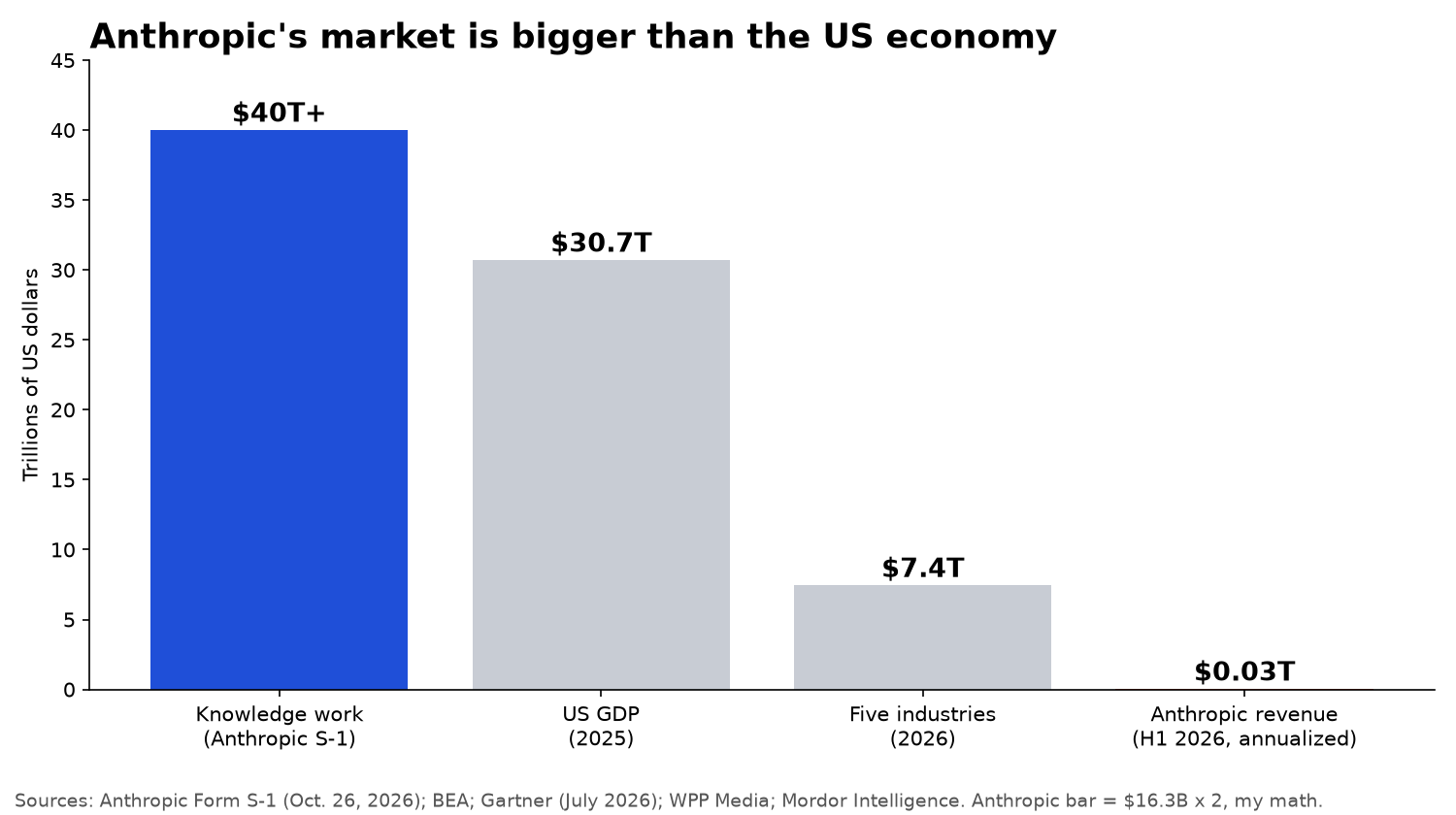
The filing also cites IDC's estimate that AI will add $22.5 trillion of cumulative economic impact by 2031, and says "we believe the impact could be even greater." Anthropic's yearly revenue today is less than a tenth of 1% of that $40 trillion.
Which industries let the horse inside?
Here is how I'd map it. The first column is who is already using Claude or ChatGPT. The last column is what a model maker can't copy quickly.
| Industry | Who's using it today | What the model learns | What the industry still owns |
|---|---|---|---|
| Software | Nearly every engineering team | How products get built and sold | Customers, distribution, data |
| Pharma | 9 of the top 10 drugmakers | How drugs get found and filed | Trials, FDA approvals, manufacturing |
| Finance | AIG, NBIM, IG Group | Underwriting, research, compliance | Balance sheets, licenses, trust |
| Legal | Firms using Cowork's legal plugin | Contract review and research | Bar licenses, liability, judgment |
| Advertising | Agencies and in-house teams | Briefs, copy, media plans | Client relationships, media buying |
| Consulting and IT services | Deloitte, KPMG, PwC as partners | How enterprises change | Executive access, delivery teams |
| Customer service | Support teams running agents | Every question customers ask | The customer relationship itself |
Sources: pharmaphorum, Anthropic's financial services examples, Anthropic's partner list and the February coverage above. The middle and right columns are my own read.
What would it take to get there?
You get to $40 trillion one industry at a time. Here are five industries where Claude already works, with what the world spends on each in a year.
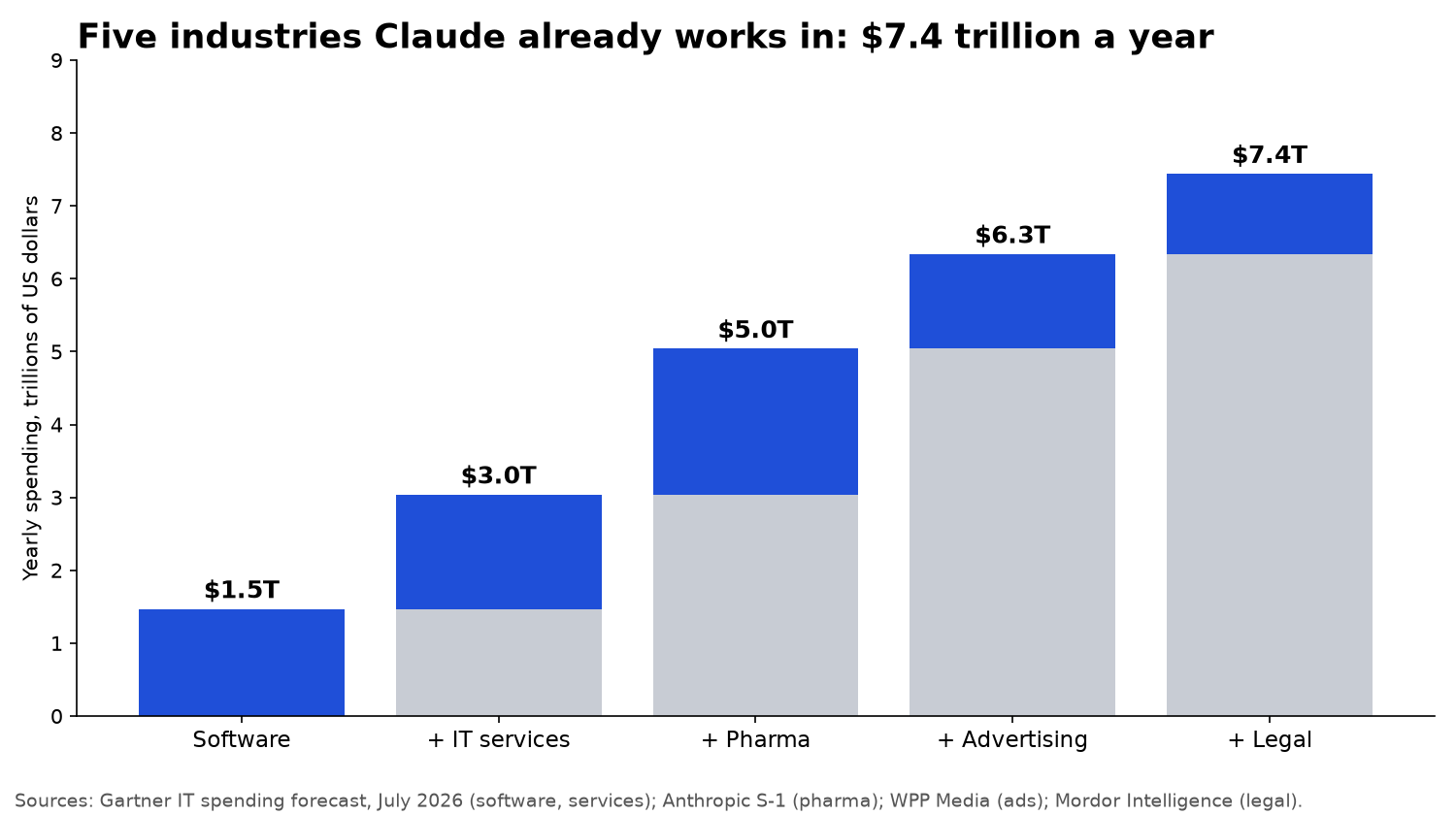
Those five add up to about $7.4 trillion, less than a fifth of Anthropic's $40 trillion. Finance, insurance, healthcare, education and customer service are still outside the chart.
Anthropic doesn't need to win most of any industry. Here is what small slices of those five would be worth.
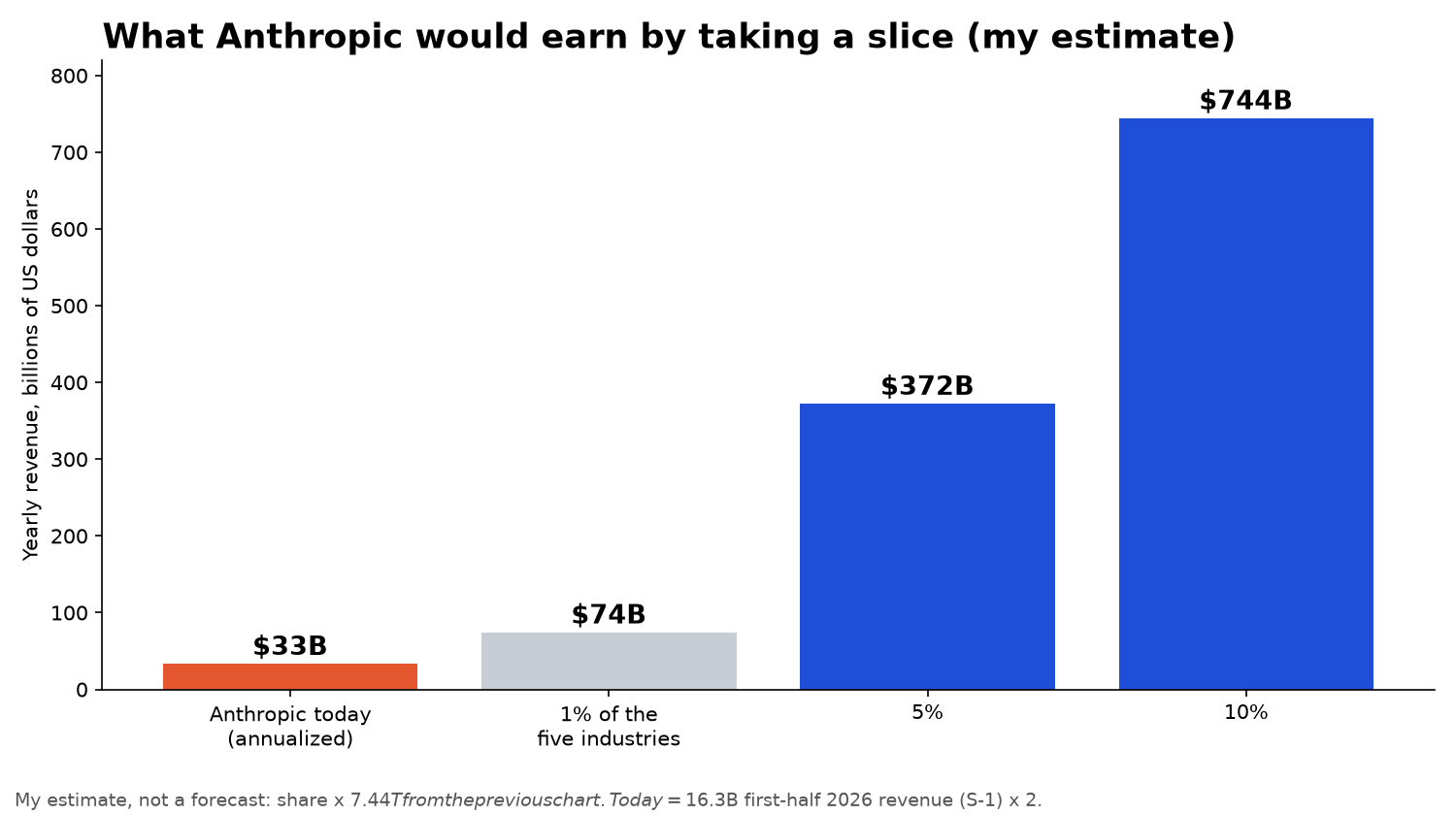
One percent of those five industries is more than twice Anthropic's current pace. Ten percent would be $744 billion a year, about what Gartner expects the world to spend on all data center systems in 2026.
What does finance show?
The filing says all 10 of the largest banks in the Fortune 500 pay Anthropic at least $100,000 a year. Insurers are in too.
AIG uses Claude in underwriting. Anthropic reports review timelines got more than five times faster in early rollouts, and data accuracy rose from 75% to over 90%. AIG CEO Peter Zaffino said the partnership "will fundamentally transform how we approach underwriting at scale."
Norway's sovereign wealth fund, NBIM, manages about $1.7 trillion and rolled Claude out to more than 600 employees in two months, saving about 20% of their time each week. AIG and NBIM are careful institutions, and they use Claude because it saves time. Each rollout also shows Anthropic which finance jobs are worth building products for.
What about legal, ads and services?
Thomson Reuters and LegalZoom were among the hardest-hit stocks after the February plugins, according to CNBC. Reuters reported ad holding companies Omnicom and Publicis fell in the same selloff, and Indian IT firms like Tata Consultancy Services and Infosys dropped too.
Each of those businesses sells work done on a screen, such as research, drafts, media plans and code. The February plugins covered legal, finance, sales and marketing, the same kind of work.
Anthropic is already moving into services. The filing describes Ode with Anthropic, a new AI services company launched with private equity firms to bring Claude to mid-sized companies and support them over the long term. Consulting and IT services firms sell that same work today.
Where does the Troy story break down?
I want to be honest about the limits here. A model can design a molecule, but it can't run a phase 3 trial, win FDA approval or build a plant. Anthropic's own filing lists regulatory and operational risks in drug development that go well beyond software.
Banks need charters. Lawyers need bar licenses and carry liability. Hospitals need beds and nurses.
Not every model maker will move into every industry either. Anthropic, OpenAI and the others have limited people and compute, and they'll pick the biggest markets first. Pharma at $2 trillion made the list. Plenty of smaller industries won't for years.
The money cuts both ways. Anthropic buys compute 12 to 18 months ahead, so those costs stay mostly fixed whether demand shows up or not, and the filing reports $6.2 billion of debt as of June 30, 2026. Sacra reports growth slowed after July as margins tightened, and the filing says it doesn't expect revenue to keep growing at recent rates. OpenAI, Google and open models are all chasing the same work, which pushes prices down for everyone.
What should leaders do now?
I'm not telling anyone to stop using AI. Pulling Claude out of your company would only hand the advantage to a competitor who kept it. The better move is to know which workflows you've connected to it and what you own that a model can't copy.
- Write down the three things your customers pay you for that a model can't do: a license, a physical asset, a relationship or a track record.
- Look at which of your workflows you've connected to an outside model. Ask what a model maker would learn from that pattern across 1,000 companies like yours.
- Own the data that comes out of your work, and keep it in systems you control.
- Build some of your own tools so you aren't renting every piece of intelligence. I wrote about which AI apps make money and which are portfolio pieces.
- Own assets, not only rented software. That is the same reason I wrote Own Assets or Be Left Behind.
The Trojans never asked what was inside the horse. Drugmakers found out on Oct. 27, when Anthropic announced its own drug programs. Every leader using Claude or ChatGPT should ask that question about their own industry this quarter. For a look at the IPO itself, I wrote about where I'd put money instead of the Anthropic IPO.
Disclosure: I own an investment in SpaceX, which owns xAI, the maker of Grok.
Related reading
Follow what I'm building and backing
I post on LinkedIn and X about the companies I back and the products I build.
Join 2,219 people following along.