Deep dive
The Midterms Showed How Wide the AI Divide Is
Keith Brown · Founding Partner, Outperform Ventures
Nov 7, 2026 · 8 min read
Texas elected its first Democratic governor since 1990, and data centers lost 36 of 38 local votes. What the extreme swing says about the gap between companies and workers on AI.
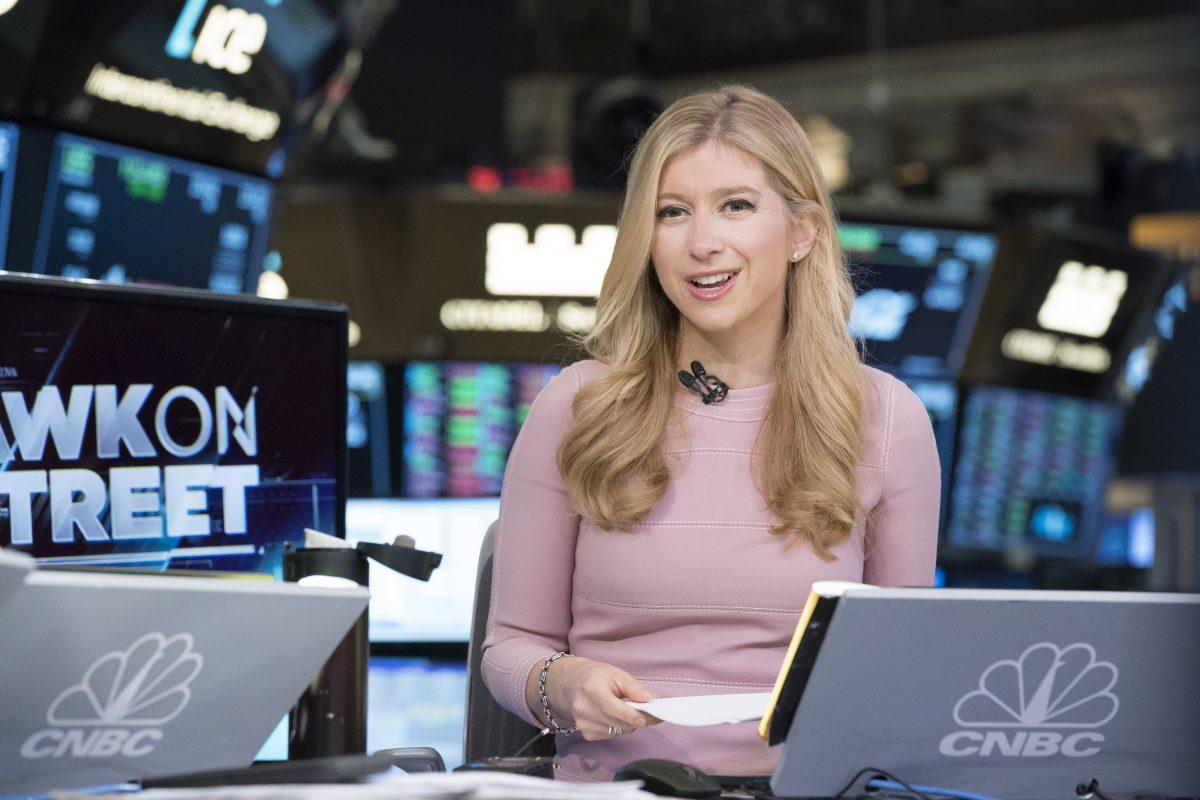
Texas elected a Democratic governor on Tuesday for the first time since 1990, two years after Trump carried the state by nearly 14 points, per NBC News. I've been thinking about results like that all week, after a post from CNBC's Sara Eisen about how far apart corporate America's AI talk and the voters are.
The disconnect between public perception and corporate America on Ai is stark. I’ve never seen such a strong consensus of optimism from businesses about a single technology. Their top priority right now is investing and implementing ai in their business to improve productivity
— Sara Eisen (@SaraEisen) View on X
I've thought about it as an American, and as a Texan who has lived here my whole life. This isn't a political post. I don't care how you vote. I care about what happens next to our country, our businesses and our capital markets. I wrote earlier this week about voters rejecting data centers. This is what's been sitting with me since.
How extreme was the midterm swing?
I'm a data person, not a politician, so here is the data.
- Texas: Gina Hinojosa beat three-term Gov. Greg Abbott 52.9% to 45.6% while being outspent nearly eight to one, per Reuters. She is the first Democrat elected governor since 1990 and the state's first Latina governor.
- Ohio: Republicans won the governor's race by 25 points in 2022. Amy Acton beat Trump-endorsed Vivek Ramaswamy, the first Democrat elected governor there since 2006, per the AP.
- Iowa: Republicans won by 18.5 points in 2022. Rob Sand flipped it, ending a Democratic drought that dated to 2006, per BGR Group.
- Georgia: Democrats took the office for the first time in 24 years, and Keisha Lance Bottoms becomes the first Black woman elected governor in US history, per NBC News.
- Kansas: No party has won three straight Kansas governor races since four-year terms began in 1974, per KMBC. Democrat Cindy Holscher, running to follow two-term Democrat Laura Kelly, leads by about 7,600 votes. The race isn't final.
- Nevada: Voters removed a sitting Republican governor, Joe Lombardo, per Civil Services.
- The map: Democrats flipped five governorships, lost none, and hold a majority for the first time in 16 years. The country has never had more than one Black governor serving at once. Five won on Tuesday, per NBC News.
Here is how far the five flipped states moved from their 2022 results.
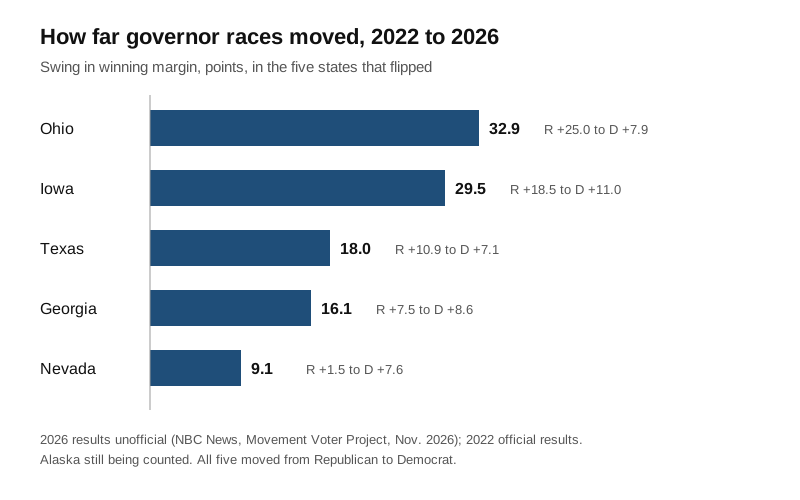
An 18-point swing in Texas and a 33-point swing in Ohio in four years. Further down the ballot, voters went against data centers in 36 of 38 counted local measures, per American Buildout. Democrats also won the House popular vote by an estimated 13 to 14 points, per Ed Kilgore, well past the 8 to 9 point lead in the final polls.
Who is talking about AI, and how?
There are two groups of people talking about AI right now.
The first is business owners and corporations. They talk about AI as productivity, higher profit margins and doing the same work with fewer people. The construction companies building data centers are in this group too, and many of them are earning billions from the build-out.
The second is the people being replaced, and the towns where the data centers are going up. Employers have tied 120,136 job cuts to AI so far this year, per Challenger, Gray & Christmas. Voters went against data centers in 36 of 38 counted local ballot measures on Nov. 3, per American Buildout.
Americans don't want Big Tech oligarchs wrecking the environment, gutting jobs and threatening humanity's future.
We've had many names for this gap over the years: the 1%, the K-shaped economy, CEOs, oligarchs. I think the newest name for it is AI.
How big is the wealth gap?
The top 1% of US households held 32.5% of the country's wealth in the second quarter of 2026, and the bottom half held 2.3%, per Federal Reserve data.
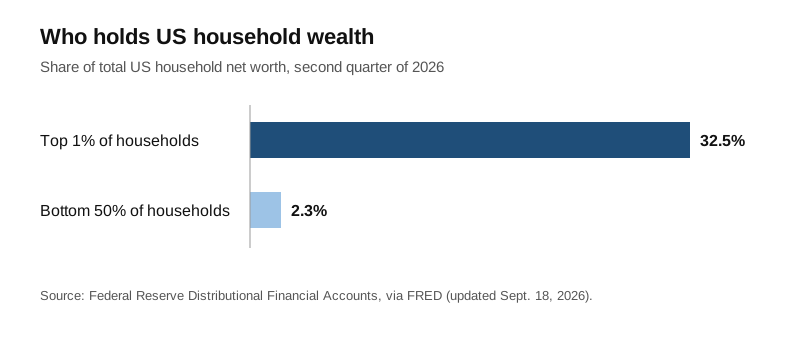
The top 1% share was 31.1% a year earlier, per the same Fed series. The Center for American Progress found that from the end of 2024 to early 2026, the top 1% added about $1.8 million in net worth per household, while the bottom half's share stayed near 2.5%.
CNBC described the post-election split as a "K-shaped AI trade": companies that already have computing capacity may gain, and those still trying to build it face higher costs.
Why don't the tariff and COVID comparisons fit?
Everyone is comparing the midterms and last week's drop to the tariffs, or to COVID and the V-shaped recovery that followed. I don't think those fit.
With COVID, we were all fighting the same virus. Unemployment jumped to 14.7% in April 2020, the highest in records going back to 1948, per the Bureau of Labor Statistics. Nobody was building coronavirus plants, and nobody was voting to keep the virus around.
The tariffs came from one place too. President Trump announced them on April 2, 2025. Seven days later he paused most of them for 90 days and cut the rate for most countries to 10%, while raising China's to 125%, per AP and Reuters. He told reporters why he backed off:
I thought that people were jumping a little bit out of line. They were getting yippy, you know.
One decision in Washington put the tariffs on, and another took most of them off. In both cases, the country was on one side and the threat was on the other.
AI has two sides inside the country. Some people are getting very wealthy from it, including the founders and early employees of the big AI labs. Others are losing jobs to it or living next to the data centers that power it. Their interests point in opposite directions, and that's why I don't expect this to fade the way the tariff shock did.
Who settles a fight inside the country?
Past shocks had someone who could end them. Trump undid the tariffs. In 2008, Washington bailed out the banks. Treasury Secretary Henry Paulson and Fed Chair Ben Bernanke asked Congress for $700 billion to buy bad assets from banks, and the Fed lent to firms like AIG. Bernanke told the Senate Banking Committee on Sept. 23, 2008:
Government assistance should be given with the greatest of reluctance.
Even so, the money went out, because the problem sat in one place. A few hundred banks needed cash, and the government had it.
This time there's no single thing to undo and no one to write a check to. How do you mediate a fight between corporate America and the lower class? I say lower class because the middle class is gone. Companies want AI for productivity and margins. The people losing jobs and living next to data centers want the opposite. No pause or bailout settles that.
How are AI companies responding?
OpenAI's CFO Sarah Friar told Sara Eisen the company will keep investing in data centers to meet customer demand, per AI Affairs. OpenAI also published commitments to the communities where it builds and now calls its data centers "compute campuses."
TechCrunch reported that tech companies that built close ties to the Trump administration are now working to rebuild ties with Democrats. Public Citizen's J.B. Branch told TechCrunch the industry "realizes they have an optics problem."
Why do I keep coming back to the middle class?
Growing up, I felt like I had to escape the middle class. Every day it seemed the rich got richer, the poor got poorer and the middle got smaller.
The numbers back that up. The share of US adults in middle-income households fell from 61% in 1971 to 51% in 2023, per Pew Research Center. The lower-income share rose from 27% to 30%, and the upper-income share from 11% to 19%.
Today I see two groups. People using technology, AI and automation to build wealth, and people being replaced by it. The Fed's numbers show the top pulling further ahead. AI is the newest and fastest version of a gap that's been growing for decades.
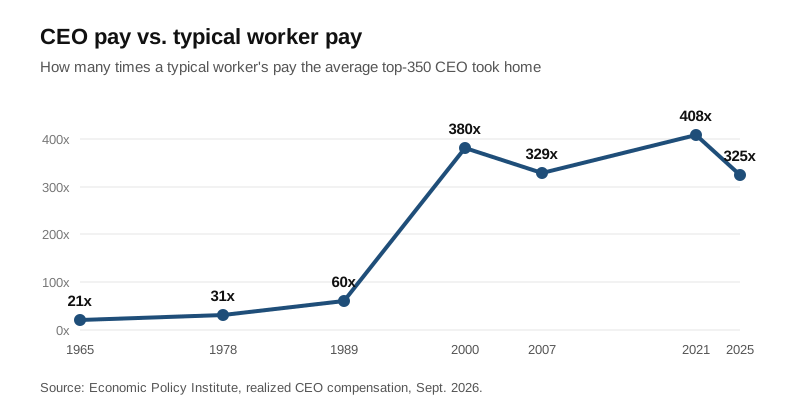
Pay at the top shows the same thing. In 2025, CEOs of the 350 largest US companies took home 325 times what a typical worker made, up from 21 times in 1965, per the Economic Policy Institute. From 1978 to 2024, CEO pay rose 1,094% and typical worker pay rose 26%, per the same group.
That's part of why I wrote about owning assets. If you run a business or lead a team, the people on the other side of this divide are your employees, your customers and your neighbors.
Where does that leave us?
I'm not trying to be a doomsayer or an alarmist. I just don't think this midterm was the status quo, and I don't think the comparisons to past elections hold up. There's a real divide forming under the surface, and AI is making it wider. That's the mindset I'm taking into this weekend.
This is my view, not financial advice.
Related reading: What Happens Next After Voters Rejected Data Centers · Jim Paulsen on What Happens If the AI Boom Slows · The Whole World Is Being Reskilled in Real Time
Related reading
Follow what I'm building and backing
I post on LinkedIn and X about the companies I back and the products I build.
Join 2,310 people following along.