Legacy
How Lifestyle Inflation Eats Every Raise
Keith Brown · Founding Partner, Outperform Ventures
Oct 21, 2026 · 10 min read
Employers and the government call about 3.6% a cost of living raise. Spending grows faster than that. How lifestyle inflation eats every raise, and the habits that put you ahead of it.
At dinner tonight, someone at the table said they had just picked up a second job. Last year they got a "cost of living" increase from their startup, which is backed by venture money and still losing money. They're already tapped out on credit cards.
That conversation stuck with me. A cost of living raise is built to keep up with a price index. It isn't built to keep up with how people live. When spending grows faster than the raise, every raise gets eaten, and the gap gets filled with debt or more hours.
On Oct. 14, Social Security announced a 3.6% increase for 2027, about $75 a month for the average retiree. Many employers use a number close to that for their own annual raises. Meanwhile, Americans owe $1.26 trillion on credit cards, and 9 million people worked more than one job in September.
Beware of little expenses; a small leak will sink a great ship.
I've written about why ownership beats a paycheck and about the K-shaped economy. This article is the everyday side of both: what happens to a normal raise, and what to do with the next one.
What is lifestyle inflation?
Lifestyle inflation is when your spending rises as your income rises. A bigger raise turns into a nicer car, a bigger apartment or more nights out. None of it feels like a big decision. Each one feels earned.
The problem is that spending sticks. A raise happens once a year. A new car payment or a new subscription keeps going every month. Over a few years, the fixed costs climb past the raises, and there's nothing left to save.
Why a 3.6% raise can feel like a pay cut
The Social Security increase is based on the CPI-W, a price index for urban wage earners. It measures a basket of goods across the whole country. Your basket may look different.
Some costs moved much faster than 3.6% this year. Gasoline prices rose 34.2% in the 12 months ending in September. If you drive a lot, rent in a hot market or pay for childcare, the average doesn't describe your year.
| Number | What it means | Source |
|---|---|---|
| 3.6% | Social Security cost of living increase for 2027 | SSA |
| $75 | Average monthly increase for retirees | SSA |
| 34.2% | Gasoline price increase, year ended September 2026 | BLS |
| $1.26 trillion | Credit card balances, second quarter of 2026 | New York Fed |
| 9.0 million | Americans with more than one job, September 2026 | BLS |
Then add the second part: your own spending has grown too. Prices went up, and so did your expectations. The raise has to cover both, and 3.6% rarely does.
How lifestyle creep happens
Most of it is small and quiet. Here is where I see it most:
- Subscriptions that renew without anyone noticing.
- A car payment that replaces a car that was paid off.
- Delivery and eating out that become the default, not the treat.
- A bigger place because the old one felt small after the raise.
- Keeping up with friends who make more or spend more.
Some of these are good choices. Buying back time with a service you value can be worth it. The test is whether you chose it on purpose or it just showed up on the statement.
The second-job trap
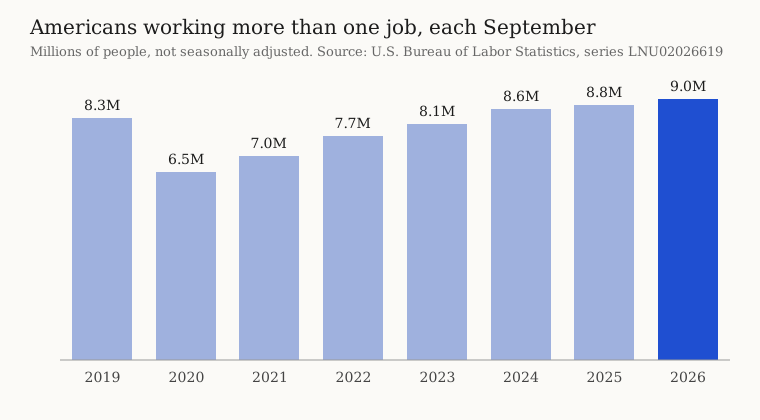
The number of Americans working more than one job hit 9.0 million in September, up from 6.5 million in September 2020 and above where it was before the pandemic.
That number likely runs low. The survey asks people about their jobs, and many don't count gig work, freelancing or cash side work as a second job. Some don't want to tell their employer, let alone a government survey.
Here is a rough estimate, and it's only an estimate. If even one in four people doing side work doesn't report it, the real number would be about 12 million (9 million divided by 0.75). Treat that as a way to think about the gap, not a statistic.
A second job isn't the problem. Working hard is good. The trap is when the extra hours only pay the minimum on the cards, and nothing gets built. Then you're working two jobs to stand still.
What credit card debt is telling us
Card balances rose $21 billion in the second quarter, to $1.26 trillion, close to the record of $1.28 trillion set last year. The New York Fed said new delinquencies on cards and auto loans "remain at elevated levels."
Debt is how lifestyle inflation hides. When the raise runs out, the card covers the difference. It feels fine until the interest is bigger than the raise.
What does living below your means look like?
Living below your means is simple to say and hard to do. It means you spend less than you bring home, every month, on purpose. The gap between the two is what lets you save, invest and sleep at night.
It doesn't mean living poorly. It means your lifestyle is set by what you decide, not by what you earn. Most people who build wealth over time do it this way: they let their income rise faster than their spending, and they keep the difference.
A few signs you're living below your means:
- You pay your credit cards in full every month.
- You could miss a paycheck without panicking.
- Your car, home and phone are paid for by your budget, not by financing you stretched to get.
- A raise feels like extra room, not like the money you were already counting on.
- You save something every month, even when it's a small amount.
If most of those aren't true today, that's fine. They're the target. Each one is a habit you can build one paycheck at a time.
A simple budget that works
A budget doesn't need an app or a spreadsheet with 40 categories. It needs to tell you where the money goes and what's left at the end. The simpler it is, the more likely you'll stick to it.
A common starting point is the 50/30/20 rule, made popular by Elizabeth Warren and Amelia Warren Tyagi in their 2005 book All Your Worth. You split take-home pay three ways:
| Share | What it covers | Examples |
|---|---|---|
| 50% | Needs | Rent or mortgage, groceries, utilities, insurance, minimum debt payments, getting to work |
| 30% | Wants | Eating out, travel, subscriptions, upgrades, hobbies |
| 20% | Savings and debt payoff | Emergency fund, retirement, investing, paying cards down faster |
If your needs already take more than half, don't give up on the idea. Use it as a direction. Push the savings line up a point or two every time your income goes up, and keep the wants line where it is.
Here is how I'd set one up in an afternoon:
- Pull the last two or three months of bank and card statements. Don't guess. Look at what you spent.
- Split everything into fixed and flexible. Fixed is the same every month (rent, car, insurance). Flexible changes (food, fun, shopping).
- Cancel anything you forgot you were paying for. Subscriptions are the easiest money most people will ever find.
- Set one monthly number for flexible spending. One number is easier to follow than ten categories.
- Check it once a week. Ten minutes on a Sunday catches problems before the month is over.
A raise, worked out
Here is a simple example with round numbers, before taxes. Say you earn $60,000 a year and get a 3.6% cost of living raise.
| Per year | Per month | |
|---|---|---|
| Raise at 3.6% | $2,160 | $180 |
| Spend half | $1,080 | $90 |
| Save half | $1,080 | $90 |
Ninety dollars a month doesn't sound like much. Do it with every raise and it stacks. After five raises, you'd be setting aside about $450 a month more than you do today, without ever cutting your lifestyle. You'd only be choosing not to grow it as fast as your pay.
The other half still goes to living. That matters. A plan that leaves no room for anything you enjoy won't last.
How much cash should you keep?
The Federal Reserve asks Americans every year how they'd pay for a surprise $400 expense. In its latest report, 63% of adults said they'd cover it with cash or its equivalent. That leaves more than a third who would borrow, sell something or not be able to pay.
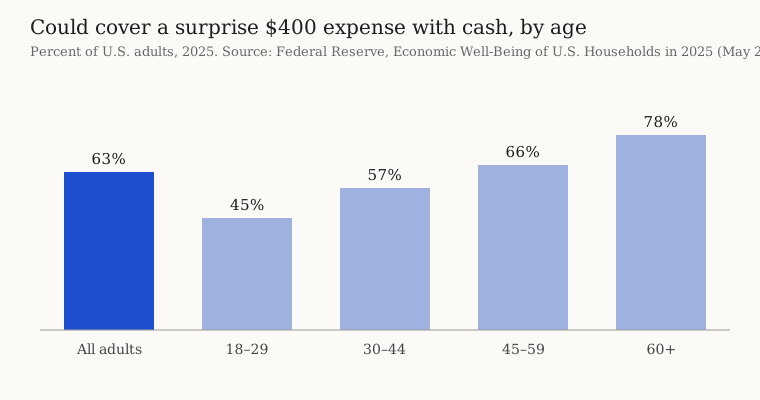
Younger adults have the least cushion. Only 45% of people 18 to 29 could cover it with cash. Those are often the same people starting their careers at startups and getting their first cost of living raises.
Cash isn't exciting, and it won't make you rich. It does something more important early on: it keeps a flat tire or a vet bill from going on a credit card. Build it in steps so it doesn't feel impossible:
- $1,000 first. Enough to handle most small surprises.
- One month of expenses. Covers a bigger repair or a gap between paychecks.
- Three to six months of expenses. The full emergency fund. Go toward six if your income is uneven or your job is less secure, like at a startup that is still losing money.
Keep it somewhere separate from your checking account, so you don't spend it by accident. A savings account at a bank insured by the FDIC protects deposits up to $250,000 per depositor, per bank, for each account ownership category. Online savings accounts often pay more interest than the big banks, so shop around.
Paying down the cards
If you already carry credit card balances, paying them down is one of the best returns you can get. Every dollar of high-interest debt you pay off is a dollar that stops costing you interest. There are two common ways to do it:
- Highest rate first. Pay the minimum on every card and put every extra dollar toward the card with the highest interest rate. This saves the most money.
- Smallest balance first. Pay off the smallest card first, then roll that payment into the next one. This builds momentum, and for a lot of people momentum is what keeps them going.
Either one works if you stick to it. While you're paying them down, stop adding new charges you can't pay in full that month. Otherwise you're filling the bucket while it leaks.
How to get ahead of lifestyle inflation
Put it all together and it comes down to a few rules you set before the money shows up.
- Save at least half of every raise. Decide this before the raise hits. If you get 3.6%, live on 1.8% more and save or invest the rest.
- Pay yourself first. Set up an automatic transfer to savings or investments the day your paycheck lands. Money you don't see is money you don't spend.
- Check every upgrade. Ask whether it buys you time or buys you status. Keep the time. Think hard about the status.
- Pay off the cards before you upgrade anything. Card interest grows faster than almost any raise.
- Build the cash cushion in steps. $1,000, then one month, then three to six months.
- Use a budget simple enough to keep. One flexible-spending number and a weekly check.
- Make the side job build something. If you work nights and weekends, aim it at something you own: a skill you can sell, a small business, or investments. I wrote more on that in what to learn from Elon Musk's net worth.
A note for leaders
If you run a company, your team hears "cost of living raise" differently than you mean it. To you, it's what the budget allows. To them, it's the number that tells them whether they're keeping up.
Be honest about what the raise is and isn't. If the company can't pay more, say so plainly, and show people other ways to build: equity, skills, a clear path to the next role. That conversation builds more trust than a number dressed up as a cost of living increase. For the longer view, see how to build generational wealth.
Start with the next raise
You can't change the last raise. You can decide today what happens to the next one. Write down the split now, half to live on and half to keep, and set up the transfer before the money arrives.
Paychecks rarely outrun inflation for long. What you own can. That's the habit I'd build first, and it's the same idea behind why I think higher prices are here for a while.
Related reading
Get my monthly newsletter
One email a month with what I'm writing and working on.
One email a month. Unsubscribe anytime.