Deep dive
What Elon Musk’s Net Worth Teaches About Ownership
Keith Brown · Founding Partner, Outperform Ventures
Oct 17, 2026 · 6 min read
You can start owning businesses without founding one or buying a whole share. The useful question is how much of your income becomes something you keep, and how long you can leave it invested.
Elon Musk’s net worth is a lesson in ownership. Forbes estimated his fortune at $839 billion in its 2026 annual ranking, using prices and exchange rates from March 1. That wealth comes largely from stakes in companies, rather than a paycheck.
Whatever brings you to Elon Musk’s net worth—curiosity, a headline or your own financial goals—the useful question is how that wealth was built. What does he own? And how can someone starting today begin owning assets too?
My own preference – and you knew this was coming – is our third category: investment in productive assets, whether businesses, farms, or real estate.
I own Tesla stock and an investment in SpaceX. That matters when you read my view of Musk’s companies. I’ve written about why I think Tesla has passed its tipping point, but this article is about a wider principle. You do not need to buy Tesla to put it to work.
Where does Elon Musk’s net worth come from?
Net worth is the estimated value of someone’s assets after subtracting liabilities. It is not the balance in a checking account. A founder can become much wealthier when investors value their company more highly, without receiving a dollar in salary.
Musk’s fortune is tied to ownership in businesses including Tesla and SpaceX. Public shares have a market price. Private company stakes require estimates. Forbes’ live ranking changes as those estimates and share prices change.
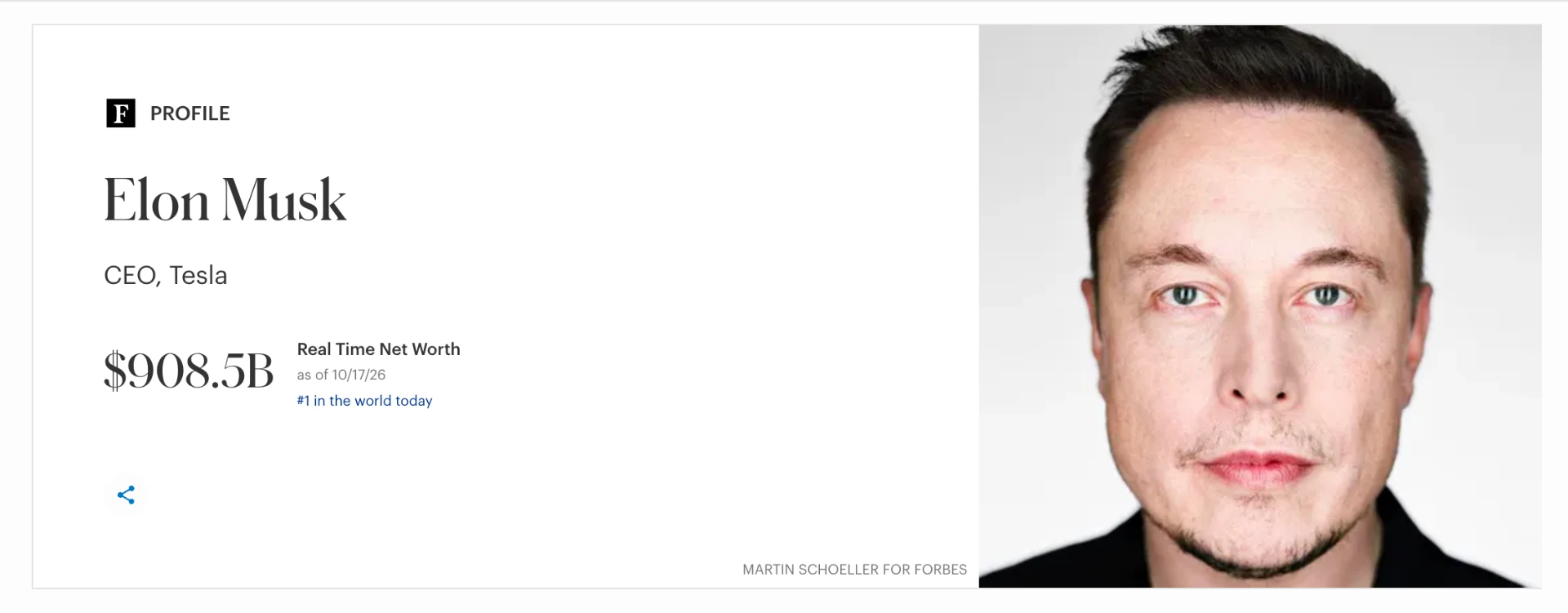
That is why I would not build a financial plan around a billionaire’s daily number. A large fortune can fall sharply. The useful lesson is that ownership gives you a share of what a company becomes, including the possibility that it becomes worth less.
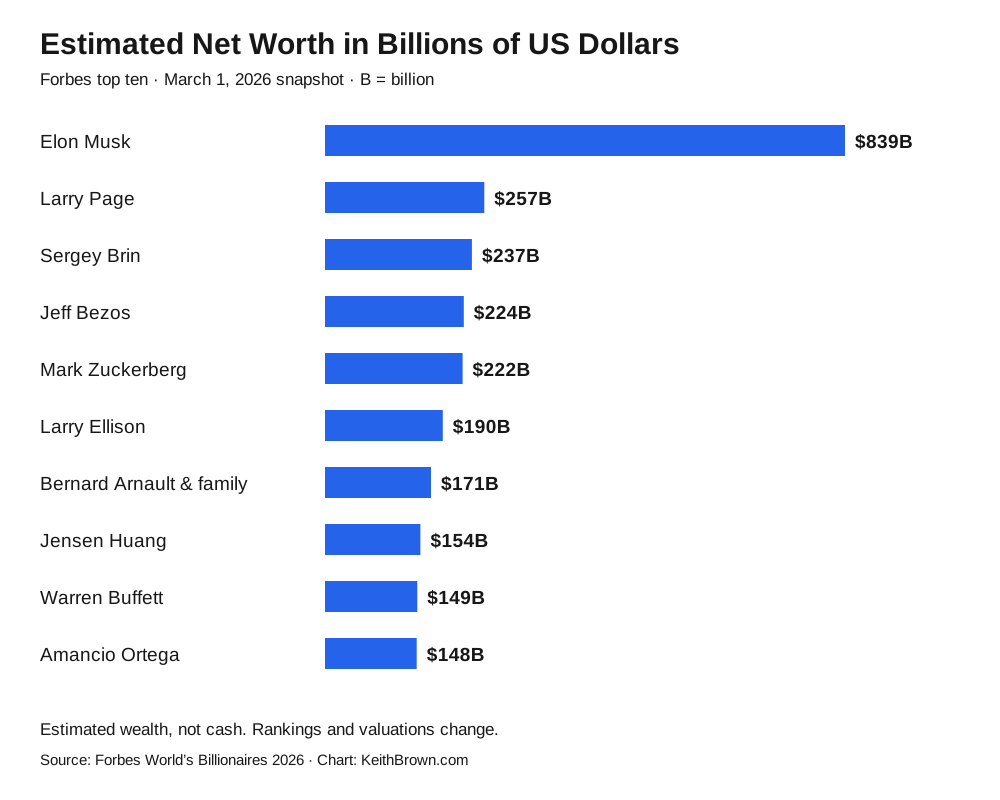
What do the ten richest people own?
Here is one consistent snapshot from Forbes’ 2026 annual list, with its March top-ten profiles. These are March 1 wealth estimates, not a claim about today’s exact ranking. Ages and countries follow the published profiles; country is not a verified current home address.
| Person / rank | Net worth | Main wealth source | Age / country |
|---|---|---|---|
| 1. Elon Musk | $839B | Tesla, SpaceX and other company stakes | 54 / US |
| 2. Larry Page | $257B | Google cofounder; Alphabet shares | 52 / US |
| 3. Sergey Brin | $237B | Google cofounder; Alphabet shares | 52 / US |
| 4. Jeff Bezos | $224B | Amazon founder; company stakes | 62 / US |
| 5. Mark Zuckerberg | $222B | Facebook cofounder; Meta shares | 41 / US |
| 6. Larry Ellison | $190B | Oracle cofounder; company stakes | 81 / US |
| 7. Bernard Arnault & family | $171B | Luxury businesses; LVMH ownership | 77 / France |
| 8. Jensen Huang | $154B | Nvidia cofounder; Nvidia shares | 63 / US |
| 9. Warren Buffett | $149B | Berkshire Hathaway; business investments | 95 / US |
| 10. Amancio Ortega | $148B | Zara cofounder; Inditex and real estate | 89 / Spain |
Wealth, age, country and business sources: Forbes’ March 2026 profiles.
The common thread is company ownership. Some founded businesses. Buffett invested in them. Arnault’s entry includes family wealth. Their paths differ, but the largest part of these fortunes did not come from accumulating salary payments.
Can a paycheck keep up with inflation?
A paycheck can grow faster than inflation. People earn raises, develop valuable skills and change jobs. I would not tell someone that hard work or a good career is pointless.
My concern is depending on a paycheck alone. If everything you earn gets spent, there is little left to grow. If your pay stays flat while prices rise, the same income buys less. You can work more hours and still feel further behind.
Buffett’s 2011 letter describes investing in terms of future purchasing power after taxes. That is the right question to ask. Having more dollars later matters less if those dollars buy less.
Owning a productive asset gives you another possible source of growth. A business can earn profits, reinvest and become more valuable. None of that is guaranteed, and stocks can fall during inflation. Buying at a bad price can make a good company a poor investment.
How do you start owning assets with little money?
You can buy less than one share. The SEC’s fractional-share investing bulletin explains how brokers let investors purchase a slice of a stock. Availability, minimum amounts, trading rules and transfer restrictions vary.
If a share costs $200 and your broker permits a $10 purchase, you would own roughly 0.05 shares before fees or price changes. You receive a proportionate economic stake. The small purchase does not remove the risk of the company losing value.
A diversified fund can be a simpler starting point than trying to choose the next Musk. It holds investments in multiple businesses. Investor.gov explains diversification: spreading investments can reduce concentration risk, but it cannot prevent every loss.
- Protect the next few months. Keep money for bills and emergencies accessible. Money needed soon does not belong in volatile stocks.
- Review expensive debt. Paying down high-interest balances can be more useful than chasing an uncertain market return.
- Check your workplace retirement plan. Understand any employer match, fees and vesting rules. An account is a container; the investments inside it still matter.
- Choose an amount you can repeat. Ten dollars is a beginning if it fits your budget. Compare broker fees, fund costs and fractional-share rules before buying.
- Make it consistent. A recurring contribution can help you build the habit. It does not guarantee a profit or make an unsuitable investment safe.
Should you get a second job to invest?
If you have the capacity, evening or weekend work can create money to invest. That might be a second job, a few freelance projects or a small service business. There is nothing wrong with starting that way.
Give the extra work a purpose and a limit. Decide what you want to save and when you will review whether the work is worth continuing. Protect your health, family responsibilities and main job.
Count the costs first. Transport, childcare, supplies and taxes can reduce what looks like a good hourly rate. Check employer restrictions before taking outside work. Extra income helps only when enough of it remains after those costs.
If you cannot add hours, look at what would improve your main income over time. A skill, qualification or better role may be more valuable than another shift. There are seasons when caring for yourself or your family must come first.
Own businesses without copying a billionaire’s risks
The top-ten list shows winners after the fact. It leaves out founders whose companies failed and investors who lost their savings. It is evidence of how these fortunes were built, not proof that concentrating everything in one business works for everyone.
If your salary and stock already come from the same employer, a downturn can hurt both together. I covered that in what your stock options are worth. Ownership deserves a plan for losses as well as gains.
I also think about building generational wealth and using wealth to help the next generation. More ownership should give you more choices about your time and the people you can help.
This is general education, not a recommendation to buy a particular security. Your debts, savings, taxes and time horizon matter. Tesla and SpaceX are disclosed above because I own them, not because they are the right starting investments for you.
Today, look at what you own. Then choose one manageable step: review your retirement plan, compare a diversified fund, or set aside the first amount you can afford. Use the income you earn to build something you can keep.
Related reading
Get my monthly newsletter
One email a month with what I'm writing and working on.
One email a month. Unsubscribe anytime.