Legacy
Americans Are Wealthier Than Ever and Giving Less of It
Keith Brown · Founding Partner, Outperform Ventures
Oct 13, 2026 · 3 min read
Household wealth has roughly doubled, and giving has shrunk as a share of it. When the top keeps more and gives less, the divide grows. Success is good. Hoarding is the problem.
Paul Tudor Jones was on CNBC's Squawk Box this morning. Between calls on the market, he talked about what many people now call the K-shaped economy: extreme wealth at the top, and real poverty at the bottom, growing apart at the same time.
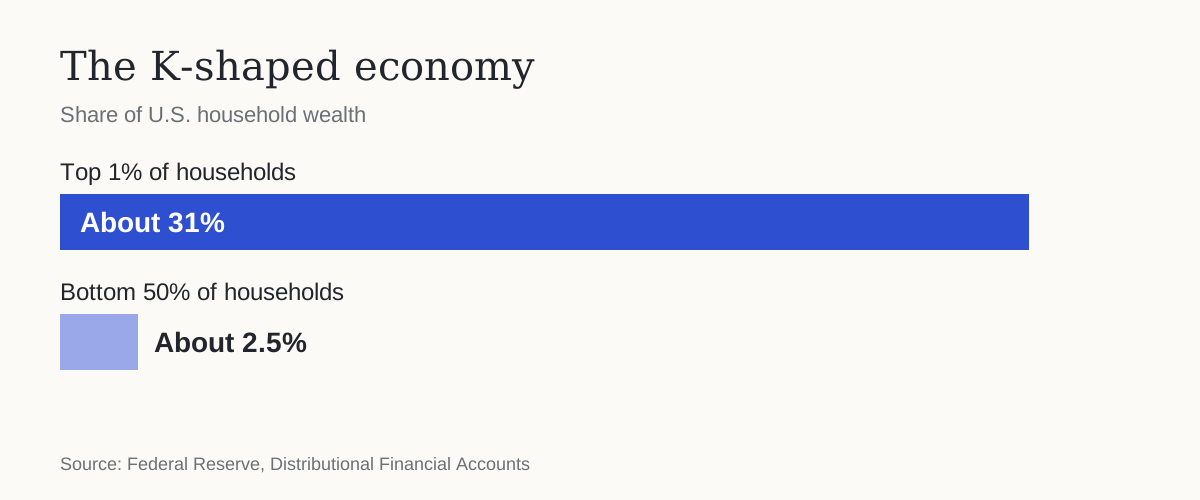
The numbers back him up. The top 1% of U.S. households hold about 31% of the country's wealth, while the bottom half holds about 2.5%, according to the Federal Reserve. This morning I wrote that we should back more entrepreneurs. This is the other half of that idea.
Here's what stands out to me. Household wealth has roughly doubled, and the share of it we give away has gone down.
What is a K-shaped economy?
Picture the letter K. One arm goes up, and one goes down. The people who own stocks, homes and businesses keep rising. The people living on a paycheck fall further behind.
Edward Jones describes it the same way: higher-income households are largely prospering while lower-income households fall behind. Rising prices for food, rent and gas hit the bottom hardest, and rising stock prices help mostly the top.
The term took off after 2020, when wealthy households bounced back quickly and working families struggled for years. Six years later, the gap is still there.
Paul Tudor Jones gives back
Jones doesn't just talk about it. He founded the Robin Hood Foundation in 1988 to fight poverty in New York City. During the pandemic, it provided more than $340 million in relief over two years, CNBC reported.
That's what I respect. He made a fortune, and he spends a lot of his life reaching back to the people who didn't get the same shot.
Wealth doubled. Giving didn't.
U.S. household net worth has roughly doubled since the early 2010s, to more than $160 trillion, according to the Federal Reserve. Americans gave about $590 billion to charity in 2024, according to Giving USA.
That giving is a record in dollars. As a share of all that wealth, it has gone down. In 2010, Americans gave about half a percent of household wealth. Today it's closer to a third of a percent.
The idea that anyone can make it only holds if the people who make it pull up the next generation.
Capitalism needs giving to work
This connects to what Jeff Bezos said this week. Success is not villainy, and I agree. Building something people love is a good thing. The problem is hoarding.
Capitalism isn't working for a lot of people right now because hoarding creates a divide. When the top keeps it all, the bottom starts to believe the system is rigged. Giving back is what keeps capitalism worth believing in.
The people I admire most do both. Warren Buffett and Bill Gates started the Giving Pledge in 2010, asking the world's wealthiest people to give away most of their wealth. Buffett has pledged more than 99% of his.
If you're in the luckiest 1% of humanity, you owe it to the rest of humanity to think about the other 99%.
Five ways to give back
- Mentor someone. An hour a month with a young person or a first-time founder can change where they end up.
- Give locally. Food banks, schools and shelters in your own town are where a small gift goes furthest.
- Hire people who didn't get a shot. Look past degrees and resumes, and train people up.
- Back first-time founders. Buy from them, introduce them, or write a small check if you can afford to lose it.
- Give your time. You don't have to be rich to give back. Showing up counts.
If you're thinking about what you leave behind, I wrote about how to build generational wealth that outlives you.
Pull up the next generation
If you've done well, you didn't do it alone. Don't pull the ladder up. Pull up the next generation.
Related reading: How to Use AI Skills to Become Better at Your Job · How to Plan Five Years Out When AI Changes Everything in Six Months · Your Identity Was Never What You Do for a Living
Related reading
Get my monthly newsletter
One email a month with what I'm writing and working on.
One email a month. Unsubscribe anytime.