Legacy
How to Spot Aphorism Slop in AI Writing
Keith Brown · Founding Partner, Outperform Ventures
Oct 23, 2026 · 6 min read
AI adds quotable lines that sound wise and carry no facts. I gave the habit a name. Here's how to spot it, with examples and the one test I use on every draft.
This morning I was training Claude on my writing voice. We were editing my article on California's billionaire tax, and one line stopped me: "The name on the tax is rarely the person who carries it in the end." I hated it, and I couldn't say why.
So I asked Claude why it sounded like AI. It gave the pattern a name: aphorism slop. You know the feeling when you've disliked something for months and someone finally names it? Since then I've seen it everywhere.

Aphorism slop is a line that sounds like a quote but has no facts in it. AI writes it when it wants a point to feel important. It reads well for a second, then you notice it could sit in almost any article about anything.
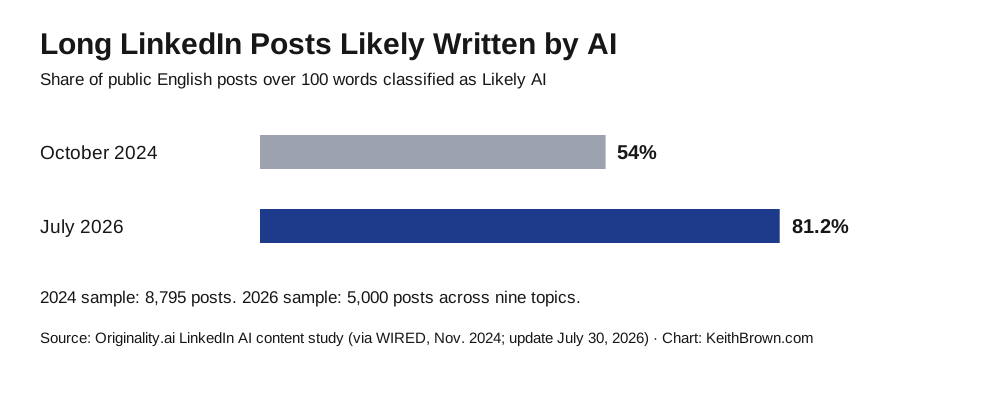
There's a lot of it to notice. Originality.ai found that 54% of longer English posts on LinkedIn were likely written by AI in October 2024, WIRED reported. Its July 2026 update put the share at 81.2%, and LinkedIn has started rolling out a "Seems like AI slop" option so members can flag posts.
Never use a metaphor, simile or other figure of speech which you are used to seeing in print.
Orwell wrote that about tired phrases in newspapers 80 years ago. AI has the same habit at a much bigger scale, because it learned from almost everything we've ever published.
What does aphorism slop look like?
It usually shows up at the end of a paragraph or the end of a post, where the writer wants a strong finish. A few examples:
- "The name on the tax is rarely the person who carries it in the end."
- "Money always finds a way."
- "In the end, someone always pays."
- "Leadership isn't about having the answers. It's about holding the space."
- "Great founders don't chase growth. They build it."
Each one sounds finished. None of them tells you who, what, when or how much. If you asked the writer what the line means, you'd get a second paragraph that should have been there in the first place.
How to spot it
There are five tells. Most slop lines have two or three of them at once.
- No names or numbers. The sentence has no person, company, date or dollar amount in it.
- Big time words. "In the end", "at the end of the day", "always", "rarely". They add weight without adding anything you can check.
- A metaphor where a plain claim would do. "Carries the bill", "the cost lands on", "works its way down". Each one hides who is paying or what is moving.
- It fits anywhere. Drop it into an article on a different topic and it still works.
- It's built to be quoted. The rhythm feels like a poster, a speech or the last line of a LinkedIn post.
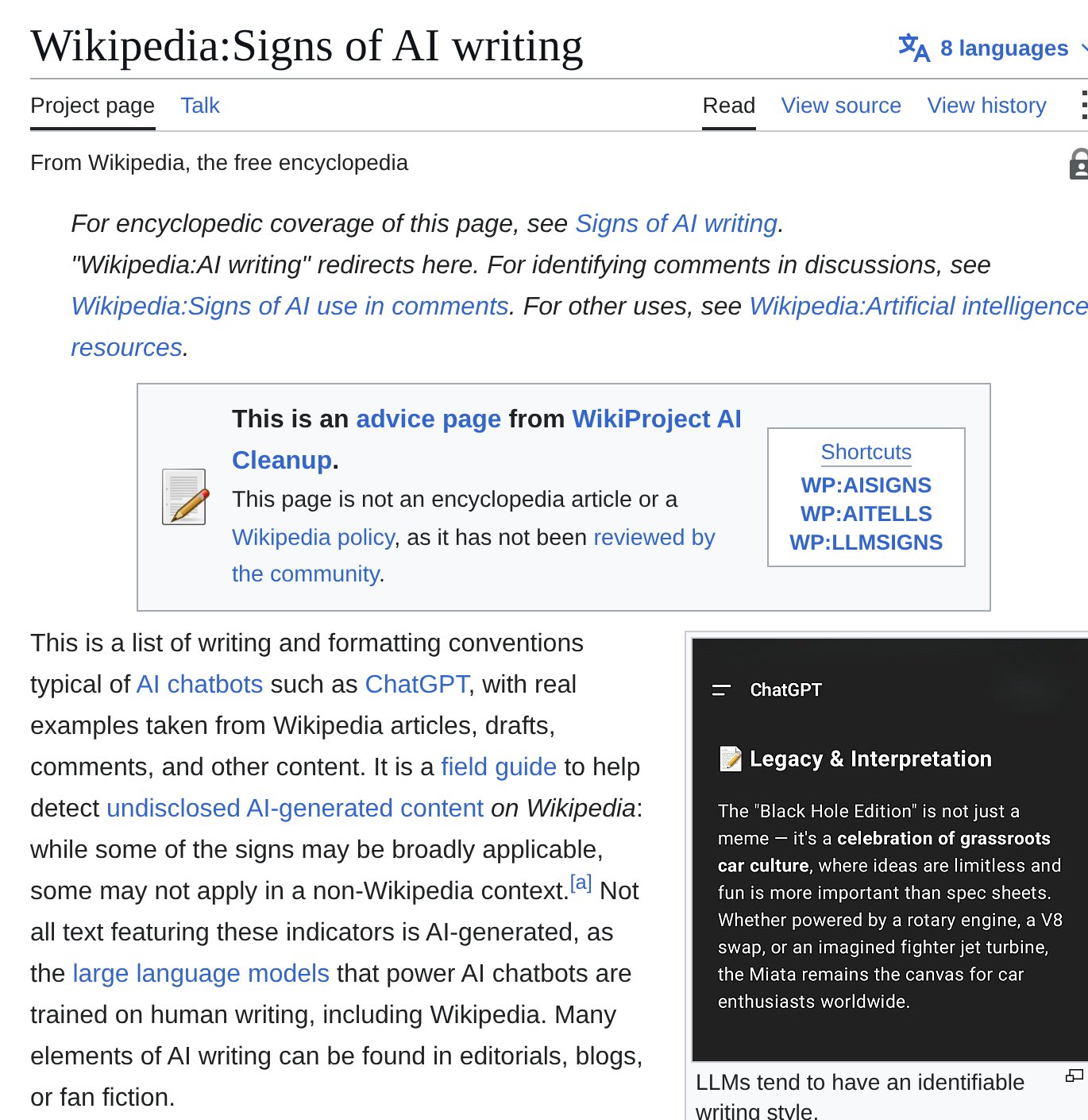
I'm not the first to notice these habits. Wikipedia volunteers have kept a page called Signs of AI writing since 2023. It lists undue emphasis on symbolism and importance, the rule of three, and "negative parallelism", the "it's not X, it's Y" move.
Aphorism slop belongs on that list. It's the line that tries to sound important when the writer has nothing specific to say.
The poster test
The fix I added to my voice skill is one question. Could this sentence hang on an office wall, or sit in someone else's newsletter, without changing a word? If the answer is yes, it goes.
Then I replace it with the specific thing it was standing in for. That's usually a name, a number or what happened next. Here are real lines from my billionaire tax draft, before and after.
| Aphorism slop | Plain and specific |
|---|---|
| The name on the tax is rarely the person who carries it in the end. | Prop. 40 is written for a few hundred billionaires. If they leave, the state still has to fill the gap. |
| Taxes that start at the top have a habit of working their way down. | The alternative minimum tax was created after 155 high earners paid no federal income tax in 1966. By 2017 it reached more than 5 million taxpayers. |
| The cost lands on everyday Californians. | Everyday Californians pay through higher prices and a weaker state budget. |
The after version is less pretty. A reader can check it, use it or disagree with it. The before version only asks them to nod.
Why does AI write like this?
Language models predict the most likely next words. After a strong paragraph, the most common move in human writing is a tidy closing line, because that's what millions of blog posts, speeches and LinkedIn posts do. The model copies the shape without the substance.
Many models are also tuned on what people rate highly. A quotable line feels good the first time you read it. You only notice how empty it is when you see the same move in every post in your feed.
Why a name helps
Having a name for it helped me more than any rule I'd written before. There's research behind that. In a 2007 UCLA study, Matthew Lieberman's team found that putting a feeling into words lowered activity in the amygdala, the part of the brain that reacts to strong emotion.
The study was about emotions, not editing, but the idea carries over. A name turns a vague feeling into something you can point at. Before this morning I'd tell Claude "this sounds like AI." Now I can say "that's aphorism slop, give me the fact," and it knows what to fix.
How to keep it out of your writing
If you use AI for posts, articles or emails, here's what I'd do this week.
- Name it in your instructions. Add a line to your custom instructions or skill: "No aphorisms or maxims. Never close a point with a quotable general truth. Say who, what and how much." I wrote about using AI skills to get better at your job, and this has become one of my most useful ones.
- Check the last line of every paragraph. That's where slop hides. Read each closing line by itself and run the poster test.
- Ask for the fact behind it. When a line sounds wise, ask the AI what specific fact it stands for. Keep the fact and delete the line.
- Read it out loud. If you'd never say it to a friend over coffee, rewrite it. I write most of my articles by talking, so these lines stand out fast.
- Keep your own strong lines. A line you said, about something you lived, isn't slop. "I grow people and businesses" is mine, and it stays.
What this means for leaders
More of what your team, customers and investors read is written with AI, and they're getting good at spotting it. LinkedIn now gives them a button to say so.
Leaders build trust with specifics: the number you missed, the customer you lost, the decision you'd make again. A slop line makes the reader wonder whether you wrote the rest of the post.
Use AI. I use it every day, including for this site, which I rebuilt after leaving WordPress. Just make it give you the fact.
Try the poster test on your last post. If a line fails, replace it with the fact it was hiding.
Related reading
Follow what I'm building and backing
Updates on the companies I invest in, the products I build and what I learn along the way.
- New companies I'm backing through Outperform Ventures
- Products I'm building, as they launch
- What's working and what isn't, as it happens
Unsubscribe anytime.