Deep dive
Why California's Poor Will Pay the Billionaire Tax
Keith Brown · Founding Partner, Outperform Ventures
Oct 23, 2026 · 9 min read
California's billionaire tax sounds like a bill for a few hundred people. Meta built Mark Zuckerberg a way to pay it without giving up any control, and the cost flows back to everyday Californians through higher prices.
On Wednesday, Meta told investors it had created a new kind of stock. The reason, in part, was a tax bill its founder might owe. California's Proposition 40, on the ballot Nov. 3, would charge a one-time 5% tax on residents worth more than $1 billion. Mark Zuckerberg is worth about $225 billion, according to CNBC.
Here's my honest read. Taxes like this are sold as a bill for a few hundred billionaires. In practice, the people with the most money also have the best lawyers, the most options and the power to change the rules around them. Once again, the wealthy don't lose. Everyday Californians pay through higher prices and a weaker state budget.
Warren Buffett said it plainly years ago. In a 2011 New York Times op-ed, he wrote that he paid 17.4% of his taxable income, "a lower percentage than was paid by any of the other 20 people in our office." I've written about the same gap in Own Assets or Be Left Behind. This story is the same lesson from a different angle.
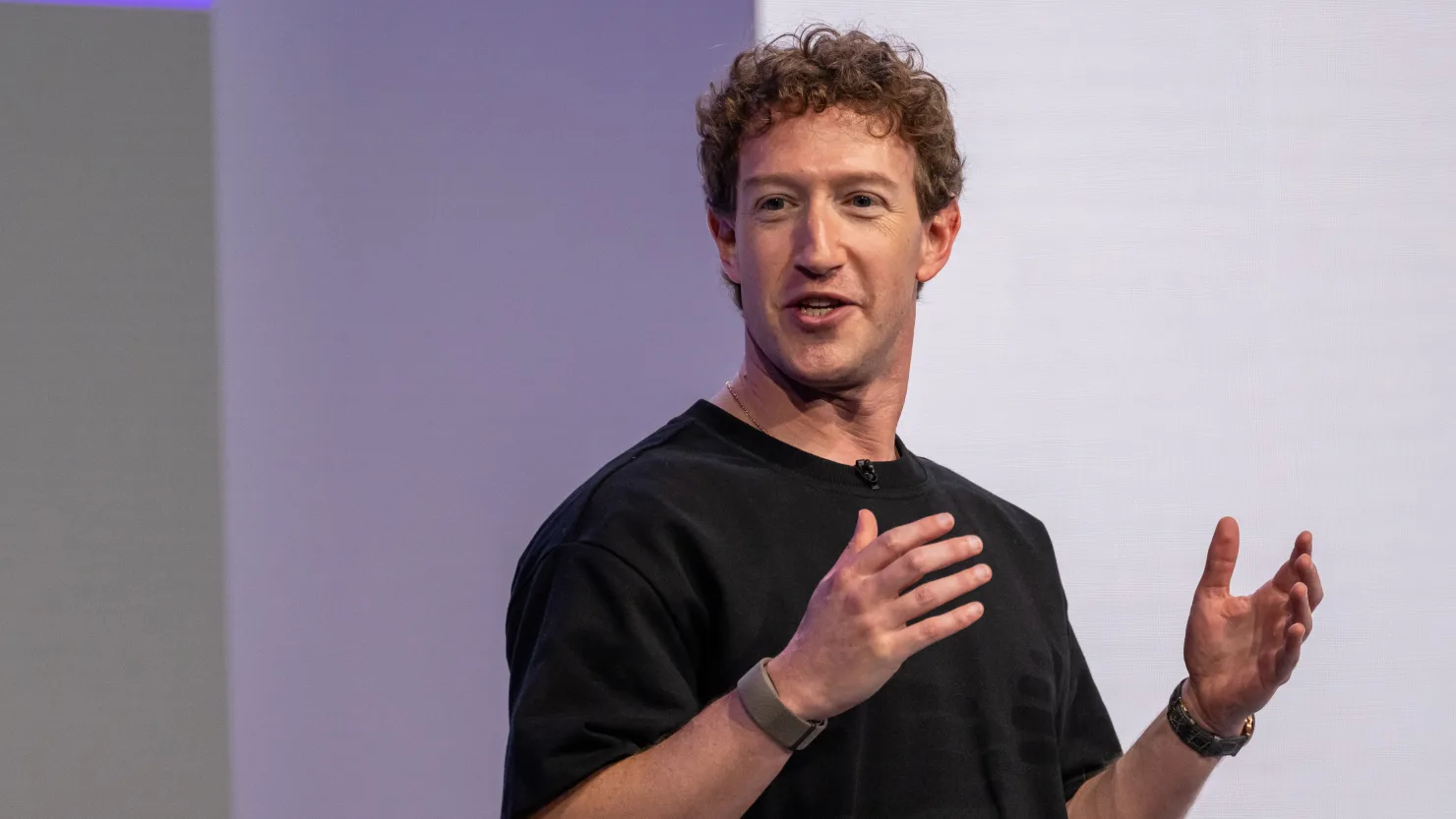
How will California's poor pay this tax?
The tax is aimed at a few hundred billionaires. The bill reaches everyone else in two ways: through the state budget and through prices.
It reminds me of a scene in The Big Short. Steve Carell's character, Mark Baum, stands up at an investor conference in Las Vegas and says what he's learned about who carries the cost when big money gets it wrong: "At the end of the day regular people are going to pay for all of this. Because they always, always do." The line is from a movie about 2008, but it fits this tax too.

The budget depends on the people leaving
California's budget runs on a small group of people. The top 1% of households pay roughly 40% to 50% of the state's personal income tax, according to the Hoover Institution. That tax supplies about 60% of the General Fund.
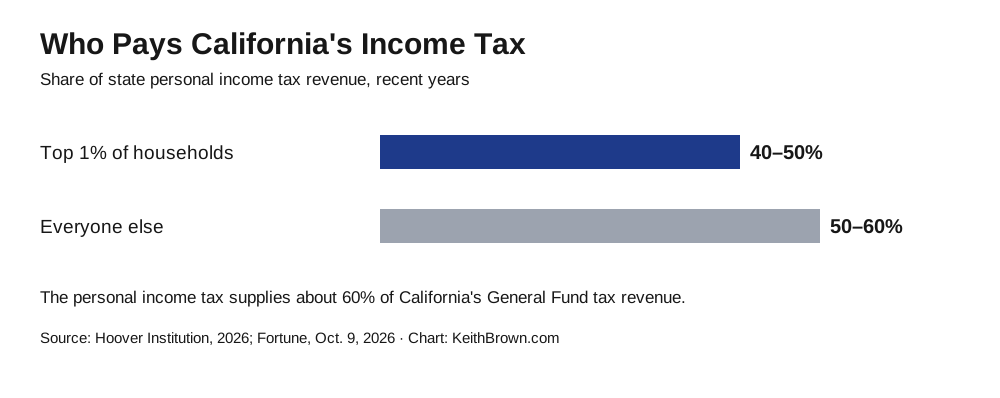
A wealth tax is paid once. Income tax is paid every year, but only by people who stay. The state's own Legislative Analyst's Office says Prop. 40 would probably bring in "tens of billions of dollars," spread over several years, and that the amount is "very hard to predict."
Hoover Institution economists Joshua Rauh and Benjamin Jaros ran the numbers in an October 2026 paper. They estimate nearly 30% of the tax base has already left the state. They put collections at about $30 billion, less than a third of the $100 billion backers projected. After counting the income taxes lost when billionaires leave for good, they estimate the net value to California at negative $38.9 billion.
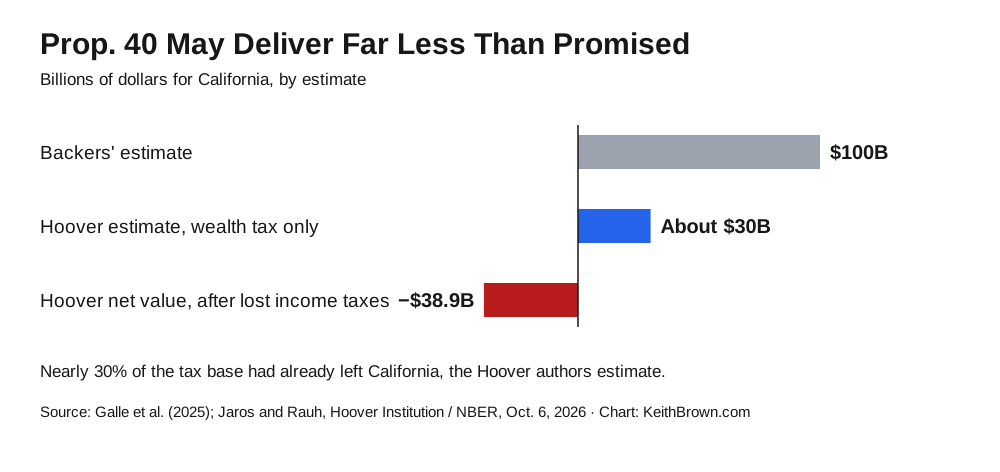
Not everyone agrees with that math, and backers dispute it. But when a budget built on a few thousand taxpayers loses some of them, the gap gets filled the same two ways every time. Programs get cut, or taxes go up on people who can't move. Medi-Cal, the state's health program for low-income people, is where most state health money goes, so it's where cuts hurt most.
Prices are already climbing
The second path runs through Meta itself. Almost all of Meta's revenue comes from ads, and advertisers are already paying more. In the third quarter of 2026, the average price per ad rose 23% in the US and Canada and 14% worldwide, while ads shown grew only 10%, Meta reported.
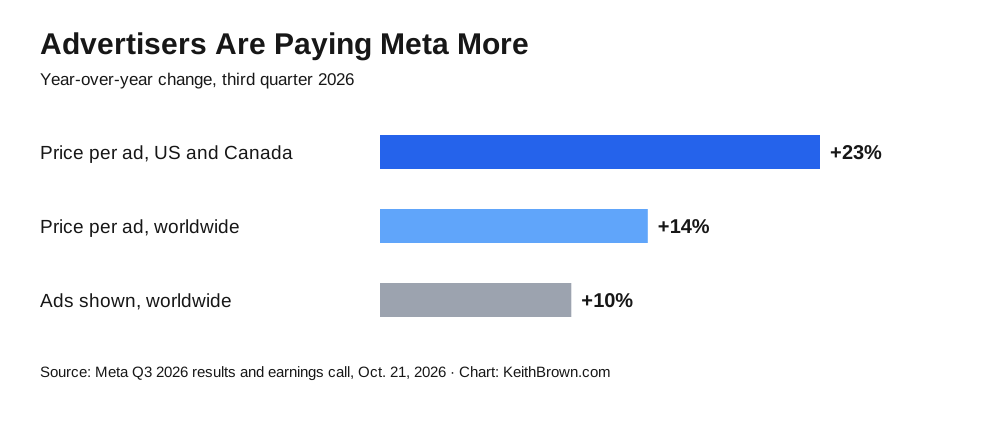
Meta is also spending heavily. It put $34.9 billion into data centers and servers last quarter, and free cash flow turned negative, according to its earnings call. It plans to use the new Class C stock to raise money, pay employees and buy companies.
More than 250 million small businesses use Meta's apps, Axios reported. A restaurant, a dentist or an online shop that pays more for ads passes that cost on to customers, because that's how a small business survives. The tax doesn't set Meta's ad prices. But every cost a company like Meta carries ends up with advertisers, and advertisers send it down to everyday Californians.
That's the disconnect between what sounds great in principle and how it plays out. Mark is rich because he knows how to play the game better than the government. He has proven that again here. The people paying the price are the ones the tax was meant to help.
What did Meta do for Zuckerberg?
Meta's board approved a new non-voting Class C common stock, effective in January. Every holder of Class A and Class B stock gets one Class C share for each share they own, according to Meta's SEC filing. Zuckerberg can sell 20% of his new shares right away "for any reason," including to pay a Prop. 40 tax bill. The rest unlock over eight years, as long as he keeps leading the company.
In return, he committed to live in California for eight years, unless circumstances make it "prudent or advisable" to live elsewhere. The filing also pointed out his salary is $1 a year. Without the plan, it said, he "would effectively be paying to serve as the Company's chief executive officer while residing in California."
Zuckerberg controls about 60% of Meta's vote. Selling his voting shares to pay the tax would have chipped away at that. Reuters reported he told Meta he was considering moving his primary residence out of the state. The board found him another way.
What Meta's other owners give up
Because every shareholder gets the same dividend, nobody's slice of Meta shrinks on day one. The change is about control. Future fundraising, employee pay and acquisitions can now use shares with no vote, so Zuckerberg's control is locked in for years.
Most people who own Meta hold it through an index fund, a target-date fund or a 401(k). They keep their slice. They also lose any realistic chance of ever having a say. The filing said Zuckerberg would not support raising money in a way that reduced his voting power, and the board built the plan around that.
The other way out is to leave
Zuckerberg is staying. Many of his peers didn't wait for the vote. Here's where some of the best-known tech billionaires live today, based on CNBC's reporting.
| Founder or CEO | Company | Where they live |
|---|---|---|
| Mark Zuckerberg | Meta | California, committed for eight years |
| Jensen Huang | Nvidia | California |
| Elon Musk | Tesla, SpaceX | Texas |
| Michael Dell | Dell | Texas |
| Larry Page | Florida, moved ahead of the vote | |
| Sergey Brin | Florida, moved ahead of the vote | |
| Larry Ellison | Oracle | Florida |
| Jeff Bezos | Amazon | Outside California |
When the people a tax was written for can pack up and move, the money they were meant to pay goes with them. The bill for the schools, roads and services they no longer fund still has to be paid by someone. That someone is usually the people who can't move.
Money and jobs follow the people who leave. Bill Ackman, the billionaire founder of Pershing Square, made that point about New York when Carnegie Mellon announced a new 35-acre AI and robotics campus in Miami. He wrote that the campus "could have been built in NY" with a more business-friendly tax policy, and that instead "we vilify our most successful business leaders."
This campus could have been built in NY if we adopted a pro-business sensible tax policy approach to our residents. Instead, we vilify our most successful business leaders and make it challenging to do business here.
— Bill Ackman (@BillAckman) View on X
He was talking about New York, but California faces the same choice. A campus like that brings construction jobs, research jobs and thousands of students who spend money in the local economy. When it goes somewhere else, the people who would have worked there don't get a vote.
What other countries learned
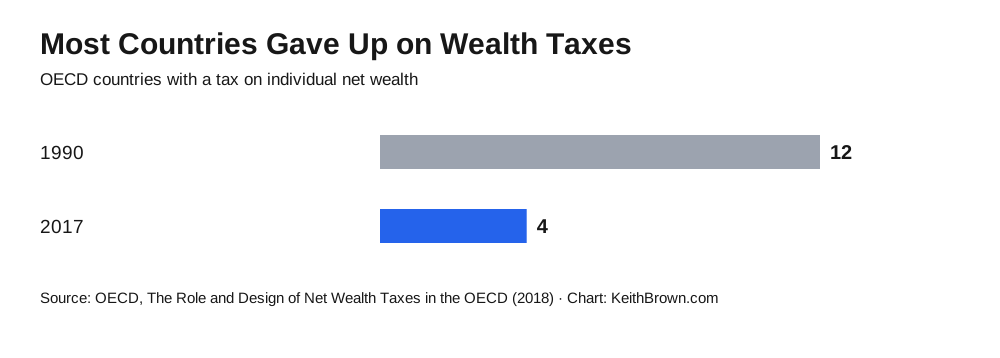
California isn't the first to try this. Twelve OECD countries taxed individual wealth in 1990. By 2017 only four still did, the OECD found, after concerns about cost and the limited money they raised.
France is the best-known case. One 2008 study by economist Eric Pichet estimated about €200 billion left the country after France brought back its wealth tax in 1988, and concluded the tax shifted the burden "from wealthy taxpayers leaving the country onto other taxpayers." France replaced it with a narrower tax on real estate in 2018.
Not every billionaire feels the same way. Jensen Huang, worth about $185 billion, told CBS Sunday Morning that paying the tax would be a "privilege." Polling is close either way. A recent Citrin-Politico poll had 46% in favor and 43% against, CNBC reported, and the measure needs a majority to pass.
Why do the wealthy keep winning?
It isn't luck. They own things, and owning things gives you choices. You can move your home, change your share structure, time your sales and hire people to plan years ahead. A paycheck doesn't come with those options.
Taxes on the rich have reached everyone else before
Two federal taxes started with the rich and later reached millions of ordinary families. The federal income tax began in 1913 as a 1% tax on income over $3,000, and it reached about 3% of Americans, according to records of the Revenue Act of 1913. Today nearly every working household files.
The alternative minimum tax followed the same path. Congress created it in 1969 after Treasury told lawmakers that 155 people earning more than $200,000 had paid no federal income tax in 1966. By 2017 it reached more than 5 million taxpayers, the Tax Policy Center estimates, many of them upper-middle-class families who never thought of themselves as rich.
| Tax | Who it was written for | Who it reached |
|---|---|---|
| Federal income tax, 1913 | About 3% of Americans | Nearly every working household |
| Alternative minimum tax, 1969 | 155 high earners | More than 5 million taxpayers by 2017 |
| Wealth taxes in Europe | The very rich | Repealed in most countries by 2017 |
| Prop. 40, 2026 | A few hundred billionaires | To be decided |
Prop. 40 is called a one-time tax. It also lifts a limit in California's constitution on taxing stocks and other intangible property, with no end date, the Hoover Institution notes. Critics call that a Trojan horse for future taxes. Backers say the measure only reaches billionaires and that courts would block any attempt to stretch it. Either way, it's worth knowing what you're voting on.
Questions to ask before you vote
I'm not here to tell anyone how to vote. That's your call. But I'd ask the same questions I ask about any big decision in a business.
- Who pays if the billionaires leave? Prop. 40 is written for a few hundred people. If they move, the state still has to fill the gap.
- What happened when others tried it? Look at the countries that repealed wealth taxes and what their own governments said about why.
- What does the state lose if people leave? Count the income taxes, jobs and companies that move, not just the money collected once.
- Can the rules change later? Look for what the measure allows lawmakers and future ballots to do next.
Own something
Owning things is what gives the wealthy their choices: where to live, when to sell, how to structure a company. The best answer I know is to become an owner yourself. I wrote about how in how to build generational wealth, and why it matters in the K-shaped economy. The gap keeps growing for people who own nothing.
Related reading
Follow what I'm building and backing
Updates on the companies I invest in, the products I build and what I learn along the way.
- New companies I'm backing through Outperform Ventures
- Products I'm building, as they launch
- What's working and what isn't, as it happens
Unsubscribe anytime.