Legacy
How Leaders Can Use AI to Recover From Hard Weeks
Keith Brown · Founding Partner, Outperform Ventures
Oct 23, 2026 · 5 min read
Most leaders use AI for work. I've started using it to plan recovery: saunas, cold plunges, quiet places to think, and better choices when I'm tired.
I was in Colorado on a business trip with a full calendar. Before my first meeting, I drove out to the Garden of the Gods, walked a red dirt trail and sat down to meditate with Pikes Peak in front of me. Twenty quiet minutes there did more for my week than another hour of email would have.

That stop wasn't luck. I had asked AI to help me plan the trip around recovery as well as meetings. Most leaders already use AI to write, research and analyze. Fewer use it for the thing that holds everything else up: their own health.
Why leaders need a recovery plan
Executives put more strain on their bodies than we like to admit. Long days, late dinners, flights and constant decisions add up. The CDC reports that 39% of adults aged 45 to 64 don't get the recommended seven hours of sleep, the highest of any age group, and that short sleep is linked to high blood pressure and heart disease.
We think, mistakenly, that success is the result of the amount of time we put in at work, instead of the quality of time we put in.
We plan our companies carefully. We rarely plan recovery at all. I've written before about keeping body and mind in balance. AI has made that much easier to do on a busy week, because it takes the planning off my plate.
Recovery is where AI helps me most
My biggest use is simple. When a week has been hard, I tell AI what happened and ask for a recovery plan for the next few days. How much I slept, how much I traveled, what I ate, and what I have access to. It comes back with a short plan I can follow.
The plan usually includes three things I've come to rely on:
- Sauna sessions, a few times a week when I can.
- Cold plunges, kept short.
- Quiet time to meditate, ideally outside.
AI is good at explaining why each one helps and how to fit it around meetings. When I understand why a habit works, I'm far more likely to keep doing it.
What the research says about sauna
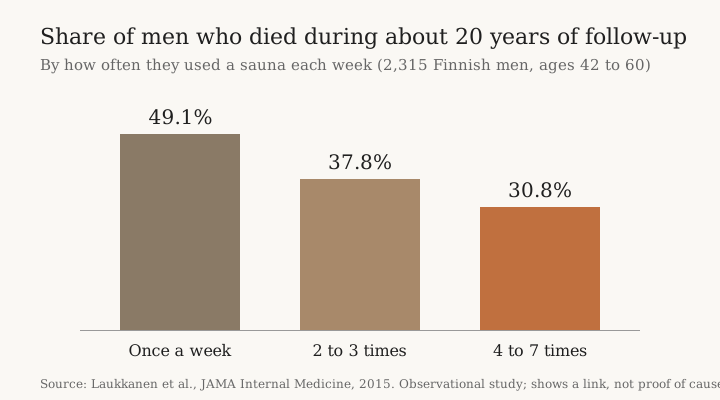
The best-known study followed 2,315 middle-aged men in Finland for about 20 years. Men who used a sauna four to seven times a week had a much lower risk of sudden cardiac death than men who went once a week, even after adjusting for other risk factors.
That doesn't prove the sauna caused it. People who sauna often may live differently in other ways. But it's one of the reasons I treat sauna as part of my week rather than a luxury.
Cold plunges and quiet time
For cold water, a 2021 study in Cell Reports Medicine of winter swimmers in Denmark found regular cold exposure changed how their bodies handled temperature. The research is still young. I use cold plunges because I feel clearer afterward, and I keep them short.
Meditation has stronger support. The National Institutes of Health says mindfulness practices may help with stress, anxiety and sleep. For me it's the habit that resets everything else. It also costs nothing.
A word of care: sauna and cold water both put stress on the heart. If you have heart problems, high blood pressure or are pregnant, talk with your doctor first, and never mix either one with alcohol.
Plan the trip around recovery
Travel is where my habits used to fall apart. Now, when I book a trip, I ask AI to find hotels near my meetings that have a real gym, a sauna or a pool, and a juice bar or healthy breakfast nearby. I also ask for a quiet place within 20 minutes where I can walk or meditate.
That's how I ended up at Garden of the Gods. It took one prompt. Without it I would have stayed in my room and opened the laptop.
After a stressful trip, I ask for a recovery plan for the first two days home. Earlier nights, a sauna, a long walk, simple meals. It's the same idea as planning the week after a board meeting.
Make good choices easier when you're tired
By the end of a long day, willpower is low. That's when the heavy meal or the skipped workout happens. I stopped treating that as a character flaw and started planning for it.
- Before a business dinner, I paste in the menu and ask for the three best options to stay sharp the next morning.
- Before a long event, I ask what to eat beforehand so I don't arrive hungry.
- For hard weeks, I keep a short list of comfort meals that don't leave me feeling worse.
The decision is made before I'm tired. I just follow it.
Understand your lab results and your doctor
When I get blood work back, AI helps me understand it in plain words. What each marker means, which numbers are a little off, and what questions to ask. It keeps me from worrying about a number that turns out to be minor.
The same goes for doctor's advice. If I'm told to watch something, AI helps me turn that into a few concrete habits. Then I take the questions back to my doctor. AI helps me prepare for that conversation. It doesn't replace it.
Be careful what you upload. Health records shared with a consumer AI tool usually aren't covered by HIPAA the way they are at your doctor's office. I remove my name and account numbers before sharing anything.
Prompts to try this week
- "I had a stressful week: [what happened, sleep, travel]. I have a gym with a sauna. Give me a simple three-day recovery plan."
- "I'm traveling to [city] for meetings near [address]. Find hotels with a good gym and sauna, healthy food nearby, and a quiet place outdoors to walk or meditate."
- "Here's the menu for tonight's dinner. I want to feel sharp tomorrow morning. What are my three best options?"
- "Explain these lab results in plain words and list the questions I should ask my doctor."
Your team takes its cues from how you show up. A leader who recovers well makes calmer decisions, and that spreads. If you want to go further, I've written about unplugging and being present and when social media helps leaders and when it hurts.
This article shares my own experience and isn't medical advice. Talk with your doctor before starting sauna, cold plunge or any new health routine.
Related reading
Follow what I'm building and backing
Updates on the companies I invest in, the products I build and what I learn along the way.
- New companies I'm backing through Outperform Ventures
- Products I'm building, as they launch
- What's working and what isn't, as it happens
Unsubscribe anytime.