Deep dive
The Country Building AI Is the Least Excited About It
Keith Brown · Founding Partner, Outperform Ventures
Nov 10, 2026 · 8 min read
The US put $285.9 billion into AI last year, yet only a third of Americans are excited about it. What that gap means for companies through 2027 and beyond.
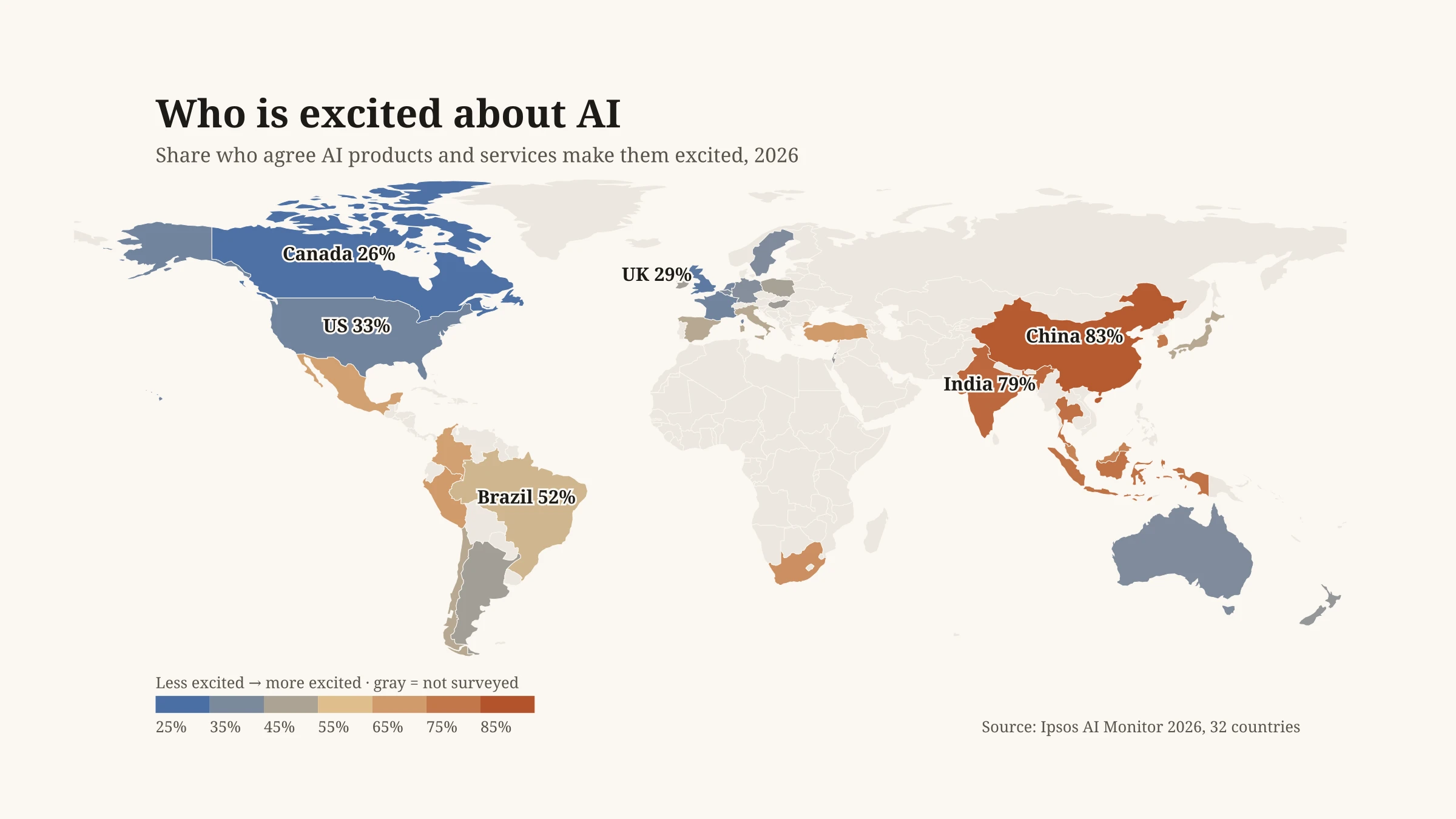
Only 33% of Americans say products and services using AI make them excited, according to the Ipsos AI Monitor 2026, a survey of 32 countries. In China it's 83%. In India, 79%. The US sits near the bottom of the list with France, ahead of only Great Britain and Canada.
That same year, US investors put $285.9 billion of private money into AI, about 23 times what went into Chinese AI companies, according to the Stanford AI Index. The country paying for most of the technology is one of the least excited about using it.
The futurist Roy Amara put it well decades ago: "We tend to overestimate the effect of a technology in the short run and underestimate the effect in the long run." I think the US is living both halves of that line at once. I wrote about one side of it in what the midterms showed about AI. This article looks at the numbers behind the mood, where the money is going, and what I expect for 2027 and the years after.
Who is excited about AI
The Ipsos chart splits cleanly by region. Six Asian countries fill the top six spots. Latin America sits in the middle. Western Europe, the US, Canada, Australia and New Zealand fill the bottom.
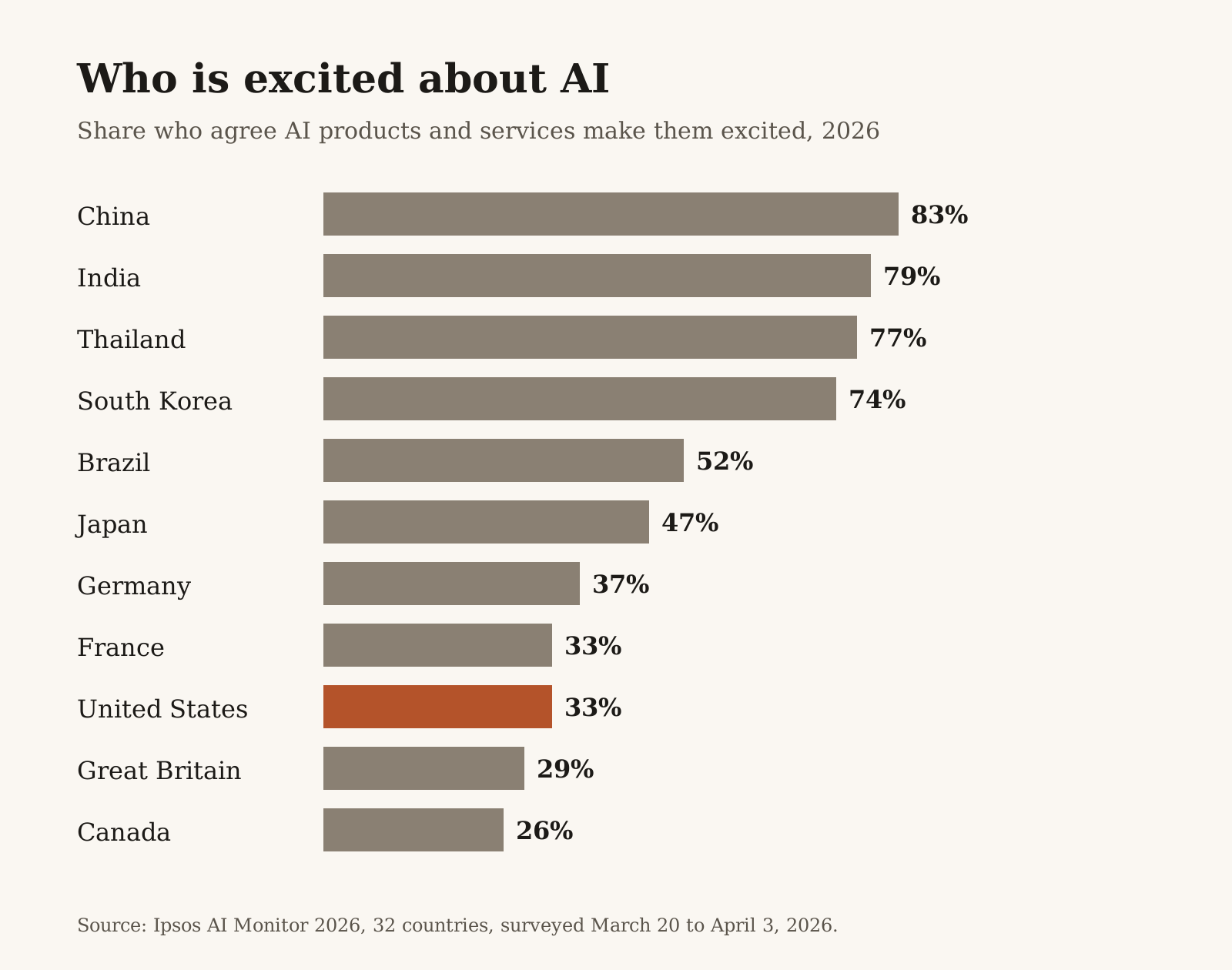
Japan is the exception in Asia at 47%, much closer to Europe than to its neighbors. Japan is rich, older and slow to change how offices work, which looks a lot more like Germany than like Thailand. That points to the real dividing line. It's less about East and West and more about whether a country is still climbing or already arrived.
Ipsos also found the same gap on the bigger question. Across the 32 countries, people under 35 are both the most nervous about AI (52%) and the most excited (56%). Many people feel both at once. In the US, 44% of adults say AI tools make them more productive at work, and 44% oppose building new data centers. Americans are using the tools while doubting the deal.
Why the gap
In India or Southeast Asia, AI looks like a way to compete with bigger companies and bigger countries. A small team in Bangalore can now ship work that used to need an office in San Francisco. For a family moving up, AI looks like a ladder.
In the US, the same tool lands differently. Most Americans already have a job, a house or a retirement account to protect. When a CEO says AI will make the company more efficient, a lot of workers hear that their job is the efficiency. People who have more to lose look at new technology for what it could take.
There's a fairness piece too. Most of the money flows to a small number of companies and places. The towns that host data centers see the power lines and the water use. The gains show up somewhere else. I covered how fast that's forcing people to retrain in the whole world is being reskilled in real time.
Americans got more worried as AI showed up
This isn't a new mood, and it got stronger once people could use the tools. Pew Research has asked Americans the same question for years: are you more excited or more concerned about AI in daily life? In 2021, 37% said more concerned. After ChatGPT launched in late 2022, that jumped to 52%, and it was still 50% in Pew's 2025 survey.
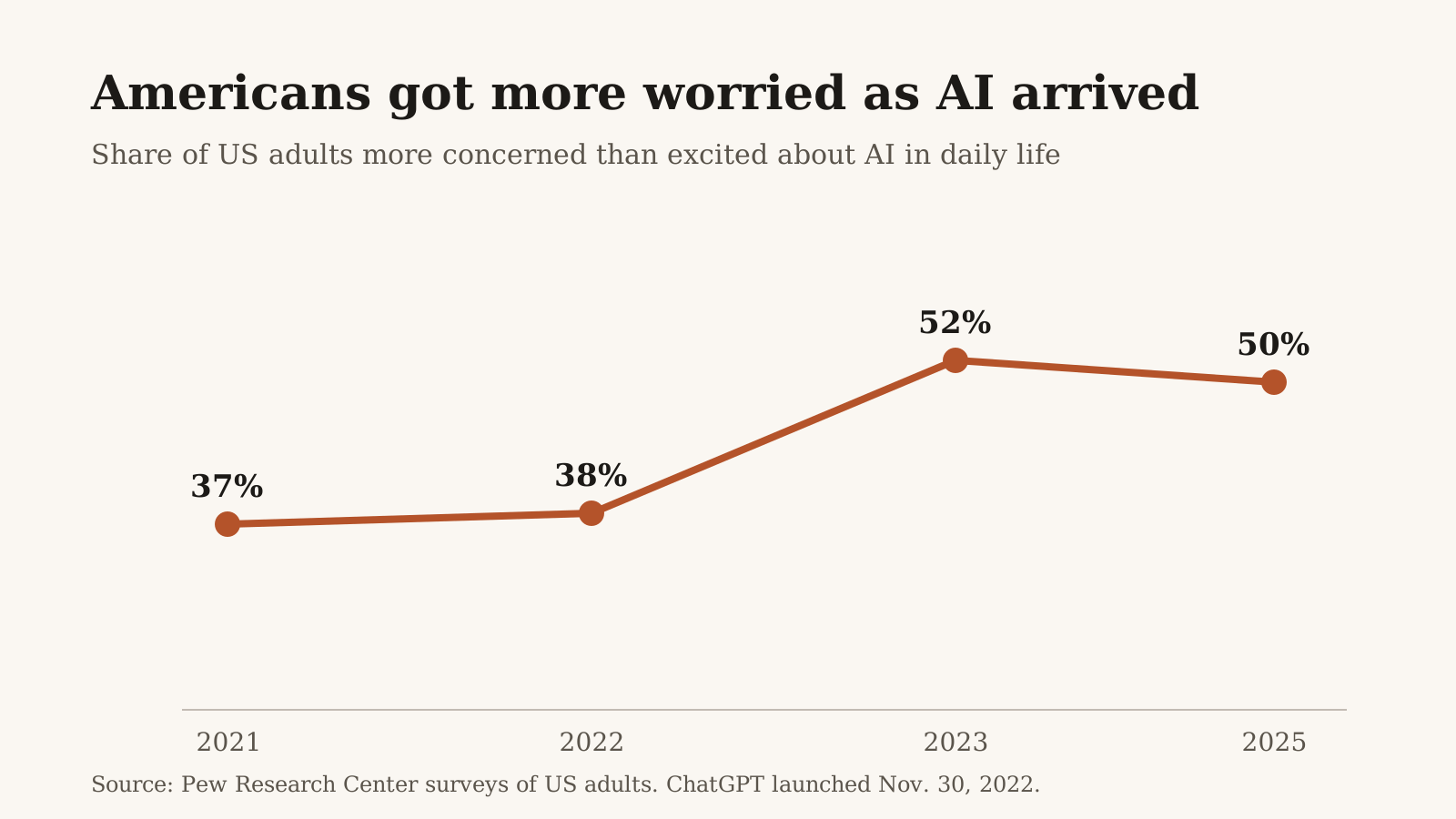
Familiarity didn't fix it. Americans saw what AI could do, and more of them got worried, not fewer. Meanwhile Ipsos says the share of Americans who use AI tools often rose to 24%, up from 17% the year before. Use is going up while trust stays flat. That's the pattern I'd plan around.
Where the AI money went
Now look at the money. Global corporate AI investment more than doubled in 2025, according to the Stanford AI Index. Private investment grew 127.5%. And the US took about 85% of the private total tracked by country.
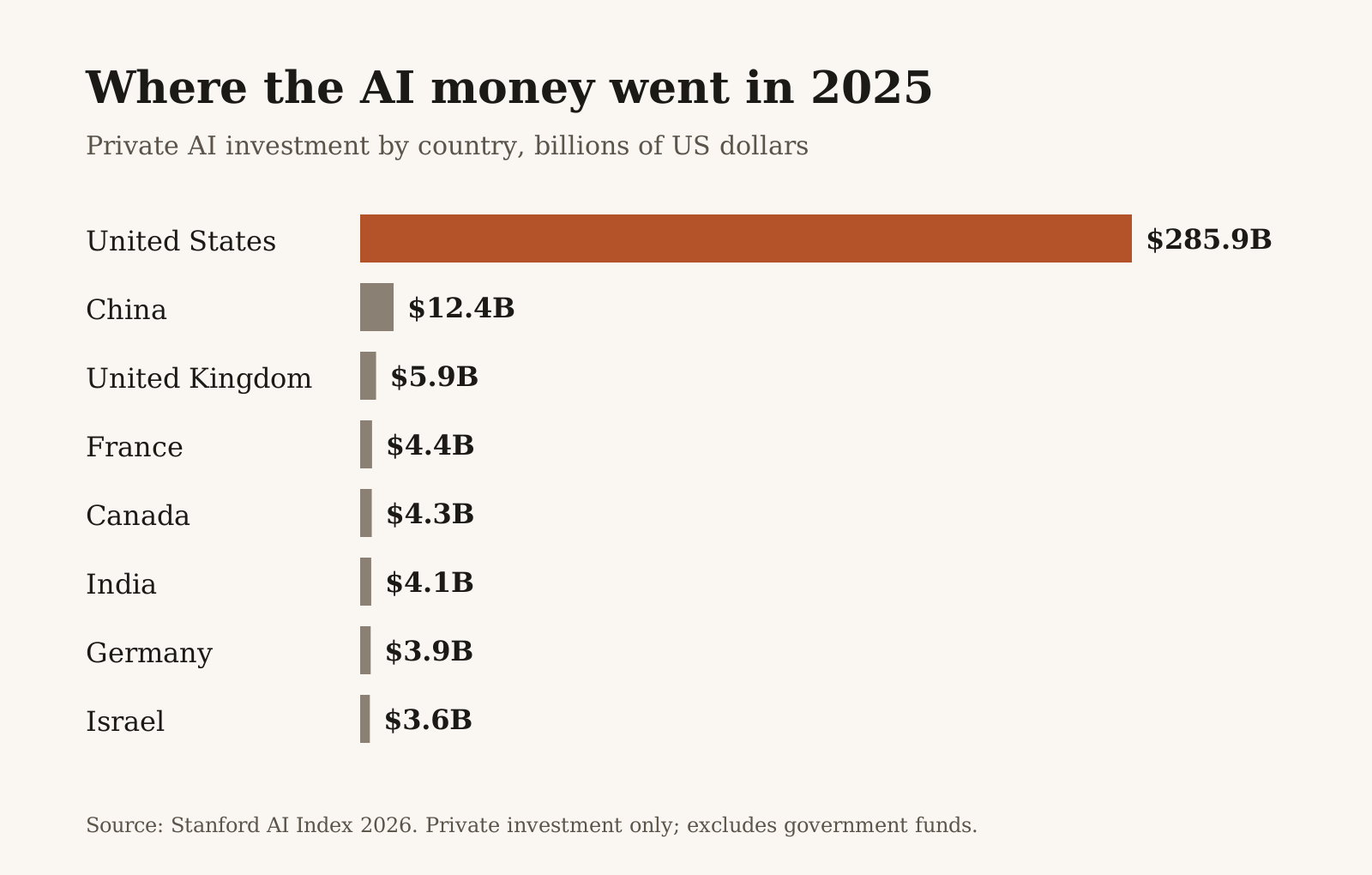
One caution on China. These are private dollars only. Stanford notes that Chinese government guidance funds put an estimated $184 billion into AI firms between 2000 and 2023, which doesn't show up here. China's real spending is much larger than $12.4 billion. Still, the private money, the venture funds and the new companies are overwhelmingly American. The US had 1,953 newly funded AI companies in 2025. The UK had 172 and China 161.
More money, less excitement
Put the two sets of numbers on one chart and the pattern is hard to miss. Countries with the most private AI money are mostly the least excited. The countries most excited, like India and China, put in a fraction of US private dollars.
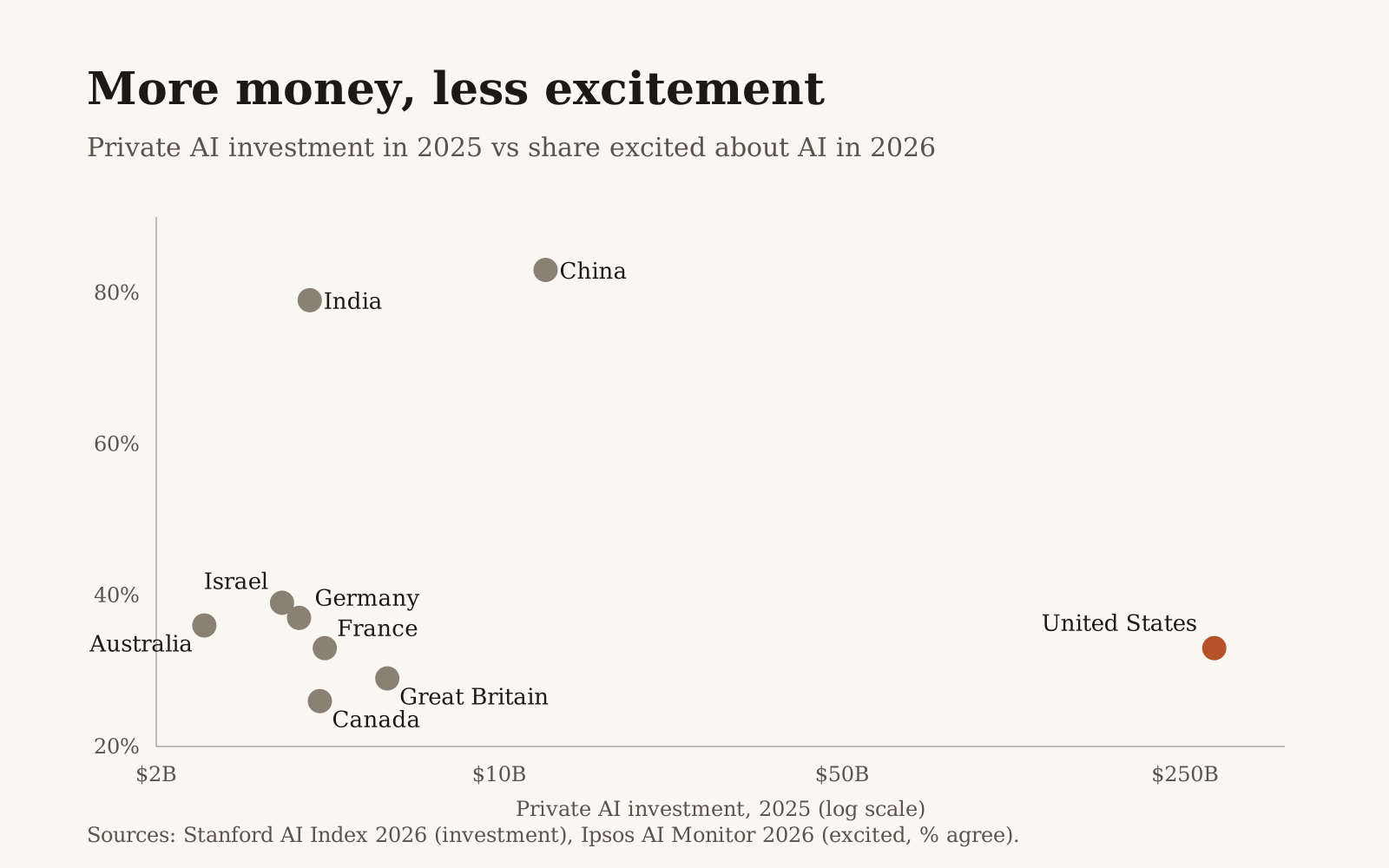
That's a strange spot for a country to be in. The US builds the models, owns the chips, funds the startups and hosts the data centers. But its own customers are some of the slowest to want the result. For an American company, the market most ready to buy what you build may not be the one outside your door.
What this means for US companies
I've spent my career helping companies grow, and the hardest part of any new tool has never been the tool. It's getting people to trust it. That's even more true when a third of your customers are excited and half are worried.
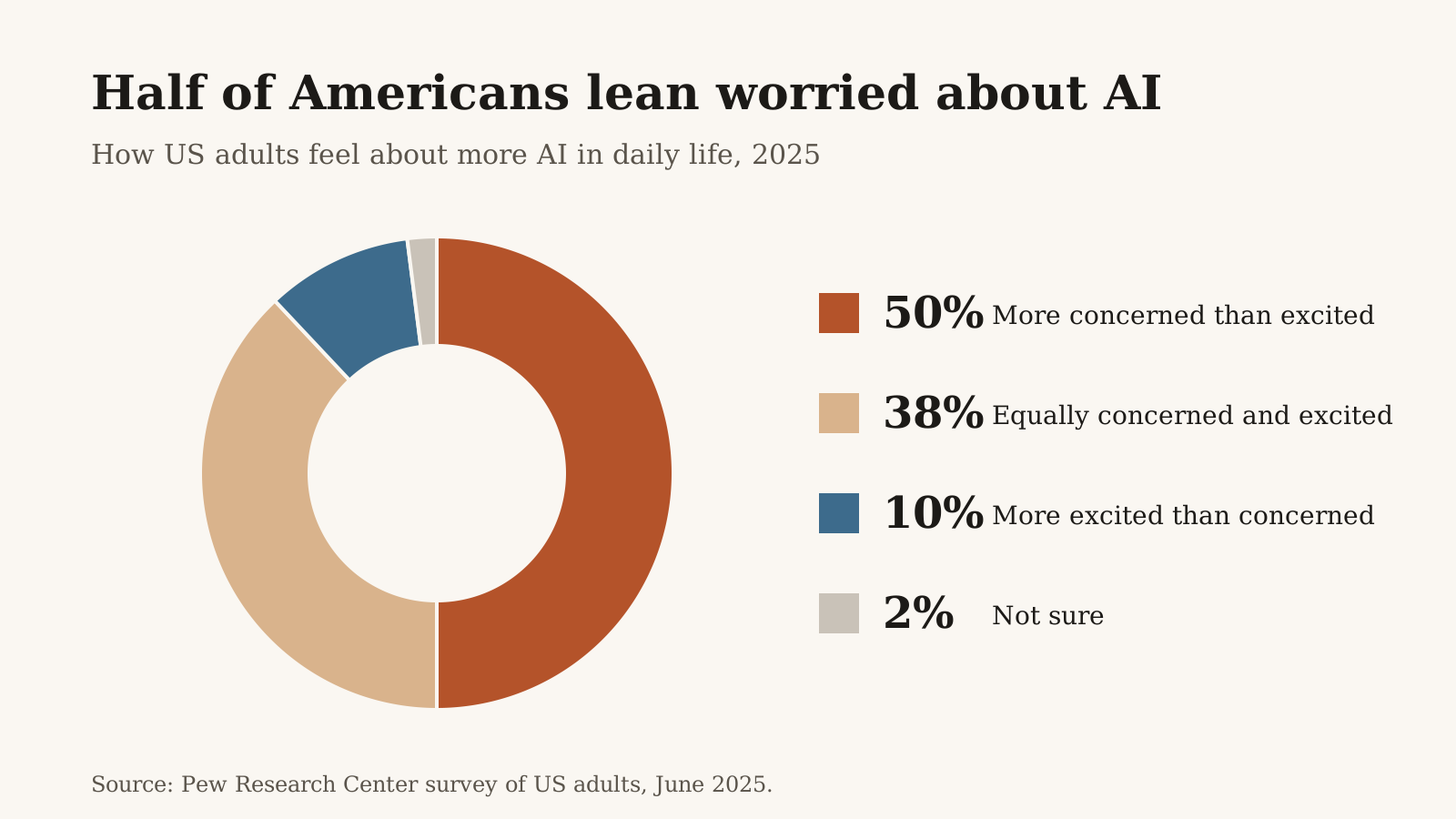
Only one American in ten leans excited. Nearly four in ten feel both ways at once, and that middle group is the one a good rollout can win.
Inside the company, I'd assume your team is closer to the Pew number than the Ipsos China number. If you roll out AI as a cost cut, people will treat it as a threat and use it as little as they can. If you roll it out as a way to take the worst parts of their job off their desk, and you show it, adoption goes up. Say plainly what changes for each role. Silence gets filled with the worst guess.
With customers, lead with what the customer gets, not with the letters A and I. A faster refund, a shorter wait, a better price. The Ipsos data says Americans are already using these tools. They just don't like being sold the technology itself. Tell people when they're dealing with AI and give them an easy way to reach a person. States like Texas are already filing bills to require that, which I covered in what Texas lawmakers want in 2027.
With growth, look at where the excitement is. India, Indonesia, Thailand, Brazil and Mexico all score well above the US. Those are large, young markets with people who want the tools. An American AI product that struggles to win trust at home may find its fastest growth abroad.
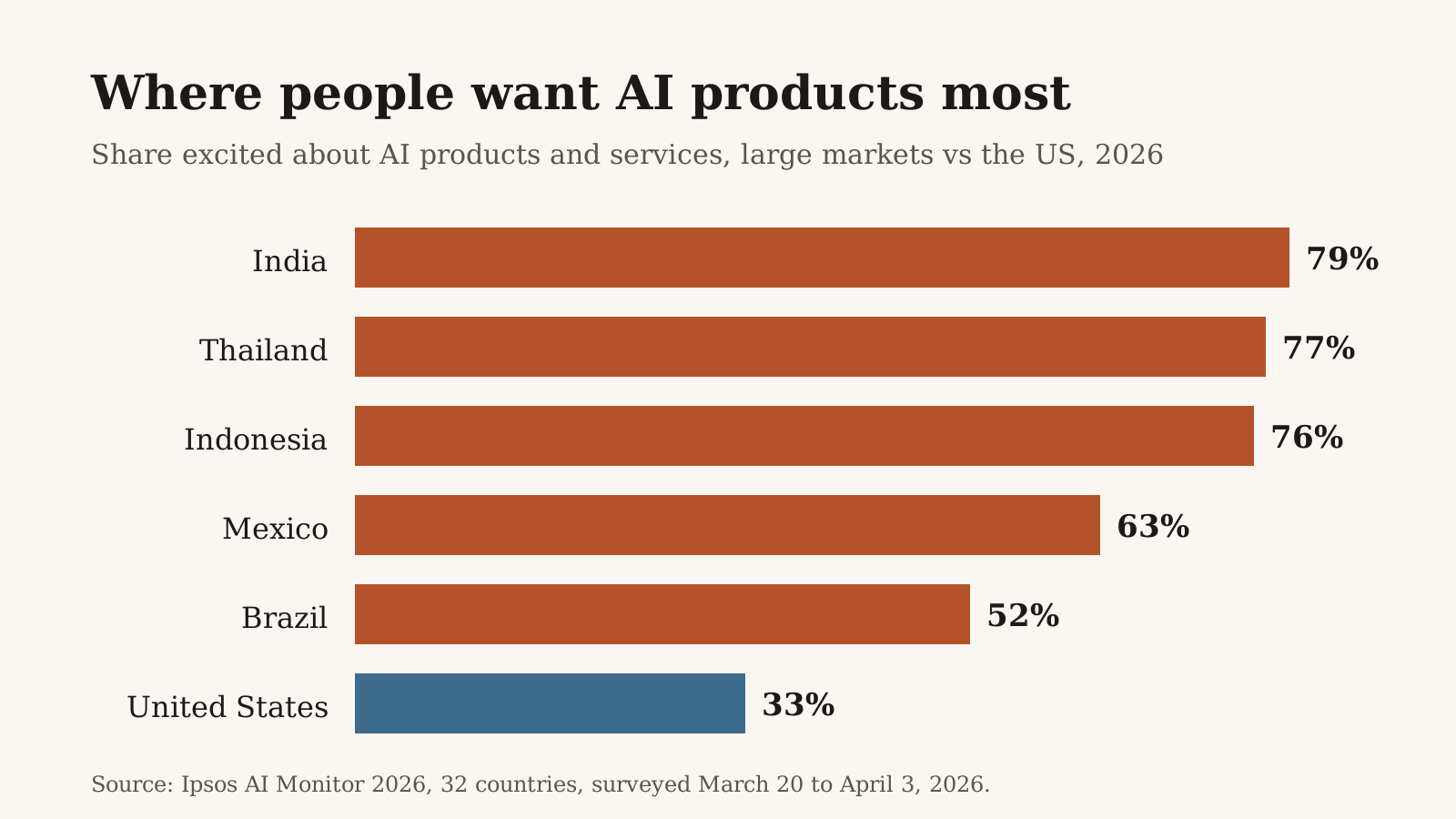
India alone has more than four times as many people as the US, and more than twice the share of them want the tools. That's a market worth building for on purpose, not as an afterthought.
What I expect in 2027 and beyond
The money isn't slowing down yet. US private AI investment went from $67.2 billion in 2023 to $109.1 billion in 2024 to $285.9 billion in 2025. Here's one path for the next two years if growth cools to about 50% this year and 30% next year. That's my estimate, not anyone's published forecast.
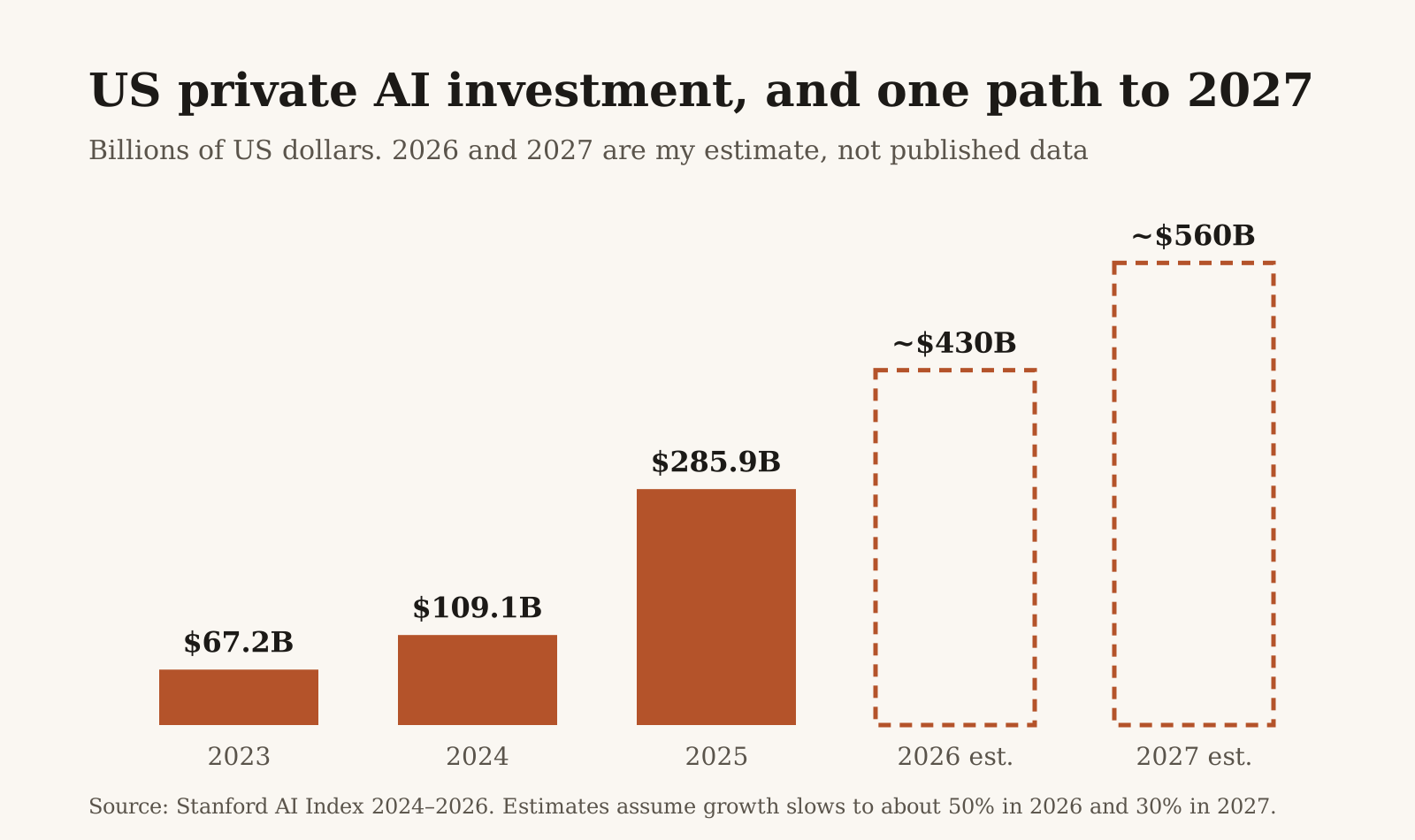
Even if the real number comes in well below that, the gap between money and mood gets wider, not narrower. Here's what I expect from that gap over the next few years.
- AI use in the US keeps rising while trust stays near where it is. People will use what saves them time and still say they're worried.
- Rules come from states and towns first. Labels, disclosure and local votes on data centers move faster than any federal law.
- Companies stop marketing AI as AI. The products that win in the US will talk about results and keep the technology in the background.
- Asia and Latin America become the fastest-growing markets for AI products, including American ones.
- The countries most excited today build more of their own tools as costs fall, so the share of AI money outside the US starts to climb by 2028 or 2029.
None of these is guaranteed. A recession, a big AI failure or a breakthrough in medicine could move the mood fast in either direction. But mood like this tends to move slowly, and the Pew line has barely moved in three years.
A note to the leaders reading this
I'm excited about AI. I build with it every day and I've backed companies built on it. But I don't think the job right now is to convince people to feel the way I do. The job is to earn it, one useful product and one honest conversation at a time.
In my experience, people don't trust a technology. They trust the company and the person using it. If your team and your customers trust you, they'll give the tools a fair shot. That part hasn't changed, and I don't think it will.
Related reading
Follow what I'm building and backing
I post on LinkedIn and X about the companies I back and the products I build.
Join 2,310 people following along.