Deep dive
What Texas Lawmakers Want in 2027, Based on 1,262 Bills
Keith Brown · Founding Partner, Outperform Ventures
Nov 10, 2026 · 7 min read
I had AI read the 1,262 bills Texas lawmakers pre-filed on day one for 2027. Here are the goals behind them and where Texas is headed next.
On Monday, Texas lawmakers filed 1,262 bills for the 2027 session (Texas Legislature Online). I had AI read through the full list for clues about where Texas is headed. On AI, the topic with the most bills wasn't chatbots. It was the buildings that run them.
You can't count on what politicians say. You can count on what they do. A filed bill has a name, a party and a date on it. This article skips the bill-by-bill summary and gives you the goals behind the bills and what the next few years may look like.
The short answer
- Texas wants data centers to pay their own way. The sales tax break is the likeliest thing to change in 2027.
- Towns want a say over where data centers go. Expect slower approvals and more local votes.
- Lawmakers want data centers off everyone else's power bill.
- AI rules are moving from government agencies to private businesses, starting with telling customers when they're dealing with AI.
- Pricing set by software is a target, but it's mostly one party's fight, so expect labels before bans.
- Texans may vote on a smaller property tax cap in November 2027.
Context matters for which of these happen. After last week's election, Democrats are on track to control the Texas House, roughly 83 to 67 in unofficial results, for the first time since 2003. Republicans kept the Senate 19 to 12, and Democrat Gina Hinojosa is governor-elect (Texas Tribune). A bill has to pass both chambers, so the ideas with names from both parties on them are the ones to take seriously. I wrote about election night in the midterms and the AI divide.
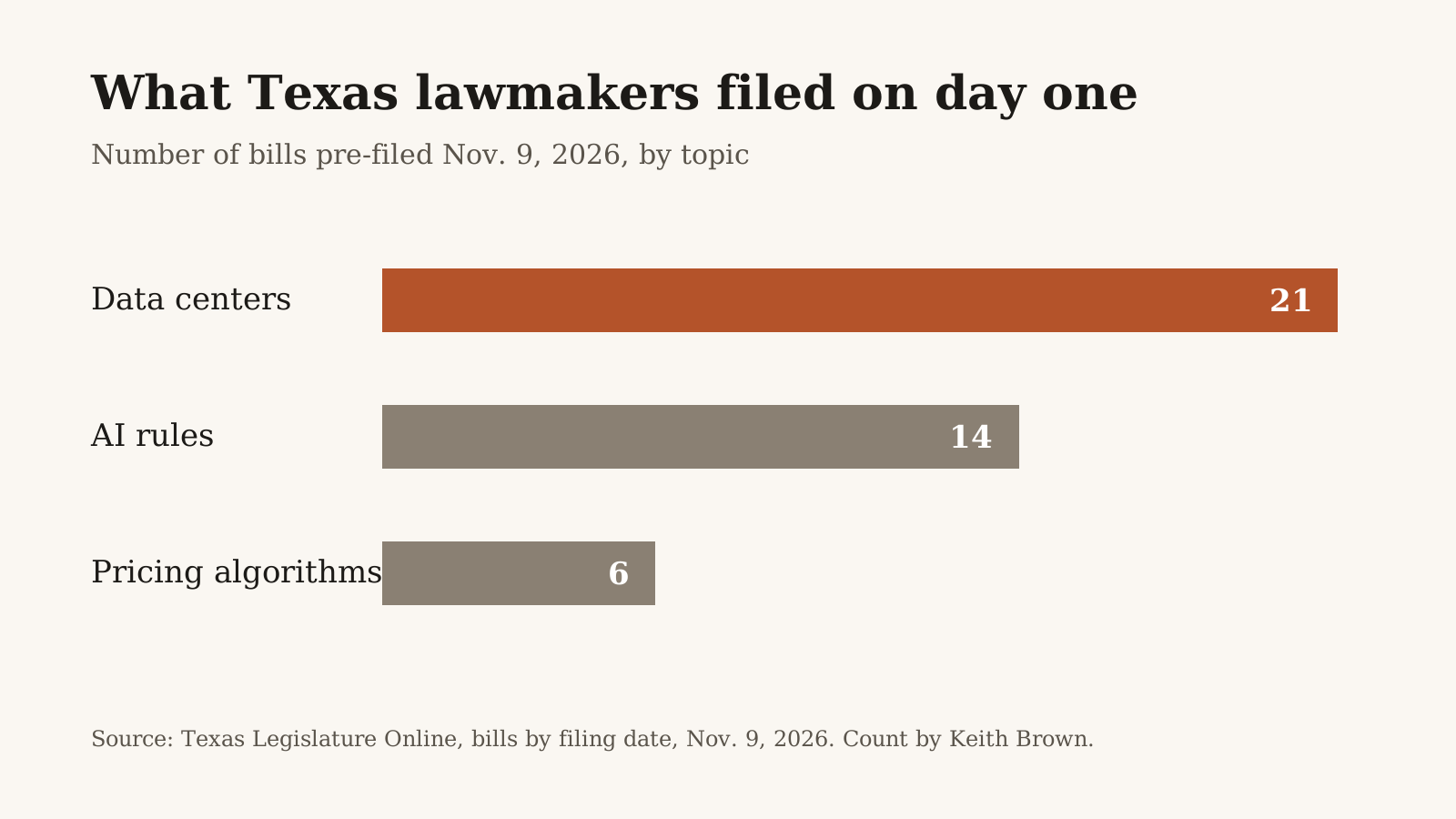
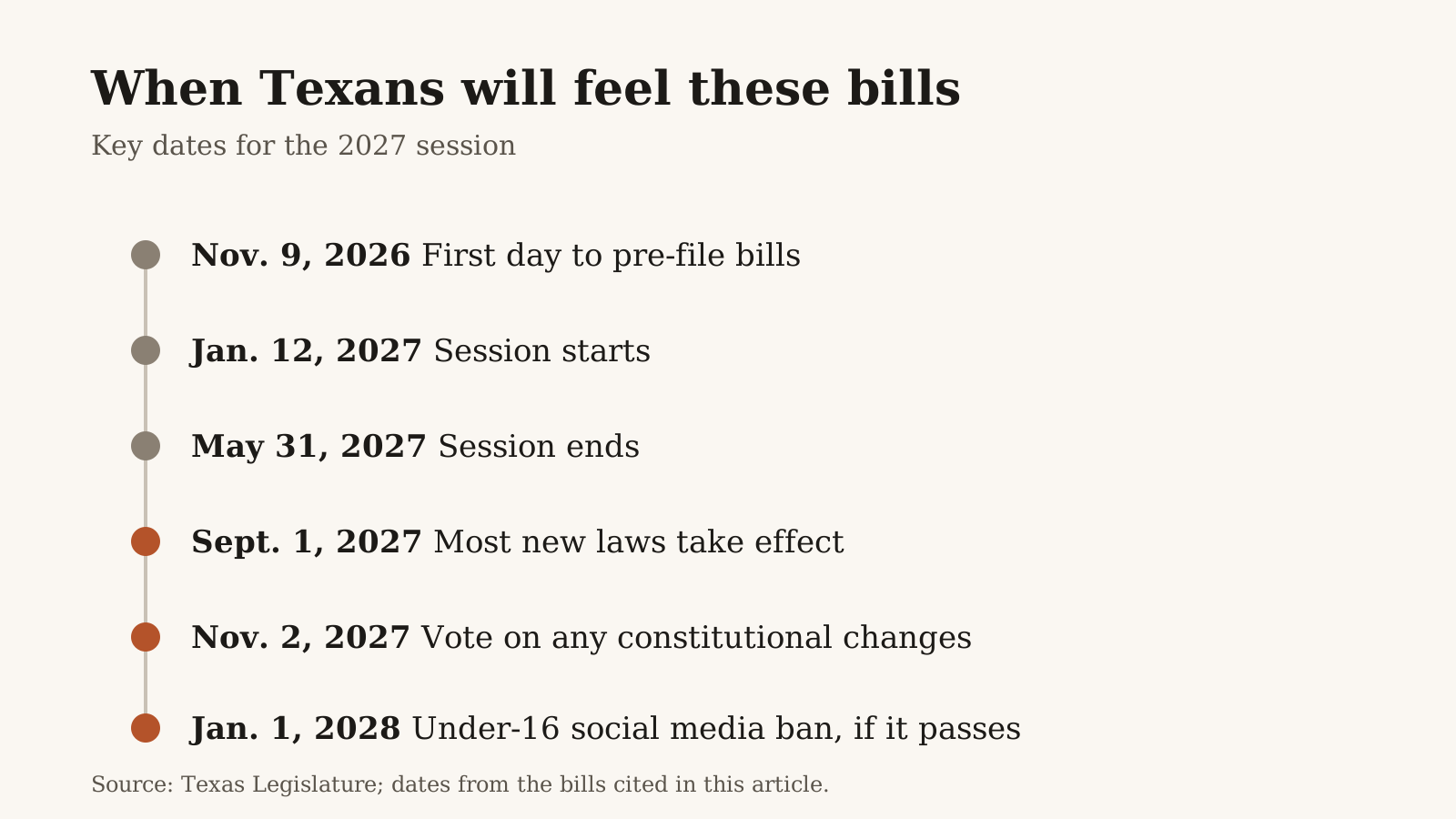
Nov. 9 was the first day to pre-file. None of these bills has had a hearing, and most will never become law. What they show is what members plan to spend their time and votes on.
Goal one: make data centers pay their own way
Texas spent a decade recruiting data centers with a sales tax break on their equipment and electricity. The 2027 bills say that era is ending. Seven bills would end or freeze the break, three from Republicans and four from Democrats. The lead bill, SB 293, comes from Senate Finance chair Joan Huffman (R) with 23 of 31 senators signed on.
The reason is the cost. Huffman said the break cost about $14.6 million in its first two-year budget in 2013. The comptroller now estimates about $3.3 billion over the next two years. Gov. Greg Abbott (R) paused data center approvals in August, and Hinojosa campaigned on ending the subsidies.
Where it's headed: when the governor, the governor-elect, the Senate's budget chair and House members from both parties want the same thing, it usually happens in some form. Builders should plan for Texas projects to cost more from 2027, and for some to look at other states. I covered the national picture in what happens next for data centers.
Goal two: give towns a say
The second goal is local control. HB 928 by Rep.-elect Armin Mizani (R) would require a city council or county vote before any data center is built. SB 34 would let counties zone land for big computing sites, which they mostly can't do today. Other bills would end secret local deals (HB 696, HB 734) and stop new city and county incentives (SB 36).
Where it's headed: the fights over data centers move from Austin to city halls and county courthouses. Developers will need the town on their side, not just the state. That means slower approvals and more public hearings.
Goal three: keep data centers off your power bill
SB 33 would put data centers in their own rate class for grid costs. SB 32 would require a state permit for sites drawing 75 megawatts or more, and HB 529 would require water reporting.
Where it's headed: the biggest power users pay for the grid they need, and the state tracks how much power and water they take. For households, the goal is to keep AI's growth from showing up on monthly bills.
Goal four: tell people when it's AI
Texas already requires government agencies to say when you're talking to AI, under the 2025 Texas Responsible AI Governance Act. HB 914 would extend that to every business. HB 625 would require labels when AI makes important decisions about people, HB 510 would require a human who can shut down risky AI, and HB 929 by Mizani (R) would label AI-made political ads.
Where it's headed: disclosure is the easiest AI rule to pass because Texas already did it once for government. Rep. Salman Bhojani (D) filed nine of the 14 AI bills, so the wider ones depend on a single author finding Senate partners. I'd expect labels and disclosures to pass well before any limits on what AI can do.
Goal five: limit prices set by software
Several bills target software that sets prices just for you, from HB 280 on personalized pricing to HB 405 on telling shoppers when AI sets the price. Three more (HB 950, SB 156, SB 255) would ban rent software that uses competitors' private data. A similar rent bill died in committee in 2025.
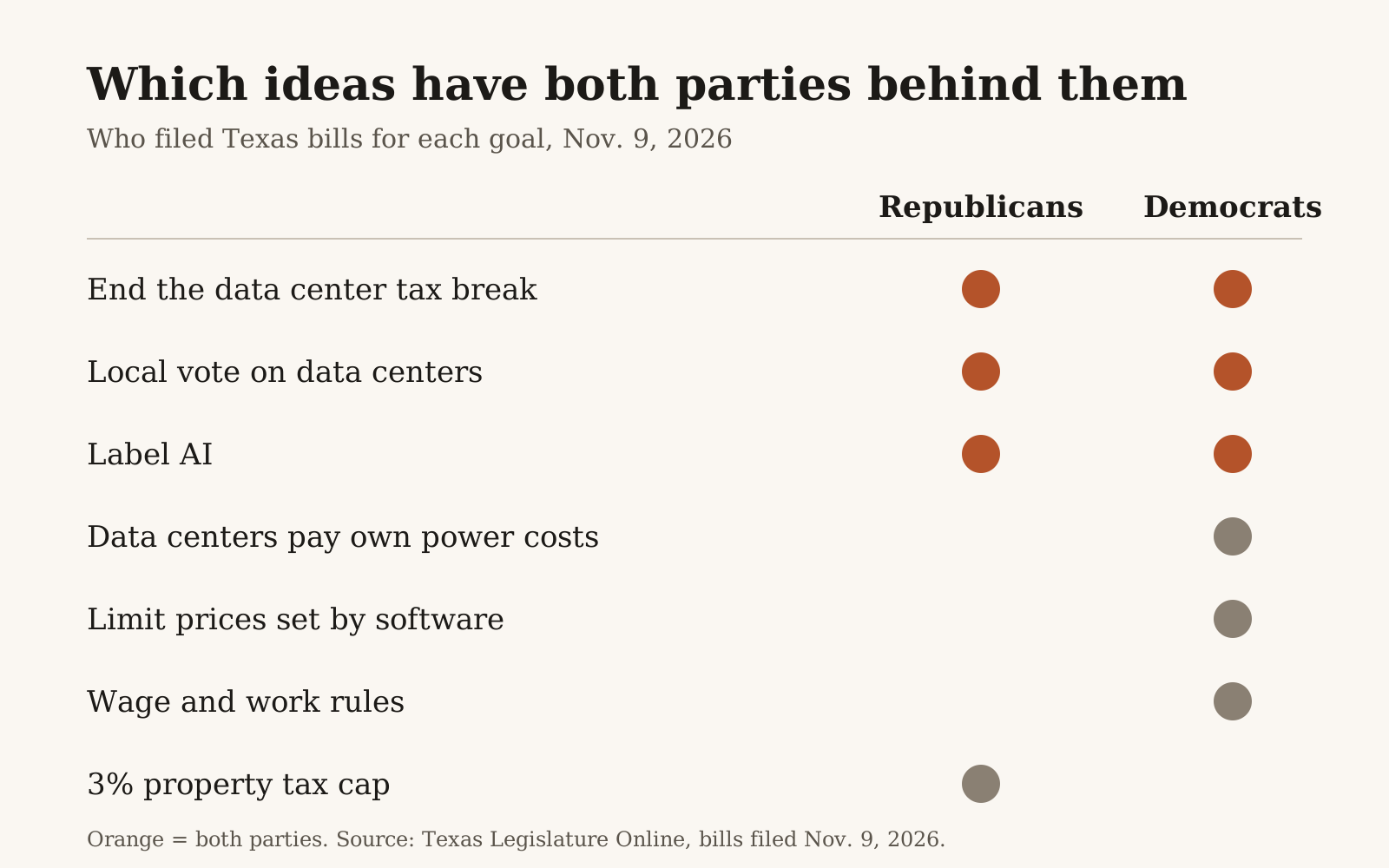
Where it's headed: nearly all of these come from Democrats, and they'd need Republican votes in the Senate. A disclosure rule like HB 405 has a better chance than an outright ban. If you use software to set prices or rents, be ready to explain how it works.
Goal six: protect the data you hand AI vendors
HB 561 is the most detailed bill in the batch. AI vendors handling a Texas business's private data would need encryption, report breaches within 72 hours, allow yearly audits and get written permission before training general models on that data. It would apply to contracts signed or renewed from Sept. 1, 2027.
Where it's headed: even if it doesn't pass, this is what buyers will start asking vendors for. It fits what I wrote about companies moving from bought software to built software, and about more than half of web traffic now being bots.
Homes, work and kids
- Property taxes: HB 563 and SB 298, both from Republicans, would lower the homestead cap from 10% to 3% a year. It changes the constitution, so voters would decide on Nov. 2, 2027. Caps slow how fast taxable value grows. They don't cut rates, so more of the bill shifts to newer buyers and uncapped property.
- Work: Democratic bills would raise the minimum wage to $15 (HB 110), require paid sick leave (HB 808) and void noncompetes for low-wage workers (SB 251). These show the new House majority's agenda. They face the hardest path in the Senate.
- Kids: HB 212 (R) would bar social media for anyone under 16 from 2028, and HB 441 (D) would offer an AI elective in high schools.
Most of this won't touch daily life until late 2027, and some of it not until 2028.
How to follow these bills
Every bill above links to its page on the Texas Legislature's site, where you can watch for a committee hearing. The full list of bills filed Nov. 9 is public, and Who Represents Me? tells you which lawmakers to call.
A note to Texans running a business
I've built and backed software companies for almost 20 years, and I've watched plenty of filed bills disappear by spring. Most of these will too. The data center bills are different, because Republicans and Democrats put their names on the same idea in the same week.
I have friends on both sides of the aisle. Some are excited about this session and some are worried. If you run a company here, you don't need to wait for a vote to get ready.
Know where your customers deal with AI in your business, read what your vendors can do with your data, and be ready to explain how your prices are set. I'll write about the bills that pass.
Related reading
Follow what I'm building and backing
I post on LinkedIn and X about the companies I back and the products I build.
Join 2,310 people following along.