Deep dive
A Growth Plan for Spikeball’s Next Hire
Keith Brown · Founding Partner, Outperform Ventures
Nov 19, 2026 · 8 min read
My bet is a two-person game you can play at home. Here’s how I’d find out in 90 days if I’m wrong.
Chris Ruder read the first five cover letters for Spikeball’s Head of Growth role and posted on X that they all looked nearly identical. The applicants spent about 95% of their letters on themselves, he said. I took his broader point to be about how people apply for jobs in the age of AI. Spikeball gives me a specific business to work through.
Strategy is free now. Here’s mine: test whether two people will keep playing a game they can set up at home in a few minutes. Start with Spikepong, which Spikeball already sells. If people try it once but won’t play it again or pay for it, I wouldn’t buy inventory. I’d pay an operator to run that test and make the call. It’s the same distinction I made when I put 753 pages of startup reports into an MCP: getting to the information should be cheap.
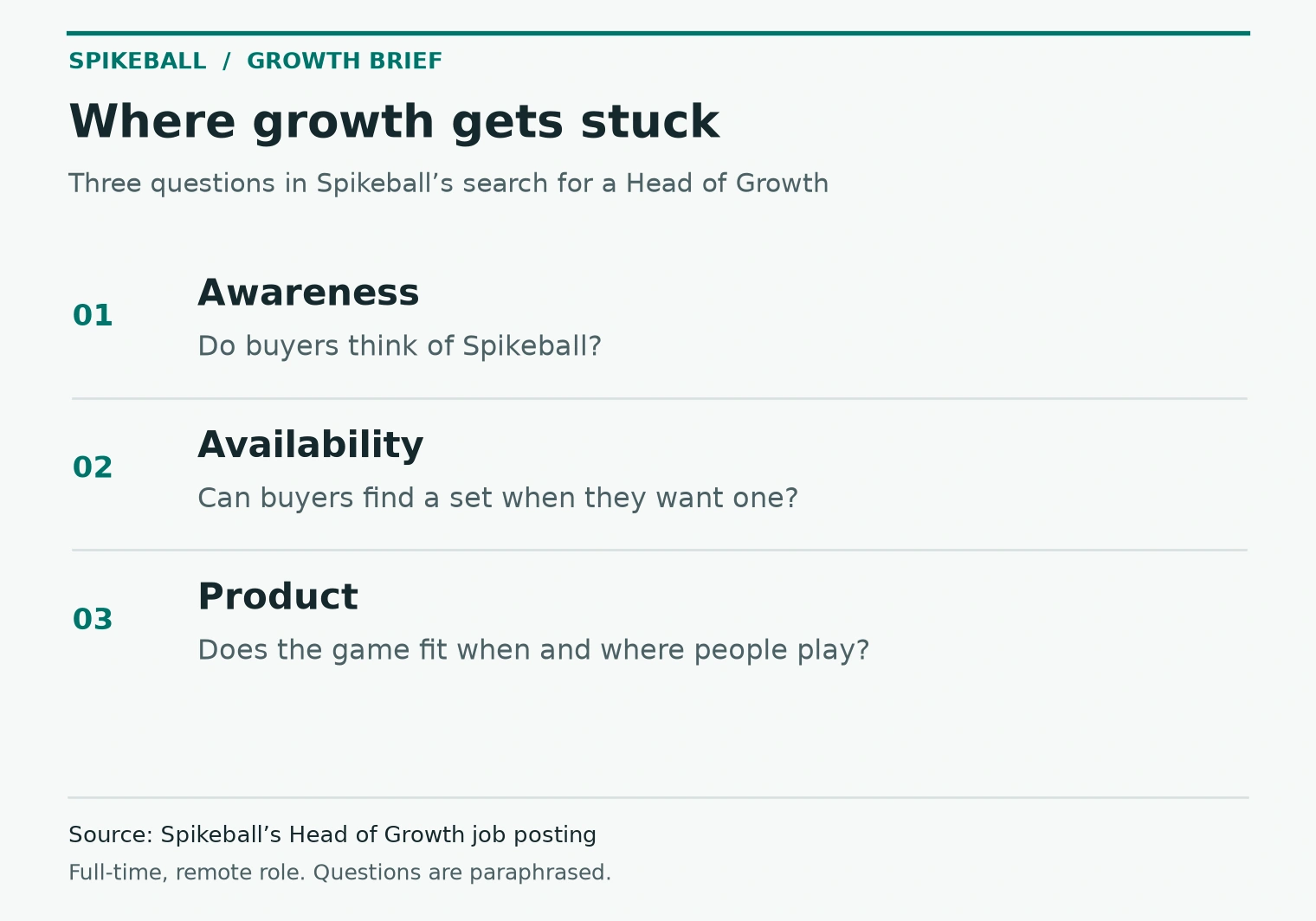
Spikeball says it reached $1 million in annual revenue in 2013 with zero full-time employees. And the hiring brief already asks the right question: is growth held back by awareness, availability or the product? Marketing researcher Byron Sharp puts it this way: “Both mental availability and physical availability need ongoing spend/support.” I’d give one of those problems priority only after seeing what happens when a new buyer tries to find, buy and play the game.
Spikeball is hiring a Head of Growth. The first 5 cover letters I've read all have nearly identical format. 95% talks about their current/past roles and the final 1-2 sentences are about Spikeball. AI SLOP!!!! Not good. I care about Spikeball and not nearly as much about your past role.
— Spikeball Chris (@spikeballchris) View on X
How Chris Built Spikeball
Chris didn’t invent roundnet. Toy designer Jeff Knurek created the original game in 1989 and later joined Premier Spike. Chris studied photojournalism, spent 13 years in corporate sales and started building Spikeball while working at Microsoft. He told Northwestern’s Garage that he went home at night to run it and kept going for five years before leaving his day job.
He started the company in 2007 with family and friends and launched the store in June 2008 with a party at Chicago’s North Avenue Beach. He thought he was selling a beach game. He later told Marketing Brew that most of the early buyers didn’t live within 100 miles of a beach, so the company moved away from that pitch. That’s a better example of growth work than anything in a cover letter: he looked at where the orders came from and changed what the company said it sold.
Spikeball went on Shark Tank in 2015. The televised $500,000 deal with Daymond John never closed, but the company credits the show with bringing it a much bigger audience. Chris reported nearly $50 million in cumulative worldwide sales by its tenth anniversary, and a 2025 interview profile reported $19 million in annual revenue for 2023. Those figures cover different periods, and I couldn’t verify a current annual revenue figure for this private company.
What Spikeball Already Does
Amazon, Walmart, Target, Dick’s, Scheels and Mercado Libre are already in the hiring brief, along with specialty retail and international distribution. The company has a wholesale program and publishes reseller rules that let it request sales by store and product. The brief already calls for a review of paid social, creators and TikTok Shop, and for tests of whether to send paid traffic to Amazon or Spikeball.com.
Spikeball already publishes a how-to-play guide, offers campus recreation partnerships, and has school equipment packages and teacher training. There’s an affiliate signup page, a history of using player-made video, and a beta app for finding and hosting games. I wouldn’t pitch any of that back to Chris as a new idea.
The Spikeball Tour Series dates back to 2014 and has aired on ESPN. Spikeball was the presenting sponsor and equipment provider at the 2024 World Championship. The federation named Premier Spike the equipment sponsor for the 2026 championship near Paris. Spikeball sells its own tournament-grade TITAN set, but that sponsor change is a reminder to measure how much competitive visibility drives purchases separately from how much casual play does.
Spikeball is also reaching people outside roundnet. This June, Paris Saint-Germain’s La Maison program in Los Angeles listed Spikeball alongside an F1 simulator and a kids’ zone. I’d compare what that kind of event does for first-time play with what a tournament does for equipment sales before putting both under the same sponsorship budget.
What the 75% Drop Means
The Semrush chart puts estimated monthly organic visits to Spikeball.com near 200,000 around the 2020–21 peak and around 45,000 at the right edge. Call it a roughly 75% drop. The chart doesn’t measure Amazon orders, store sales, how many people play, or what caused the decline.
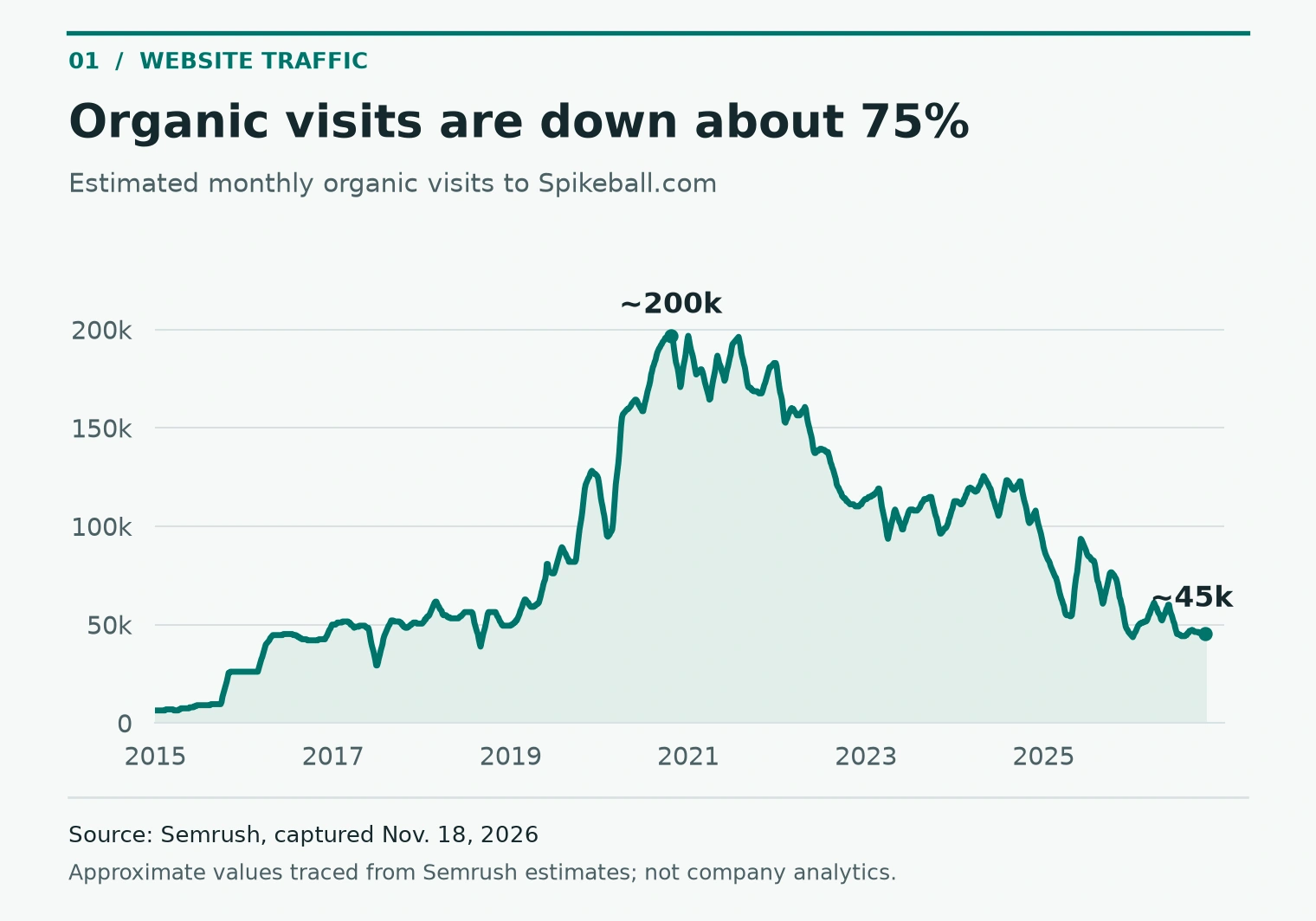
The decline was underway before Google added AI Overviews. But AI has changed what a search visit is worth counting on. In Pew’s March 2025 browsing study, a traditional result got a click on 8% of Google visits with an AI summary, versus 15% without one. That’s a reason to check where buyers end up, not proof that AI took three quarters of Spikeball’s search traffic.
What Changed After 2021
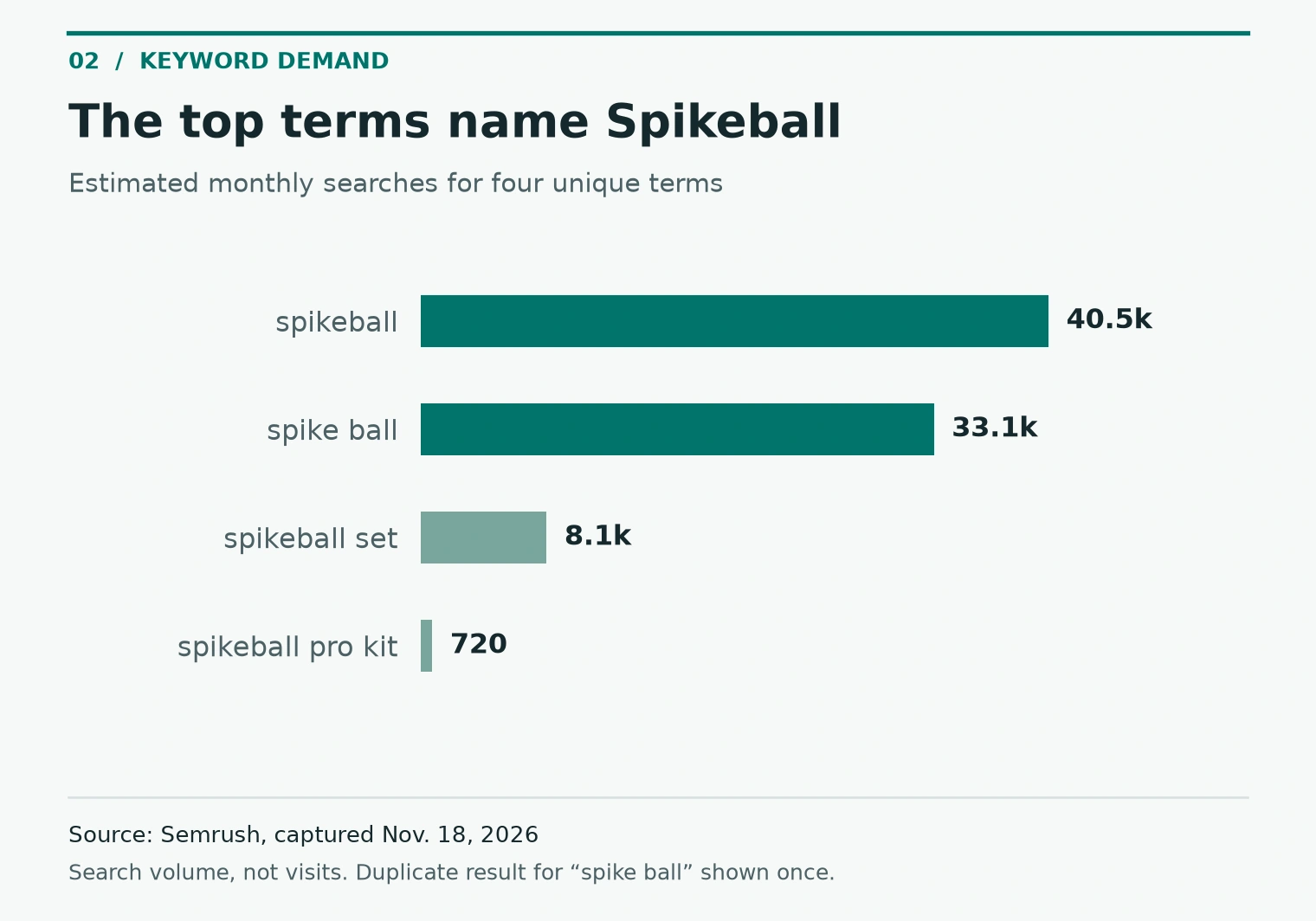
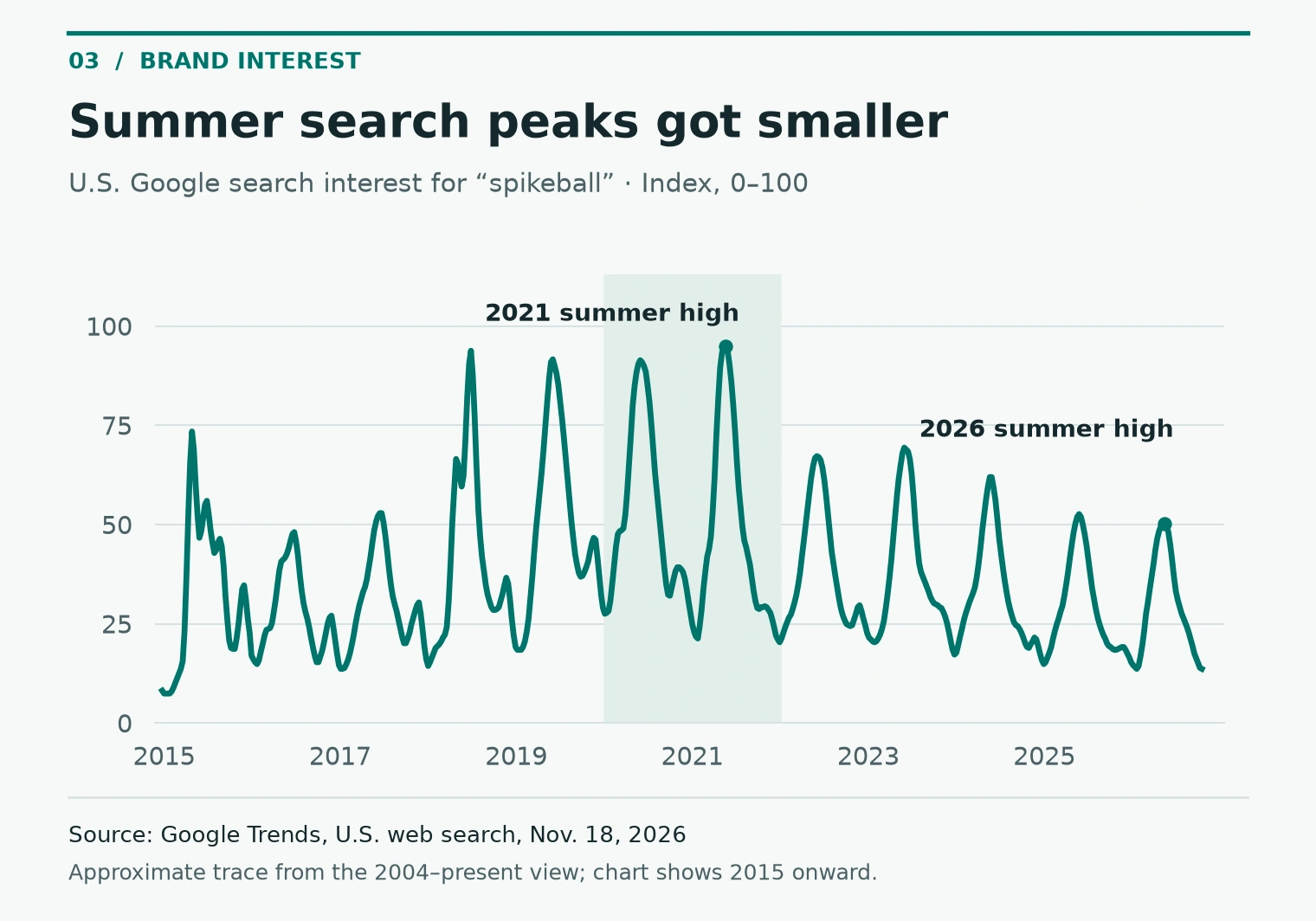
I looked at searches for “spikeball” itself to see whether the decline was just about the website getting fewer clicks. The Google Trends chart shows another strong summer around 2021, after COVID hit in 2020. The summer peaks since then have been lower. The chart has a higher spike before COVID, so 2021 is a useful turning point rather than an all-time record.
The Next Game Should Work at Home
The product bet I’d make is that two people at home will play more often if they can start a game in a few minutes, with the space they already have. A standard roundnet game needs four players and room to move. That’s a good fit for a Saturday with friends. If the next product is going to get played on a Tuesday after dinner, I’d build for that Tuesday and watch what people do with it.
Spikeball is already partway there. It sells Spikepong for a dining table and a Rookie Kit for beginners that can be used indoors. I’d start with the data from those launches. The question I’d put to the team is whether a two-person game gets used again on a normal weeknight once the novelty wears off. If Spikepong already does that, I’d give it a bigger launch. If it doesn’t, I’d use that feedback to build and test the next game.
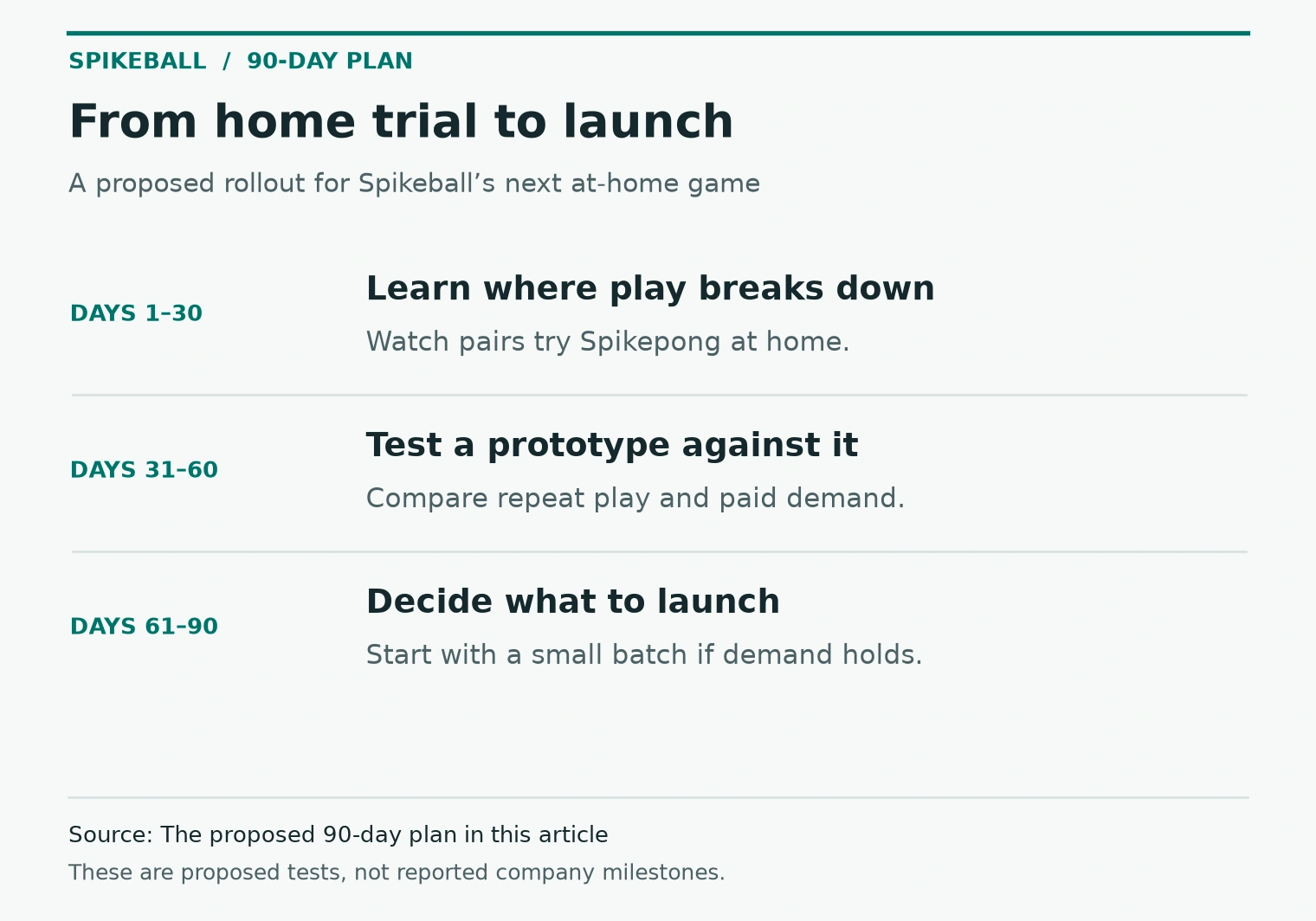
Days 1–30 Watch People Play
I’d read the prior tests and compare sales, stockouts and returns for Spikepong and the Rookie Kit. Then I’d watch pairs try Spikepong at home without a demo. Include people who own a set and people who have never bought one. Note how long it takes to start, what gets in the way, and whether they get the game out again on their own.
I’d check awareness and availability early so I don’t mistake a distribution problem for a product problem. If people who try Spikepong already play again and want to buy it, but can’t find it or hadn’t heard of it, I’d test getting the existing game in front of them before building another one.
Days 31–60 Test the Home Game
Give one group Spikepong and another the simplest prototype that addresses what held people up. Agree in advance how much repeat play and paid demand would justify a launch. Count who plays again the following week without a reminder and who puts money down at the intended price. If neither game clears both bars, I’m wrong about the opportunity as tested. If Spikepong does as well as the prototype, put the money behind Spikepong.
Days 61–90 Decide What to Launch
If one game earns a launch, start with a limited batch on Spikeball.com. See whether it brings in people who weren’t going to buy a full set and whether the price leaves enough after manufacturing, shipping and returns. Take those numbers to a retail partner before asking them to stock it. If neither game earns a launch, leave that inventory money unspent.
That’s the decision I’d hire an operator to make. Give them a 90-day budget, access to Sales and Marketing, and a weekly meeting with Chris. Pay for the work and offer a share of the upside: a cut of the extra profit after discounts, returns and other variable costs, or equity if the role continues. Agree on the baseline before the work starts and settle after the return window.
An experienced operator can tell you in ten minutes how they’d start. I’d ask for an example of when they shipped a test and changed the budget because the result surprised them. The best candidate may already run a business. Make the offer worth their time, then decide whether the work needs a full-time hire.
Spikeball’s careers page says it wants people who question the status quo and are open to constructive criticism. The 90-day engagement would give both sides a chance to see how that works before committing to a full-time hire.
Chris, you went home after work for five years to build Spikeball before you bet your livelihood on it. I’d give the next person a chance to earn a bigger role the same way: run one test with your team, show you the numbers, and agree on what they’ll own if it works. Good luck with the search.
Related reading

Follow what I'm building and backing
I post on LinkedIn and X about the companies I back and the products I build.
Join 2,388 people following along.