Deep dive
What Happens Next After Voters Rejected Data Centers
Keith Brown · Founding Partner, Outperform Ventures
Nov 5, 2026 · 6 min read
Voters went against data centers in 36 of 38 counted ballot measures. Here are the facts on what that means for AI, taxes and jobs.
On Tuesday, voters faced 41 local ballot measures on data centers in 10 states, according to Ballotpedia via CNBC. Of the 38 counted so far, 36 went against development: 21 restrictions and 15 bans passed, and all 13 measures that would have helped development failed, American Buildout tallied.
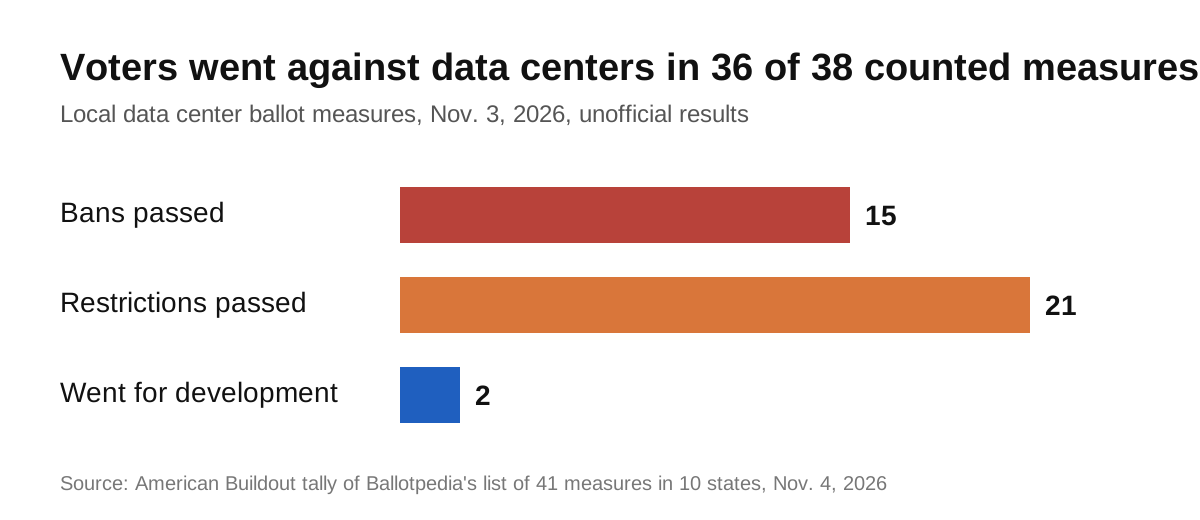
Ohio had 21 of the measures, and at least 14 Ohio communities passed bans or restrictions, including Sunbury, where Amazon proposed a $2 billion data center, The Guardian reported. Sherrod Brown beat Sen. Jon Husted after casting him as "the face of data centers," CNBC reported.
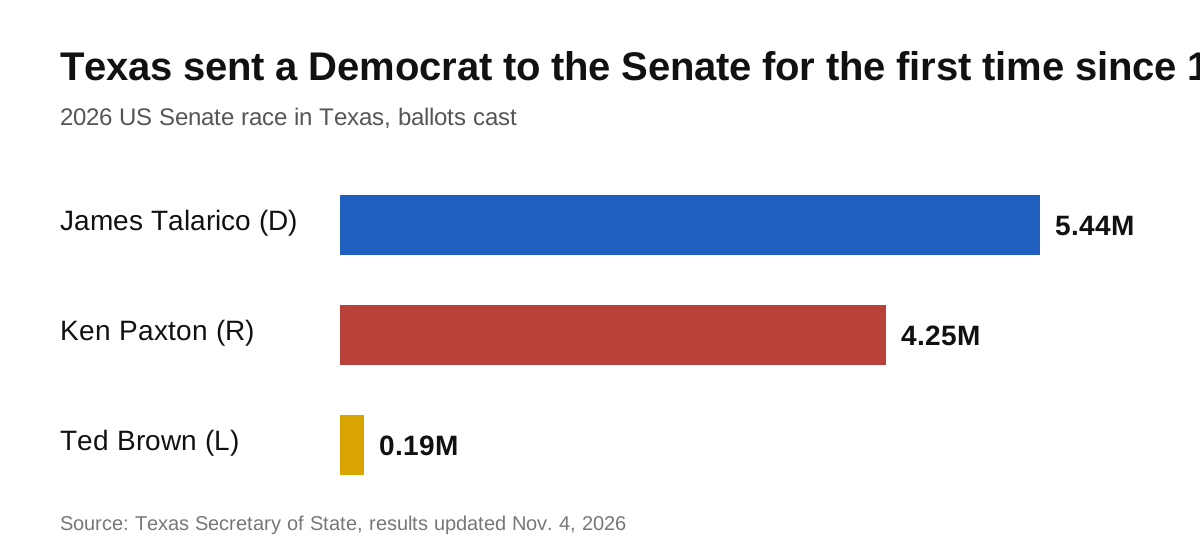
Democrats also won at least 228 House seats and 54 Senate seats, taking both chambers of Congress, per Deloitte. In Texas, James Talarico became the first Democrat elected to the US Senate since 1988, winning 5,444,982 votes to Ken Paxton's 4,249,373, per the Texas Secretary of State.
I wrote this for leaders and business owners in both parties. Every fact below has a source, as of November 5. The question for all of us is what happens next.
Why did voters say no to data centers?
In Trenton, Ohio, a ban on data centers over 25 megawatts passed with 79.68% of the vote. The group behind it cited noise, diesel generators, water use and emissions, Spectrum News reported. "The noise, the noise," resident Lesa Derosier said. "And no, I didn't move here for noise."
A statewide poll of 1,650 Ohio adults in October found 55% opposed building data centers in Ohio and 22% supported it. On tax breaks for data centers, 65% were opposed, including 53% of strong Republicans, according to Ohio Northern University and SurveyUSA.
In Texas, where industry estimates put a quarter of new US data centers, Governor-elect Gina Hinojosa supports a moratorium on new projects and protections for electricity ratepayers, The Washington Post reported.
How much was AI holding up the economy?
On the All-In election-night livestream, Altimeter Capital CEO Brad Gerstner estimated that about 75% of this year's US GDP growth came from AI infrastructure, according to the transcript. He put US AI compute at about 38 gigawatts at the end of 2026, with 43 more gigawatts forecast for 2027.
"I think we could see at least 10 to 15 gigawatts of the expected build not come online," Gerstner said. He estimated that would take roughly half a point off US GDP growth. Both numbers are his forecasts, not official data.
Builds were already slowing before the election. In Ohio, a new data center now waits 84 months for a grid connection, and one-fifth of US projects under development had been delayed by a moratorium, Wood Mackenzie reported in October. The average wait for new power projects where data centers are being built is 64 months, according to MSCI.
What are business leaders on each side saying?
Bill Ackman, Chamath Palihapitiya and Gerstner warned that Democratic opposition to data centers could threaten the AI boom. Richard Branson and Reid Hoffman criticized billionaire spending on the election, and Elon Musk's $224 million bet on Texas races fell short, CNBC reported.
JPMorgan Asset Management's David Kelly said divided government would bring "moderation in growth, moderation in inflation, less uncertainty," CNBC reported.
Inside the new House majority, proposals on AI vary. One of the most direct came the day after the election:
Top of the Democratic agenda on day 1 needs to be a pause on advanced AI development, regulation of this out of control industry, and a ban on artificial superintelligence.
— Rep. Yassamin Ansari (@RepYassAnsari) View on X
What happened when Europe built less?
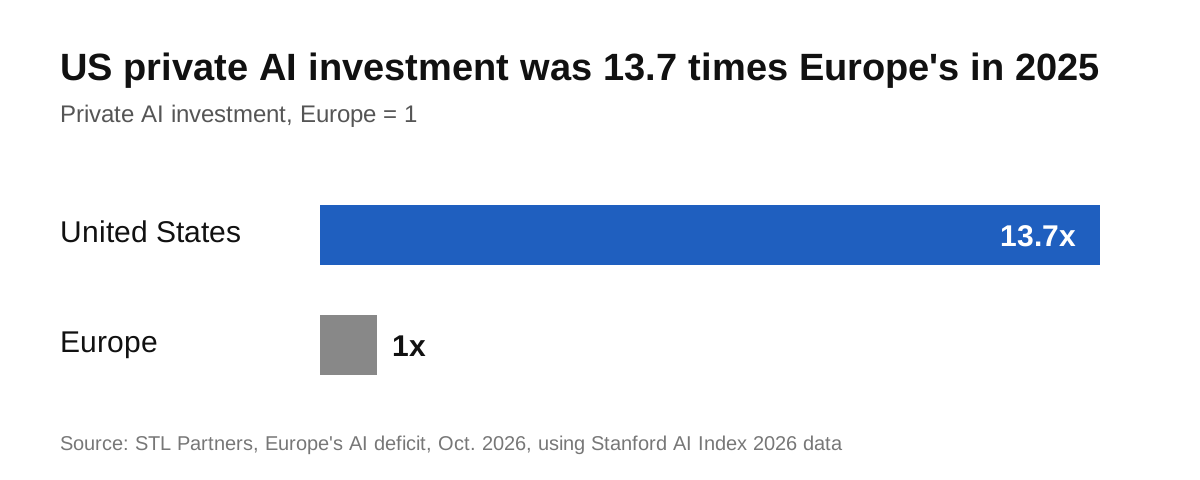
US private AI investment was 13.7 times Europe's in 2025, and 51 times in generative AI. The US runs close to five times the data center capacity of the EU's 27 countries, and Europe's share of global capacity fell from over 25% in 2015 to about 15% by 2024, according to STL Partners.
Only two gigawatts of AI compute, 5% of the world's total, sits in the EU, Bruegel found. Capital Group pointed to higher energy prices and an aging grid as two bottlenecks slowing Europe's buildout, in a September report.
"Of the fifty largest technology companies in the world, only four are European," says the Rhine Group, launched in August by former ECB president Mario Draghi and Stripe CEO Patrick Collison. Its members include Shopify's Tobi Lütke and Klarna's Sebastian Siemiatkowski.
Europe has always been very focused on safety, but probably less so on growth.
Siemens CEO Roland Busch said most of the company's €1 billion industrial AI investment will go to the US because of Europe's rules, and that the EU's AI Act and Data Act "miss the mark," Bloomberg reported.
What tax changes are on the table?
Democrats plan to raise the corporate rate from 21% to pay for larger health, child and earned income credits, Private Wealth Daily reported, citing the Tax Foundation. Tax experts expect proposals to raise taxes on high earners, and a federal wealth tax could get more attention, CNBC reported. President Trump still holds the veto, and Deloitte expects any change to need a deal with the White House.
The local votes did not split cleanly by party. In the Ohio poll above, 53% of strong Republicans opposed tax breaks for data centers.
In California, six of the state's 214 billionaires were widely reported to have moved before the cutoff for Proposition 40, the proposed 5% wealth tax, taking about $27 billion in potential revenue with them, Fortune reported. As of November 5, the measure was losing 56% to 44%.
What is already happening to jobs?
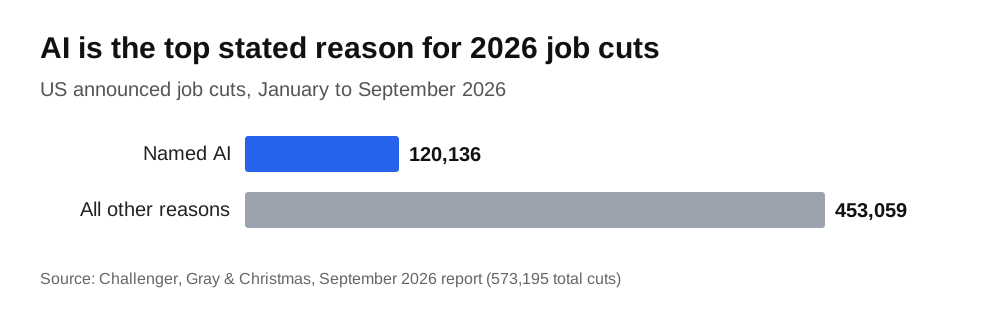
Through September, US employers announced 573,195 job cuts in 2026 and named AI as the reason for 120,136 of them, more than any other reason, according to Challenger, Gray & Christmas. I wrote about what laid-off experts can build next in The Whole World Is Being Reskilled in Real Time.
Challenger counts the reason employers give in their announcements, so the AI number is not an independent measure of what caused each cut, HR Director noted. In October, employers cited AI for 1,265 cuts, the lowest month of 2026, down from a record 38,579 in May. Market and economic conditions have now passed AI as the top reason for the year, at 130,531 cuts, Challenger reported on November 5.
What could slower builds change?
Grid operators are starting to give earlier connections to data centers that agree to cut power use when supply is tight, TrendForce reported. More than 90 gigawatts of power plants built on site with data centers sit in US connection queues, according to Wood Mackenzie, and MSCI found developers moving to on-site generation and new power technology because grid power is scarce.
What happens next?
I'm not sure what happens next. But this is what voters wanted. I'm not a financial advisor, and nothing here is financial advice. For how ownership fits the K-shaped economy, see Own Assets or Be Left Behind.
It feels like we threw out the baby with the bathwater. Data centers were holding up our economy, and they were also driving inflation and job loss. Both things are true.
Related reading: The Whole World Is Being Reskilled in Real Time · Software Dollars Are Moving From SaaS to Custom · Proton Shows People Are the Hard Part of AI
Related reading
Follow what I'm building and backing
I post on LinkedIn and X about the companies I back and the products I build.
Join 2,219 people following along.