Prediction
Why Even Dividend Stocks Aren't Safe Anymore
Keith Brown · Growth & Leadership
Oct 11, 2026 · 4 min read
Even dividend stocks aren't safe. When SpaceX said it would become a U.S. mobile carrier, Verizon, AT&T and T-Mobile had their worst days in decades. Any dividend stock that is purely digital, or exposed to fast change, deserves a second look.
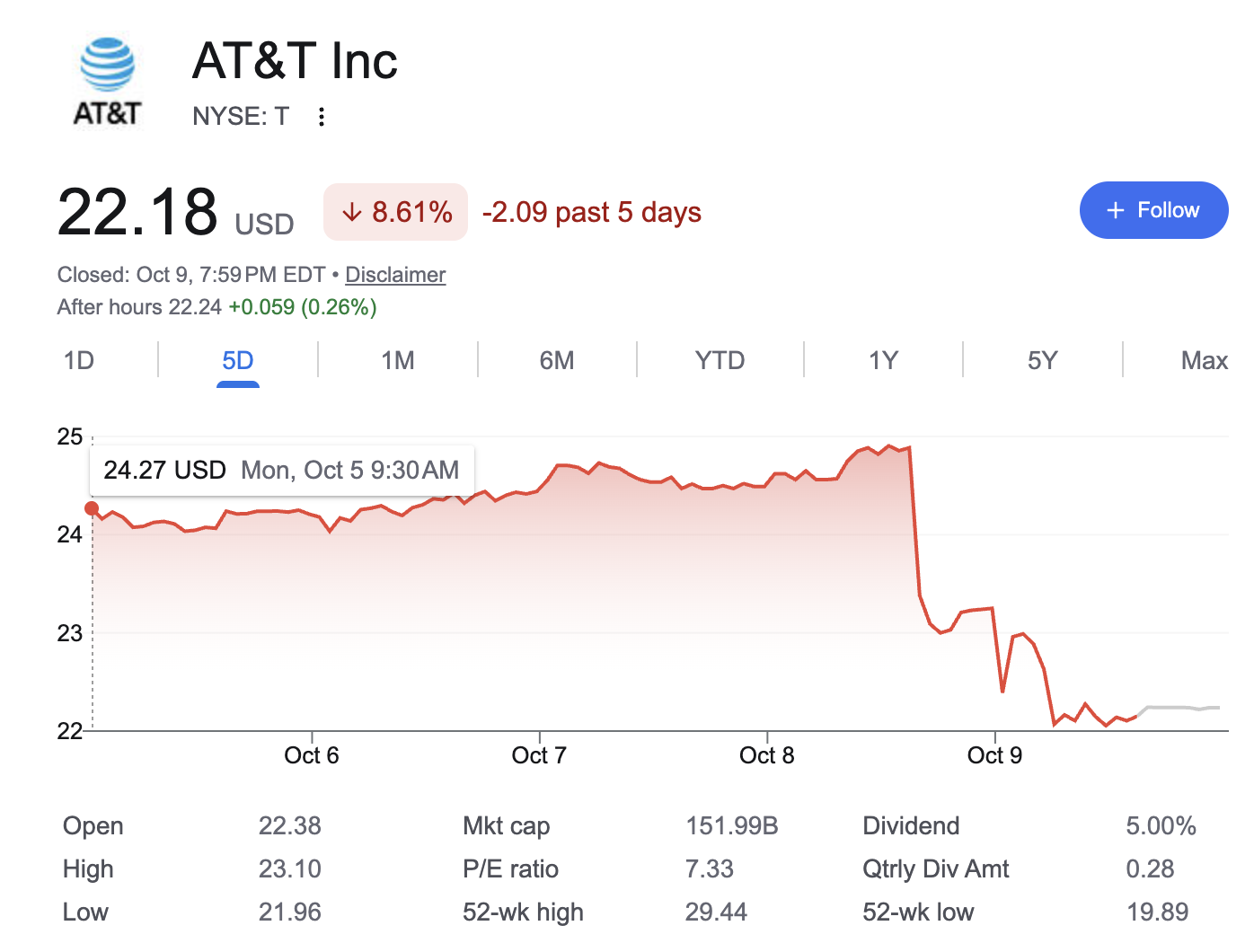
Even dividend stocks aren't safe. On Friday, SpaceX said it will become a U.S. mobile carrier, and Verizon had its worst day since 2002. T-Mobile fell 13.27%, its worst day since 2013, and AT&T fell 9.81%, its worst since 2000.
NBC News reported the three carriers lost more than $50 billion in market value before lunch. This week was 2026 in a nutshell.
A truly great business must have an enduring “moat” that protects excellent returns on invested capital.
I've written about why I'd rather own physical assets than software. Friday showed why, in a part of the market most people thought was safe.
What happened to AT&T, Verizon and T-Mobile?
SpaceX agreed to buy a nationwide block of wireless spectrum and plans to combine it with its Starlink satellites. The new service is called Starlink Mobile, and it still needs final approval from the FCC.
FCC Chair Brendan Carr told CNBC the competition was "really good news for the American consumers." That's true for customers. For shareholders of the three carriers, it was a very different day.
Why do dividend stocks exist?
A dividend stock pays you a share of its profits every quarter. It can do that because its business is supposed to be steady. Steady usually means it has a moat.
Telecom looked like the textbook case. Everyone pays their cell phone bill. Few people like to switch plans, and when they do, they switch to one of the other big carriers. There were no other real options.
Then one company with satellites said it was coming. In a single day, a moat that looked permanent was in question. If you're investing in those companies, running them or working there, that should have been the safe part of your life.
Which dividend stocks deserve a second look?
I'd take a second look at any dividend stock that is purely digital, or exposed to how fast things are changing. That's a longer list than most people think.
- Telecom. Satellites now compete with towers and phone plans.
- McDonald's. GLP-1 drugs are changing how much and how often people eat.
- Coca-Cola and Pepsi. How people eat and drink is shifting with them.
Buffett saw this decades ago. In the same 2007 letter, he wrote that his test for an enduring moat "causes us to rule out companies in industries prone to rapid and continuous change." Today, AI and companies like SpaceX are bringing rapid change to industries that used to be slow.
Who won on Friday?
Not everything fell. Tower owners rallied: Crown Castle rose 15.6%, American Tower 9.3% and SBA Communications 7.34%. Analysts argued Starlink Mobile's new spectrum works best on the ground, with towers.
That fits what I keep seeing. Physical things that are hard to build hold up better than services that can be copied. It's the same reason I think Tesla has passed its tipping point: the hardware and the charging network are the moat.
So what is safe?
I thought telecom and your phone bill were essential. They aren't. What you can count on are the fundamentals of life.
- Water, because people will always drink it.
- Plumbing, because that water has to go somewhere.
- Lights and power, because we can't live in the dark.
- Food and clothing.
- Gas stations, which may become charging stations.
Outside of that, it doesn't feel like anything is safe. That's also why I'm careful with pure software bets, like the ones I wrote about in the Anthropic IPO.
How to check your dividend stocks
- Name the moat. Write down why customers can't leave. If the answer is "habit" or "no other options," it's weaker than it looks.
- Ask who could enter. Look past today's competitors to companies with new technology, money and a reason to want your customers.
- Check how physical it is. Pipes, wires, land and power plants are harder to copy than a subscription.
- Watch the payout. A dividend is only as safe as the cash flow behind it. If growth stalls, payouts often follow.
- Don't let yield do your thinking. A high yield can be a warning sign as often as a reward.
If you lead a company, the same questions apply to you. The AI-proof test takes a few minutes and shows where your business is exposed. I wrote about how to plan through this kind of change in planning five years out.
Disclosure: I own SpaceX and Tesla stock. This is my opinion and not financial advice.
Related reading
Get my monthly newsletter
One email a month with what I'm writing and working on.
One email a month. Unsubscribe anytime.