Prediction
Where I'd Put Money Instead of the Anthropic IPO
Keith Brown · Growth & Leadership
Oct 8, 2026 · 5 min read
Anthropic has built one of the fastest-growing companies ever. I'm still passing on the IPO. As models get cheaper, I think the money in AI moves to the businesses using it and the companies that own the physical side. My guess is the IPO lands after the November midterms.
Anthropic has built one of the fastest-growing companies ever. I'm still passing on the IPO. As models get cheaper, I think the money in AI moves to the businesses using it and the companies that own the physical side.
I bought Reddit when it went public, and I wrote about why I bought Reddit's IPO. So this isn't me being against IPOs. This one just doesn't fit how I invest.
This article covers where I'd put money instead, when the Anthropic IPO is likely to happen, what the S-1 prospectus shows and what the valuation looks like.
What I'd buy instead
If models keep getting cheaper, the winners are the businesses that use them well. Their costs drop every year without them doing anything. The physical side gets paid whether the model on top wins or loses.
- Companies that own the physical layer, like energy, power and shipping.
- Businesses with real customers and real data that get faster and cheaper as AI improves.
- Founders building on top of the models, who can switch providers whenever the price drops.
When is the Anthropic IPO?
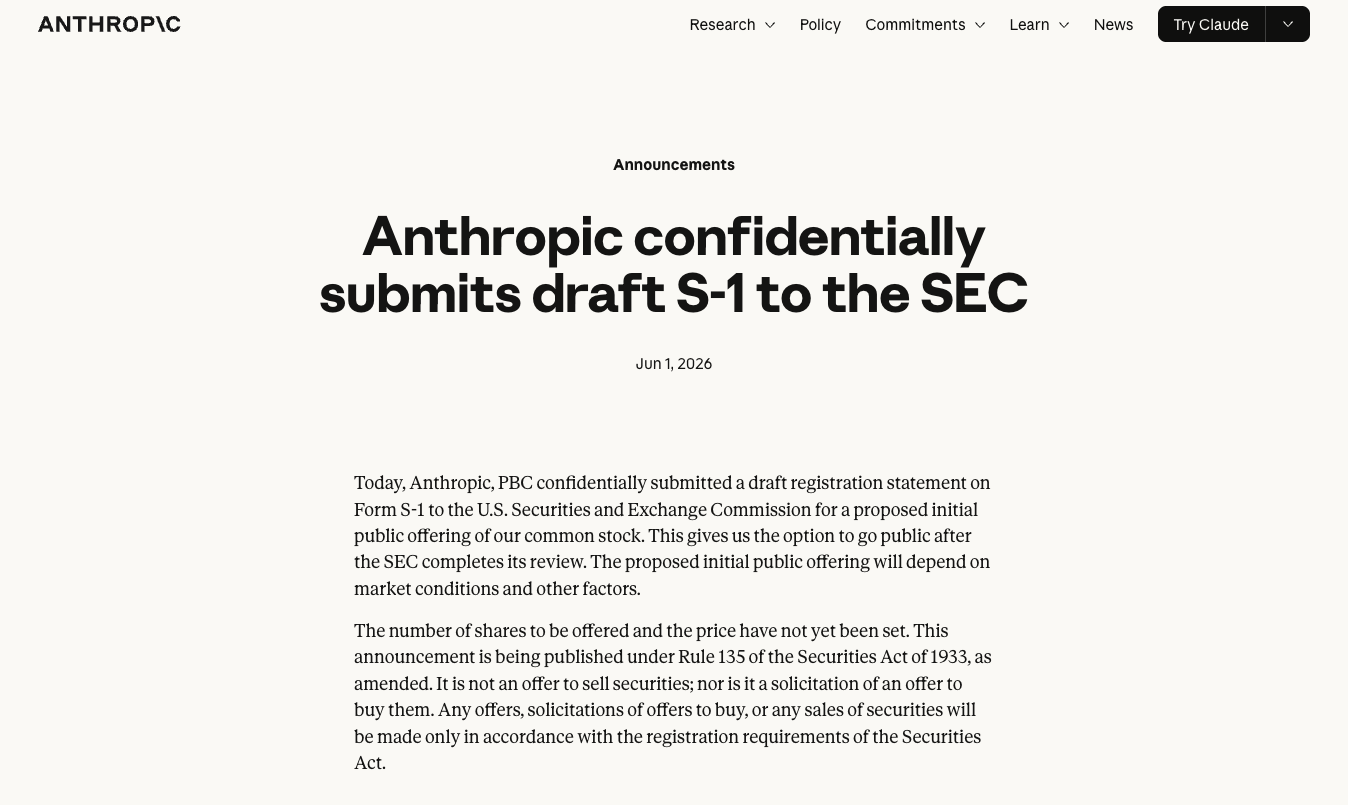
Anthropic confidentially submitted a draft S-1 to the SEC on June 1, 2026. That gives it the option to go public once the SEC finishes its review. The share count and price haven't been set.
Reports now point to a roadshow starting the week of November 9, with trading before Thanksgiving. The midterm elections are November 3.
My call is that Anthropic waits until after the midterms. Election weeks are loud, and a company asking for $2 trillion wants the market calm and paying attention. Once the dust settles, the window opens. That's my prediction, not something the company has said.
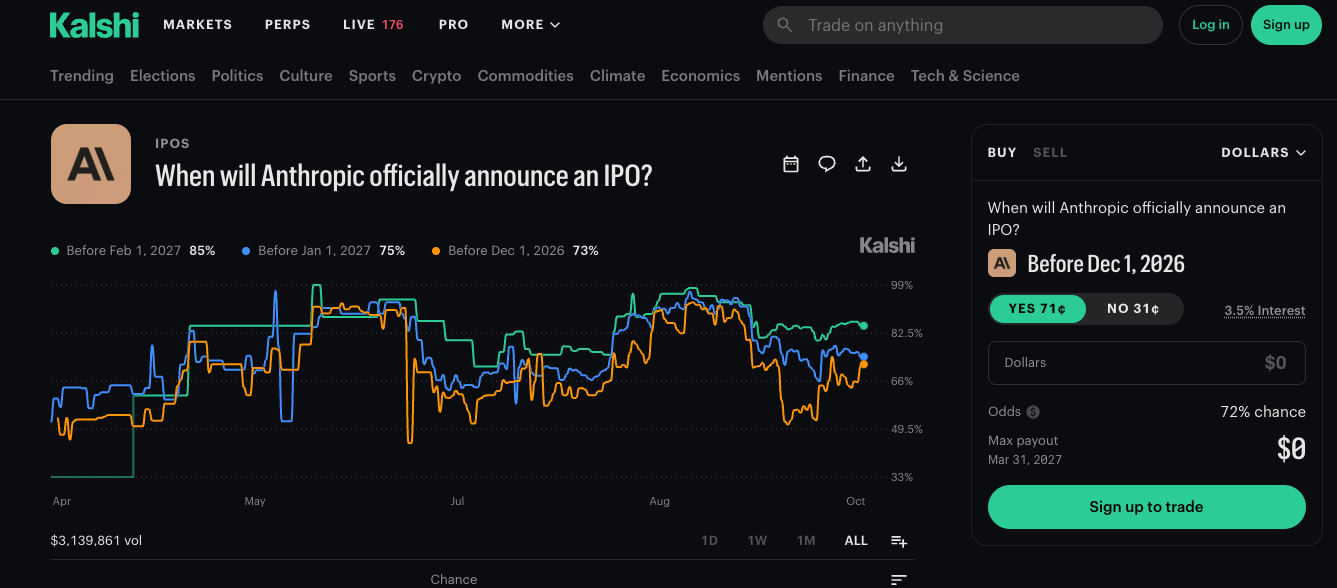
Traders mostly agree on the timing. On Kalshi, the market for an official IPO announcement before December 1 sits around 73%.
Until it lists on Nasdaq, you can't buy Anthropic stock on a public exchange. Anyone selling you shares before then is selling something else.
What the Anthropic S-1 shows
The numbers come from the prospectus, as reported by Reuters.
- Revenue: $4.59 billion in 2025, up 1,088% from $386 million the year before.
- Operating loss: $8.06 billion, up from $2.98 billion.
- Net loss: $41.97 billion, most of it a non-cash charge of about $34 billion.
- Compute and infrastructure: $7.33 billion, up 190%, and 58% of operating expenses.
- Compute commitments: about $518 billion.
- Cash and short-term investments: $20.28 billion at year end.
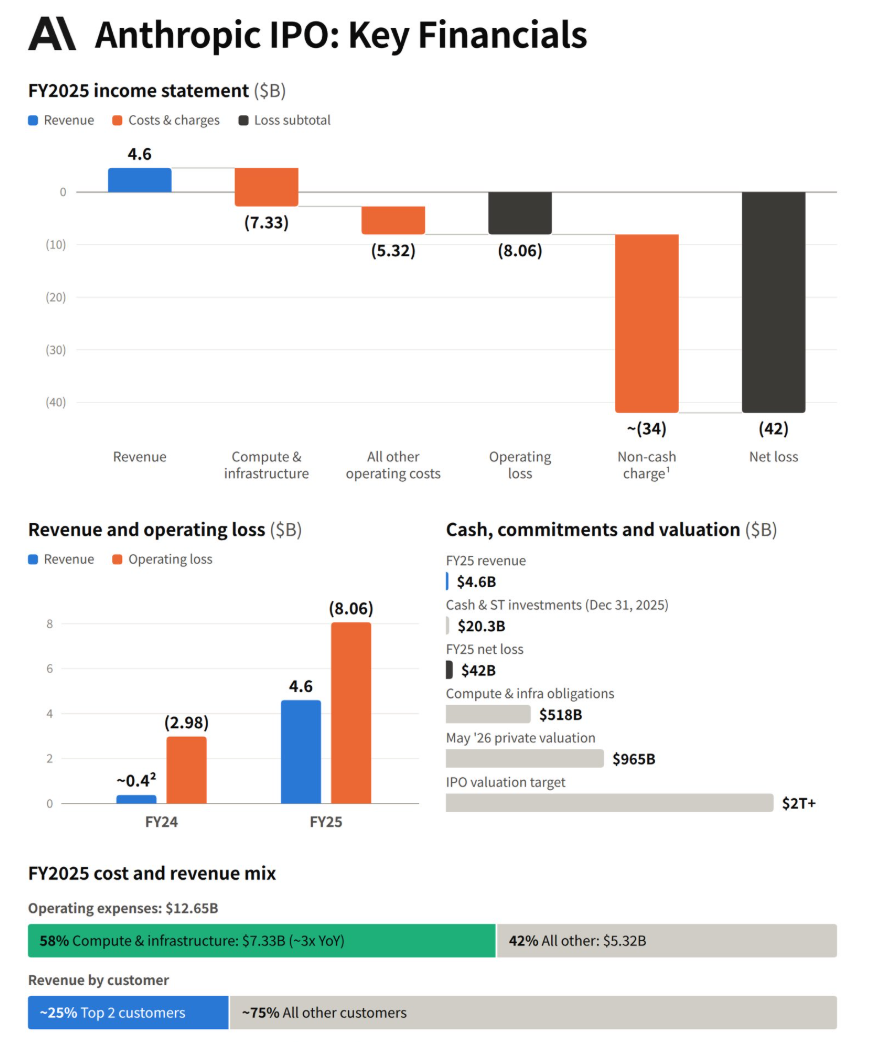
Growth like that is rare. So is spending like that. Every dollar of revenue cost well over two dollars to produce last year, and the biggest cost is the one that keeps growing.
The Anthropic IPO valuation
Anthropic is reportedly targeting a $2 trillion valuation. Its last private round in May valued it at $965 billion. Lawrence McDonald put it in perspective:
2004: Google at $23B mkt cap on $3B revs (so 8x sales). 2026: Anthropic targets $2T mkt cap on a $65B run rate (~31x), but 2025 actual rev was just $4.6B, so 435x on real numbers, w/ a $42B loss.
Chamath Palihapitiya thinks the price comes down. On the All-In Podcast, he put a hypothetical deal at $1 trillion or less in rough numbers. He was clear those were his own estimates, and that he recruits against Anthropic for talent.
It's probably going to clear at a much lower price than anybody thinks.
When I look at a company, I ask what the multiple is paying for. You can run that math yourself in the company valuation tool. At 435 times last year's revenue, the multiple is paying for a future where Anthropic keeps its pricing power for a long time. That's the part I don't believe.
Good enough gets cheap
Look at the last few weeks. Meta's Muse went viral as a personal agent people use to cancel subscriptions and switch insurance. On September 29, OpenAI launched Dots, always-on agents built to take on Muse. Open-source models keep getting better and cheaper underneath all of it.
When every model is good enough, customers pick on price. That's great for the people using AI and hard on the people selling it. I've watched the same thing happen to software, which is why I wrote about what's happening to legacy SaaS.
I'm not the only one saying it. Research firm New Constructs called it "the most ridiculous IPO of 2026", pointing to growing losses and the rise of open-source models.
Two customers, a quarter of the revenue
Anthropic's two largest direct customers each made up 12% of revenue, or 24% combined. The prospectus also warns that many enterprise customers aren't locked into long contracts.
Any buyer of a private company would flag that. If you've ever sold a business to private equity, you know concentration comes up in the first meeting. I wrote about how those buyers think in the spreadsheet PE firms. Public investors deserve the same question.
I also wrote about where Anthropic's biggest users do their work. The biggest users are coders, and coders switch tools fast when something better or cheaper comes along.
AI still has to be built somewhere
AI runs on buildings, power lines and water. More and more people are standing up to them. Reuters reports that voter anger over data centers has become a national issue. Sunbury, Ohio paused data center development until 2027, and Andover Township, New Jersey banned them in every zone.
That matters when you have $518 billion in compute commitments. Every fight over a site adds time and cost, and those costs land on the companies renting the compute.
It's also why I own energy and shipping instead. The physical side of AI gets paid whether the model on top wins or loses. I explained that in why I own tankers and oil companies instead of SaaS.
The risk section they wrote themselves
According to CNBC, citing Reuters, Anthropic dedicated about 80 of the prospectus's 261 pages to risks. It used 48 pages to describe the business. The filing warns that its models could pose a "catastrophic or existential risk to humanity."
I respect the honesty. I also read it as a company telling you, in writing, how much it doesn't know.
For transparency, I own SpaceX, which now includes xAI. I own it for the rockets and data centers, the physical side of AI, for the same reasons I explain here.
I could be wrong on the timing, and Anthropic could prove me wrong on pricing power. If it prices well below $2 trillion, I'll take another look. Either way, cheaper AI is good for every founder reading this.
If you're thinking about this IPO or building on top of these models, let's connect on LinkedIn.
Related reading
Get my monthly newsletter
One email a month with what I'm writing and working on.
One email a month. Unsubscribe anytime.