Deep dive
Where Software Engineers Will Work Next
Keith Brown · Founding Partner, Outperform Ventures
Oct 20, 2026 · 5 min read
Software vendors need fewer engineers. The companies leaving those vendors need more of their own. I think millions of engineers and marketers move from selling technology to running it inside businesses.
This week I had lunch with a VP of Sales. He told me that if his company could replace Salesforce, it would. For now, they're "stuck" with it.
It made me realize something. Salesforce probably needs fewer engineers. The businesses leaving Salesforce need their own now.
So will AI replace software engineers? I don't think so. I think software engineers will change jobs. Everyone is an engineer now, because we can all build, and there's no shortage of things to build.
Nvidia CEO Jensen Huang said the same thing three years ago, on stage at Computex in Taipei, CNBC reported.
We have closed the digital divide. Everyone is a programmer. Now, you just have to say something to the computer.
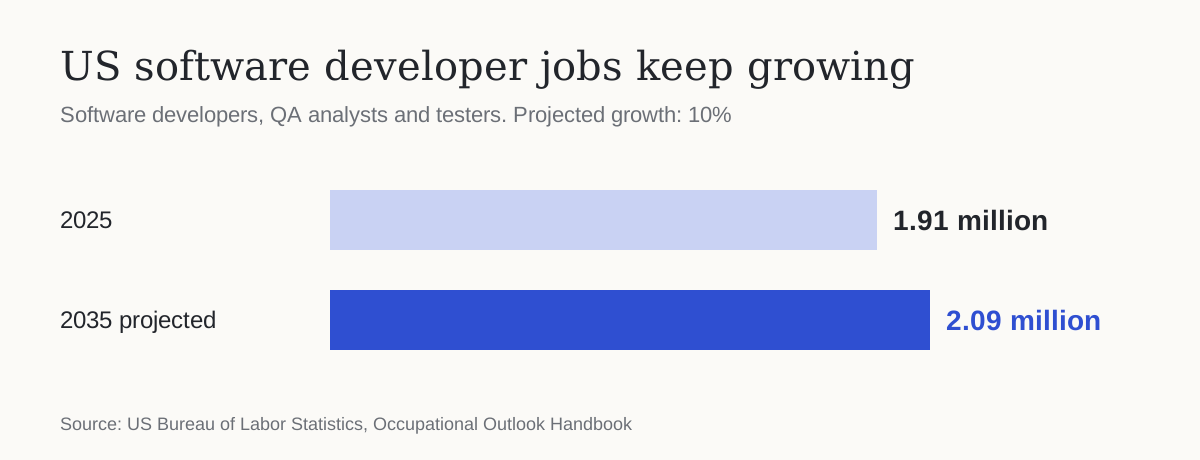
The vendors are already adjusting. Salesforce CEO Marc Benioff said in December 2024 that the company wouldn't add any software engineers in 2025, because AI had raised engineering productivity by more than 30%. Yet the US Bureau of Labor Statistics still projects software developer jobs to grow 10% from 2025 to 2035, from about 1.9 million today. I wrote about how the rest of work is changing in we need a new model for employment.
Buyers want the problem solved
AI is a technology. Technologies aren't readily understood by most end buyers. This is true in software, and it's true in AI.
The software buyer is looking for someone to solve their problem. The AI buyer is looking for someone to solve their problem. Neither is looking to become an expert in technology.
That's why I think there will still need to be engineers around for the foreseeable future. Somebody has to turn a problem into something that works.
Benioff said as much in the same interview. While Salesforce held engineering flat, he planned to add 1,000 to 2,000 salespeople, because, in his words, "we really need to explain to people exactly the value that we can achieve with AI." When the company selling AI needs more people to explain it, the companies buying it will need people to run it.
How companies buy software today
Take software from a pure customer's point of view. Every purchase starts the same way.
- A customer has a problem.
- They search for ways to solve it, or a salesperson or channel partner finds them.
- They decide the best way to solve it is to pay somebody else to solve it.
- They buy Salesforce, then work with Salesforce or a partner to implement it.
- They pay a Salesforce admin to manage it, or hire someone internally to do it.
They're not going to go from doing all of that to doing it all themselves. That's the part of the AI conversation I think people miss.
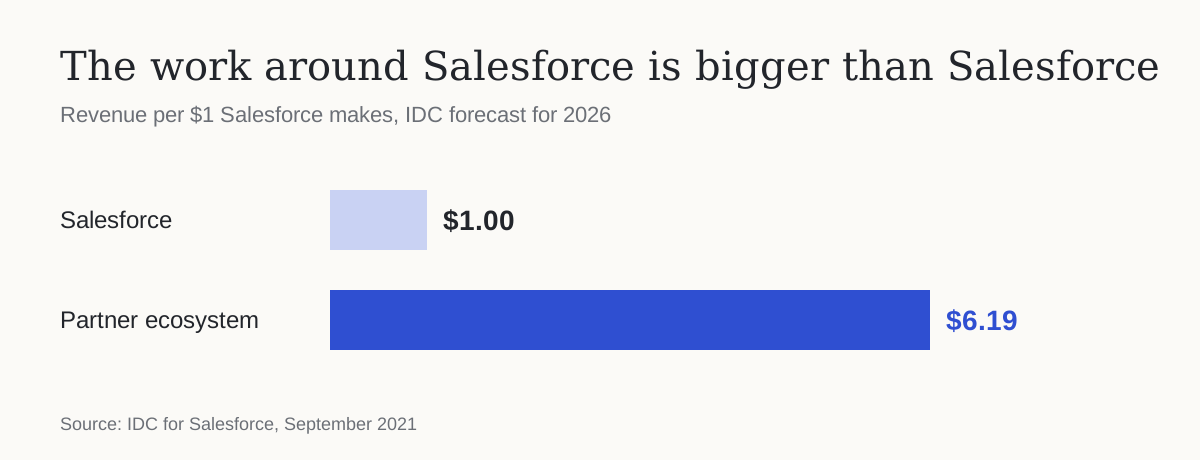
The money around a piece of software has always been bigger than the software. In a study Salesforce commissioned, IDC forecast that Salesforce and its partners would create 9.3 million new jobs by 2026, and that partners would earn $6.19 for every $1 Salesforce makes. Most of those jobs are people implementing, connecting and running the software inside other companies.
Will companies build their own software with AI?
As it gets easier to build internal tools, the whole idea behind SaaS starts to fall apart. Companies don't need to rent a tool built for everyone when they can build one built for them.
It's already happening. In Retool's 2026 build vs. buy report, 35% of the 817 builders surveyed said their team had already replaced at least one SaaS tool with a custom build, and 78% expected to build more this year. CRM and sales tools were among the most common things replaced, at 25% of teams. Retool sells tools for building software, so read that with some care. It still matches what I hear from leaders like the VP of Sales.
I don't think buyers are going to vibe code their own SaaS, meaning build it themselves by describing it to an AI. I think they'll pay someone to, because that's the behavior. They paid someone to implement Salesforce. They'll pay someone to build and run whatever replaces it.
And building is the easy part. Running software well for years is the work, as I wrote in beehiiv's CEO on vibe coding and the long game. Every internal tool a company builds needs someone to keep it working.
Where engineers go next
I don't know exactly how many engineers exist. Add in marketers, content writers and digital marketers, and it's probably millions of people.
I think that whole pool shifts. Fewer of them work for the company that sells the technology. More of them become the people implementing that technology inside businesses, either as employees or as people the business pays to do it.
That looks a lot like the small core and wide circle of people I described in the new model for employment. It also explains why the platforms are fighting so hard over who connects to whom, which I covered in the Integration Wars.
It won't be painless. Vendors will keep trimming engineering teams, and entry-level jobs are already harder to find. Most of the work moves closer to the customer.
What leaders should do now
Whichever side of this you're on, a few things are worth doing this quarter.
- If you're stuck with a tool. Write down the three workflows you'd rebuild first if you could. Start with one small internal tool and see what it takes to run it for six months.
- If you're hiring. Look for one engineer who wants to learn your business. Someone who understands how you sell, bill and serve customers is worth more than someone who only knows a framework.
- If you sell software. Your customers' own engineers are becoming your buyers. Make it easy for them to build on top of you, or they'll build around you.
- If you're an engineer. Pick an industry and learn it. Sales operations, finance and marketing all need people who can build.
If you want to test your own company, my AI-proof business check takes a few minutes.
The VP of Sales I had lunch with won't write the code himself. He'll hire someone who can. That person will sit inside his company, close to his team and his customers. I think that's where a lot of engineers will work next.
Related reading
Get my monthly newsletter
One email a month with what I'm writing and working on.
One email a month. Unsubscribe anytime.