Prediction
Welcome to the Integration Wars
Keith Brown · Growth & Leadership
Oct 9, 2026 · 6 min read
The open web ran on two assumptions: users are human, and platforms are hard to build. Both are gone. When any partner can rebuild you, every integration teaches them how. I think platforms will stop sharing, and the open web will start to close.
On October 7, RealPage paused new EliseAI activations. In August, ServiceTitan shut off Podium's integration for about 1,000 shared customers after nine years as partners. Both platforms cut off a partner that was building a replacement for them. I understand why they both did it.
When software is this easy to build, the company plugged into your platform can rebuild it using your own customers. I learned that lesson early, watching Google crawl my old employer.
What Superpages taught me about integrations
My first job after the financial crisis was at Superpages.com. We had the largest nationwide directory of businesses.
When Google reached out to "better crawl our directories," I was excited. Our internal SEO app was massive, thousands of cities multiplied by hundreds of business categories. I kept a second computer running at my desk just to watch Google crawl our rankings all day.

We played nice. Then Google used our data to seed what is now Google Business Profiles.
Not every integration ends well. We worked hard to make it easy for them, and that made it easy for them to replace us.
Two assumptions that no longer hold
I see the same thing happening today, at a much bigger scale.
Sending traffic and passing data freely worked because of two assumptions.
- Users are human. The internet was open because it served human browsers.
- Platforms are hard to build. Integrations were safe. Replicating a partner's tech took years and distracted from your core business. You couldn't just copy and replace them.
The first one is already gone. Imperva's 2025 Bad Bot Report found that automated traffic passed human traffic for the first time in a decade, at 51% of all web traffic. Bad bots alone made up 37%, up from 32% the year before. It's the same reason I think human marketing wins when bots outnumber people.
The second one is going just as fast. It has never been easier to build software. Both are changing at the same time, so every platform is now nervous about who it lets in.
I wrote about what agents do to subscription businesses in why recurring revenue is about to get a lot less recurring. Integrations are the same story from the other side.
Now software is replacing software
In 2011, Marc Andreessen wrote Why Software Is Eating the World in the Wall Street Journal. His sharpest example was an integration deal. It was about Borders and Amazon.
In 2001, Borders agreed to hand over its online business to Amazon under the theory that online book sales were non-strategic and unimportant. Oops.
Borders thought it was outsourcing a side channel. It was teaching its replacement how to sell books. That's the Superpages story with a different logo.
Andreessen was right about software taking over traditional businesses. What he couldn't have known in 2011 is that software would one day be cheap enough to replace other software. Building a competing platform used to take years, a big team and a lot of money. Now a well-funded agent company can rebuild the parts it needs while it learns from yours.
So every partnership looks different now. In 2011, plugging into a bigger platform was how a small company grew. In 2026, it's also how a small company studies the platform it plans to replace. The firm Andreessen co-founded, Andreessen Horowitz, just led EliseAI's latest round.
When rebuilding is easier than integrating, the platform stops being a moat.
What happened between ServiceTitan and Podium?
ServiceTitan runs scheduling, dispatch and invoicing for home services contractors. Podium sat in front of it for nine years, handling texting, webchat and review requests, and writing leads, payments and conversations into the ServiceTitan record.
Then Podium went all in on AI agents. Jason Lemkin at SaaStr reports that ServiceTitan gave roughly 1,000 shared customers about 30 days' notice that the Podium integration was being switched off, in the middle of peak HVAC season.
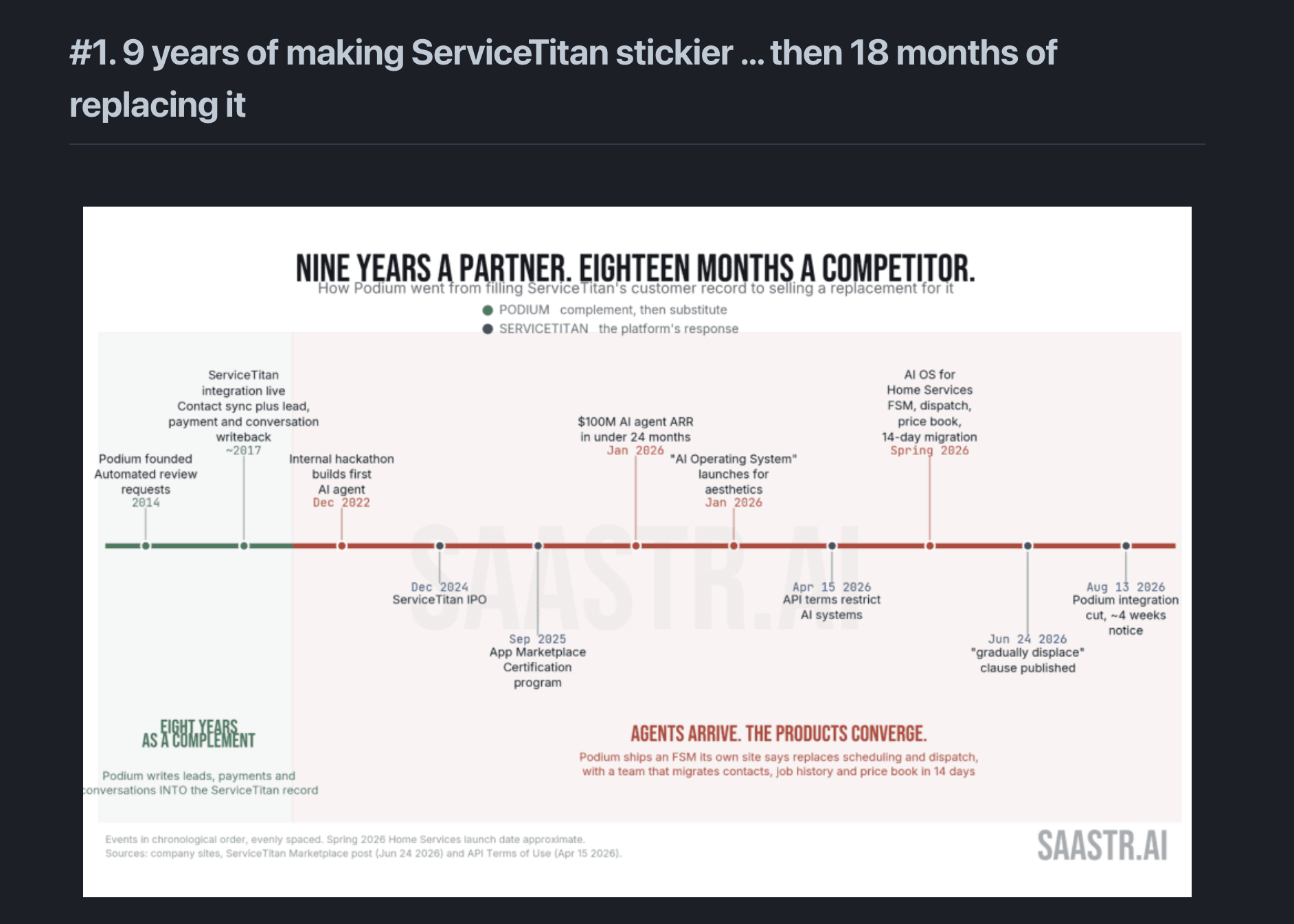
- Podium built a replacement. It now sells its own field service software that it says replaces scheduling and dispatch, with a team that migrates your contacts, job history and price book in 14 days.
- ServiceTitan wrote the rule down first. Its marketplace policy welcomes competitive partners "as long as they're not leveraging the partnership and our support to gradually displace additional parts of ServiceTitan."
- Its API terms changed too. As of April 15, 2026, they bar AI systems from independently choosing which endpoints to call.
Podium co-founder and CEO Eric Rea explained why Podium built its own system.
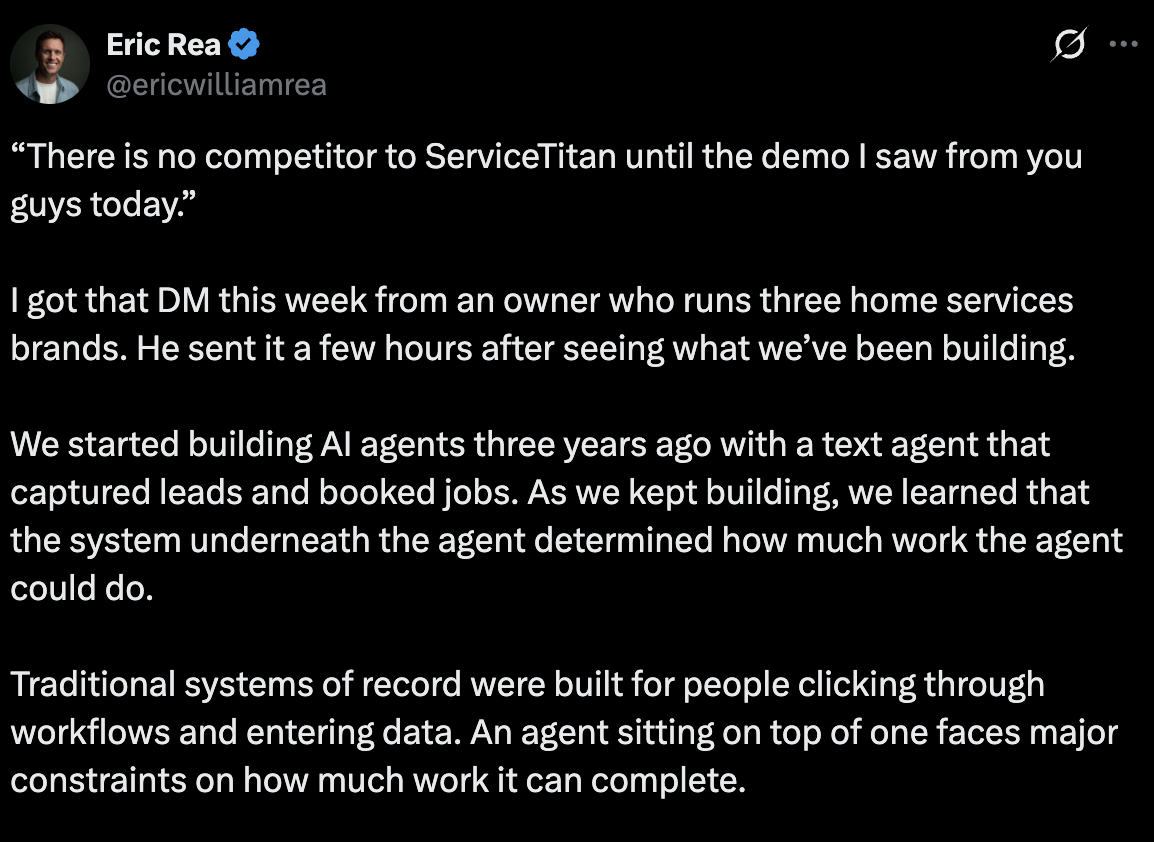
The agent needs the record, so the agent company builds the record. Lemkin put it this way: "AI agents made the layer in front good enough to absorb more of the layer behind."
Why did RealPage cut off EliseAI?
On October 7, RealPage told its customers it had paused all future site activations with EliseAI. Existing setups stay in place, at least for now. New ones are suspended indefinitely. Brad Hargreaves at Thesis Driven broke down the details.
- The size of the upstart. EliseAI just raised $350 million led by Andreessen Horowitz at a $4 billion valuation, and says more than 6.5 million apartment units use its software.
- The trigger. EliseAI launched a new agent called Apollo last month. Its product page says it "sees across silos," working across maintenance, leasing and operations.
- It isn't the first time. Earlier this year, CRM company Funnel tied EliseAI's access to a promise not to copy certain features.
I understand why RealPage did it.
Not everyone reads it that way. Guillermo Salazar, a proptech founder, posted that RealPage just told the world it's scared of EliseAI.
Closing a door rarely comes from a position of strength, it comes from fear & weakness.
He may be right about the fear. Given how cheap software is to build now, it's a reasonable fear.
Your integration partners are building you
There is nothing stopping Elise from replicating the entire RealPage monolith over the next few years in an AI-native way. Platforms don't really get to opt out. Your integration partners are building you, and you are building them.
That's why I've argued legacy SaaS is worth its data, and why headless CRMs train customers to stop logging in. Once the agent does the work, the system of record is the only thing left to defend.
My prediction is that cutting off partners like this becomes normal in 2027.
Why platforms are closing the door
RealPage could either watch Elise slowly rebuild their platform using their own customers, or protect it. I understand why they chose to protect it.
A two-way integration gives a partner your customers, your data and a close look at how your product works. That used to be safe. It isn't anymore.
I'm not picking a side. But I understand RealPage standing up for their business, their customers and thousands of their employees around the world. Cutting off an integration partner in 2026 is not the same as doing it in 2018.
Most platforms in RealPage's position would make the same call.
What founders should do now
Assume everyone is trying to build everything.
- Know what you're handing over. Every field a partner can read is a field they can learn from.
- Price in the rebuild. If your team says rebuilding is easier than integrating, your competitors' teams are saying the same about you.
- Own something they can't copy. Customers, trust and things in the physical world are harder to rebuild than code. I explained that in why I own tankers and oil companies instead of SaaS.
Now we'll find out whether Elise can stand on its own as a platform.
For transparency, I worked at RealPage from 2012 to 2014.
Related reading
Get my monthly newsletter
One email a month with what I'm writing and working on.
One email a month. Unsubscribe anytime.