Prediction
Remote Work Exposed the Illusion of Measuring Output
Keith Brown · Founding Partner, Outperform Ventures
Sep 2, 2021 · 5 min read
Many companies measured presence because it was easy. The fight over offices is really a fight about measuring output.
Remote work didn't create a productivity problem. It exposed one. For years many companies measured hours and presence because they were easy to see, and called it output. When people left the office, the gap between what leaders assumed was getting done and what was getting done became impossible to ignore.
The fight over the office
We are in the midst of the one of the most fascinating shifts in modern labor. Businesses are desperately trying to get teams back to the office, while many people are considering whether they even want to work at all.
The culprit is not remote work, millennials, or corporate real estate. Those are a red herring. The central issue is productivity.
If I hired a brilliant engineer that could code more in 25 hours than a mediocre one could in 40 hours, would I care if she worked 25 hours a week? Not really.
If I hired an amazing admin who could balance a calendar and optimize my world, would I care if he could do it in 30 hours a week instead of 50? Nope.
What I mean by the illusion of output
The gap that exists is what I call the illusion of output. The gap between what a company assumes is done each week and what is actually accomplished each week.
Organizations by their nature are terrible at translating goals and initiatives from the top all the way down through the entire organization. And now some of the smartest people in the world, have had 2 years to think about this gap. Even if they don’t have a name for it.
This isn't a new idea. In 1955 the historian C. Northcote Parkinson wrote in The Economist that "work expands so as to fill the time available for its completion." If the week is 40 hours, the work takes 40 hours. Time becomes the measure because time is easy to count.
Why hours became the measure
Counting hours is simple. A manager can see who is at a desk at 8am and who is still there at 6pm. Measuring results is harder. It means someone has to decide what a good week looks like for each role, write it down, and check it.
Andy Grove, the former CEO of Intel, argued in High Output Management that a manager's output is the output of the team they lead and the teams they influence. By that standard, a manager who tracks attendance and not results isn't measuring their own job either.
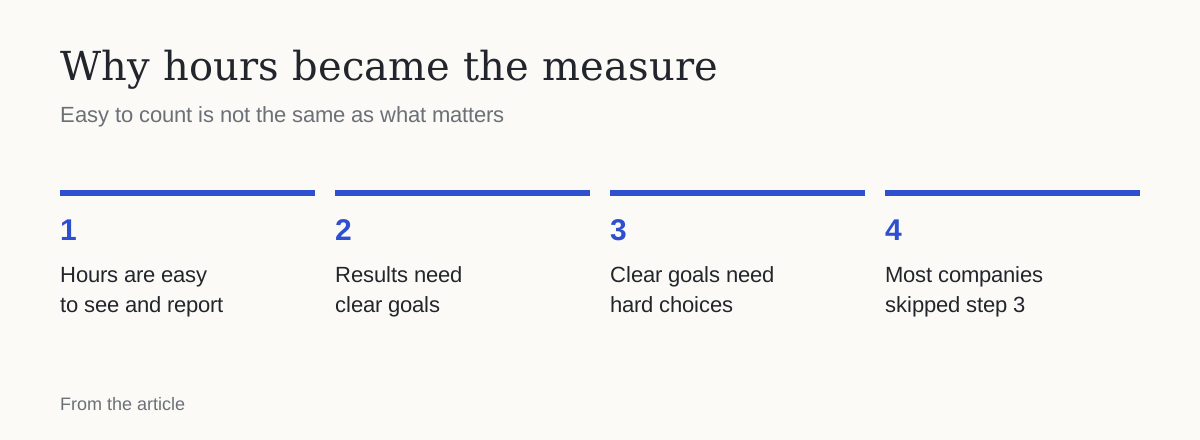
- Hours are easy to see and easy to report.
- Results require clear goals for every role.
- Clear goals require leaders to make hard choices about what matters.
- Most companies skipped that last step and let the 40-hour week stand in for it.
What people did with the gap
People are quitting their job in record numbers, working multiple jobs, getting raises, and exploiting this gap to their advantage.
The 40-hour workweek has stood in as a poor replacement for well-written strategy and great middle management. That illusion is now gone. And while it’s easy for companies to blame remote work, the location where employees work is irrelevant.
The research backs this up. A Stanford study led by Nicholas Bloom, published in the Quarterly Journal of Economics, followed call center employees at a large Chinese travel company who were randomly assigned to work from home. Their performance went up 13%, and fewer of them quit. Where they sat mattered less than whether their work could be measured.
Clear goals are the whole game
Work from home? Try work from anywhere. That is where we are headed. And it only needs one thing to thrive. Clear goals.
Corporate America doesn’t realize it yet, but they are geared for remote work. The typical earnings call has a “give me the highlights and don’t waste my time” feel to it. No filler, no illusion of output, just results.
If a CEO can report a quarter to investors in an hour, a team can report a week to its leader in a few lines. What shipped, what moved, what's stuck. That's enough.
How to close the gap on your team
- Write down what a good week looks like for each role, in results.
- Share company goals all the way down, so every person can connect their work to one of them.
- Review results weekly. Stop reviewing hours.
- Fix the structure when the same problem keeps coming back. I wrote about that in fixing structural problems.
- Protect time to think. Activity is easy to fake, as I learned again on a morning in New York.
What leaders get wrong about return to office
Bringing everyone back to a desk can bring back the feeling of control. It doesn't bring back clarity. If nobody knew what a good week looked like before, nobody will know when they're sitting next to each other again.
The companies that handle this well start with the work. They decide what each team owns, how it's measured and how often it's reviewed. Then they decide where people should sit to do it. Some roles need a room together. Many don't.
- If a team needs to build trust fast, time together helps.
- If a team needs focus, quiet time anywhere helps more.
- If a team has no clear goals, no office policy will fix it.
None of this depends on where people work. It depends on leaders doing the hard part of deciding what matters. The same pressure is now reshaping management itself.
A simple weekly check
Each Friday, ask every person on your team for three lines. What did you finish? What moved because of it? What's blocking you next week? It takes five minutes to write and five to read. Within a month, you'll know who is producing results and where the company is stuck.
Is it really that hard to imagine a future in which companies only care about results, instead of where and when you work?
Related reading
Follow what I'm building and backing
I post on LinkedIn and X about the companies I back and the products I build.
Join 2,219 people following along.