Deep dive
Should You Raise Money or Bootstrap?
Keith Brown · Founding Partner, Outperform Ventures
Mar 12, 2025 · 5 min read
Raise when speed decides who wins your market and you can use the money to grow faster than you otherwise could. Bootstrap when customers can fund your growth and the market will still be there in three years. Both paths have costs. Venture costs ownership and control. Bootstrapping costs time.
I've helped founders for free, for equity, and with my own money. I've seen both paths work, and both go wrong.
Most founders decide by default
Many founders raise because it's what founders are supposed to do. Others refuse because they've heard horror stories.
Neither is a decision. The right answer depends on your market, your business model, and what you want your life to look like.
What raising costs
- Ownership. Each round sells part of the company. After a few rounds, founders often own far less than they expect.
- Control. Investors get board seats and approval rights over big decisions.
- Expectations. Venture money expects a very large outcome. A good business that sells for a modest price can be a failure on their spreadsheet.
- Time. Fundraising takes months away from customers.
What bootstrapping costs
- Speed. You grow at the pace customers can pay for.
- Risk to you. Your savings, your salary, sometimes your house.
- Market position. A funded competitor can outspend you on sales and hiring.
When raising is the right call
- The market rewards whoever gets big first.
- You need to build something expensive before anyone can pay for it.
- You can show that more money turns into more growth, not just more burn.
When bootstrapping is the right call
- Customers will pay early, and margins can fund growth.
- The market is real but not winner-takes-all.
- You want to keep control and can live with steadier growth.
Common mistakes
- Raising to avoid finding product-market fit.
- Taking money from investors whose expectations don't match the business.
- Bootstrapping out of pride when the market is clearly moving fast.
- Not modeling what you'd own after two or three rounds.
That last one is worth doing before you take a meeting. The Exit Math tool shows what you'd actually take home after each round.
You can do both
Plenty of founders bootstrap to real revenue and then raise once, on their terms. Revenue gives you leverage that a pitch deck never will.
What venture money is built for
Venture capital is designed for one kind of company. Paul Graham defined it in his essay on growth:
A startup is a company designed to grow fast.
Venture funds need a few very large outcomes to make up for the many companies that fail or return little. So they look for companies that can grow very fast in very large markets.
If your business is healthy, profitable and growing steadily in a smaller market, that doesn't make it a bad business. It makes it a bad fit for venture money. Plenty of great companies fall in that group.
A bootstrapped company can get very big
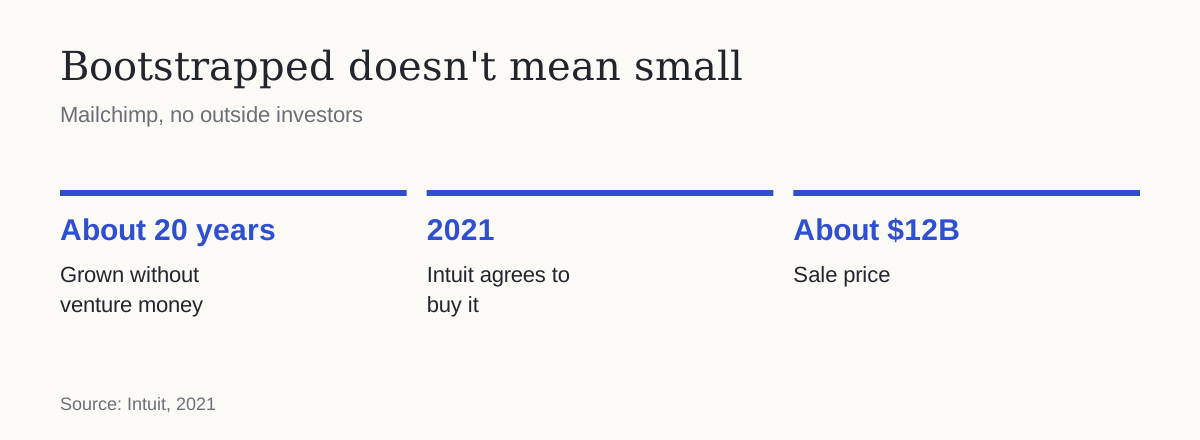
Bootstrapping doesn't mean staying small. Mailchimp grew for about twenty years without outside investors. In 2021, Intuit agreed to buy it for about $12 billion.
That's rare. But it shows that customers can fund a company all the way to a very large outcome when the margins and the market allow it.
Other ways to fund growth
Raising equity and paying for everything yourself aren't the only choices. Many founders use a mix.
- Customer prepayments. Annual contracts paid upfront fund the next hire.
- Bank and government-backed loans. The U.S. Small Business Administration backs loans for small businesses through approved lenders.
- Revenue-based financing. Repaid as a share of monthly revenue instead of giving up ownership.
- Angel investors. Smaller checks from people who may bring experience along with the money.
Each one has its own cost and risk. Debt has to be repaid even when things go badly. Angels still take ownership, just less of it.
Questions to answer before your first meeting
- How much do I need, and exactly what will it buy?
- How much of the company will I own after this round, and after two more?
- What size of exit do these investors need for this to work for them?
- Would I still take this money if growth took twice as long as planned?
If those answers make you uneasy, keep building with customer revenue for now. The Valuation tool can show what the company might be worth at each stage, which helps you judge whether a round is priced fairly.
How to choose investors if you raise
If you decide to raise, who you take money from matters as much as how much. An investor is a long relationship, often longer than most jobs.
- Talk to founders they've backed. Especially the ones whose companies struggled. That's when you learn how an investor behaves.
- Ask what they need the outcome to be. A large fund needs a much bigger exit than a small one.
- Understand what they'll help with. Introductions, hiring and future rounds are worth more than advice alone.
- Read the terms, not just the valuation. Preferences, board seats and approval rights shape the next ten years.
A slightly lower valuation from the right partner is often a better deal than a higher one from the wrong one.
How to stay bootstrapped longer
If you choose to bootstrap, a few habits make the money last.
- Charge from day one, even if the price is low.
- Ask for annual payment upfront in exchange for a discount.
- Hire slowly, and only when a role pays for itself.
- Keep at least six months of expenses in the bank.
Steady, profitable growth gives you options. You can raise later from a position of strength, sell, or keep building on your own terms. Whichever you choose, know what you'd take home when you sell before you sign anything.
You can change your mind later
This choice isn't permanent. Many companies bootstrap until they've proven what works, then raise money to grow faster. Others raise early and later pay down investors or buy back shares. What matters is choosing on purpose for the next stage. The raise or bootstrap tool helps you compare.
Find your answer
The Raise or Bootstrap test asks ten questions about your market, model and goals and gives you a clear recommendation. For the deeper version, read Should I raise money, or stay bootstrapped?
Related reading
Follow what I'm building and backing
Updates on the companies I invest in, the products I build and what I learn along the way.
- New companies I'm backing through Outperform Ventures
- Products I'm building, as they launch
- What's working and what isn't, as it happens
Unsubscribe anytime.