Founder Mode vs. Founder Drift

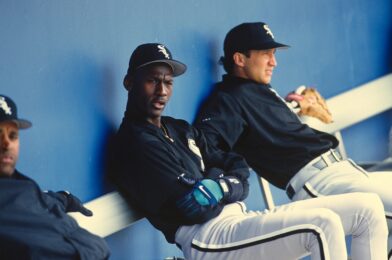
There’s a photo of Michael Jordan from 1994, sitting in a White Sox dugout in full uniform, looking like he isn’t quite sure he belongs there. He didn’t. He’d walked away from the best basketball career alive to go play minor league baseball, and he’d hit around .200.

Nobody remembers him as a baseball player, and there’s a reason for that: being generational at one thing has never once meant being generational at everything, not even for him.

Founder Mode” is a real term now. Paul Graham coined it in 2024 after watching Airbnb’s Brian Chesky describe how conventional management advice (hire great executives, delegate, get out of the way) had nearly wrecked his company. It describes a founder who stays hands-on in the details of the business that made them a founder in the first place, instead of stepping back from it.

I want to name its opposite, because we don’t have a clean word for it yet: Founder Drift. Same intensity, same obsessive energy, aimed at anything except the company that made them a founder. A side project. A newsletter. A second, third, or fourth venture. The shiny new thing instead of the one already staring them in the face.

Three people are running this experiment live right now, in public, with quarterly earnings as the scoreboard. Two are in founder mode: Brian Niccol at Starbucks and Brian Chesky at Airbnb. One is drifting: Dharmesh Shah at HubSpot.

Founder Mode

Brian Niccol took over Starbucks in September 2024, inheriting the company’s worst same-store sales stretch since COVID. Starbucks’ previous CEO had tried to modernize and expand his way out of the slump. Niccol didn’t reinvent anything.

“Back to Starbucks” meant reintroducing seating, bringing back ceramic mugs, and cutting the discounting that had trained customers to wait for a deal instead of walking in for a coffee. It also meant renovating stores, about $150,000 a location, more than 1,000 “uplifts” completed by mid-2026, 1,500 targeted by fiscal year-end. The plan adds roughly 25,000 café seats across the U.S. by the end of the fiscal year.

The results, reported quarter over quarter: four consecutive quarters of same-store sales growth. Q2 fiscal 2026 alone delivered U.S. comparable sales up 7.1%, transactions up 4.3%, revenue up 9% to $9.5 billion, and net earnings up 33% to $510.8 million. It was the company’s first simultaneous top- and bottom-line growth quarter in more than two years.
By Q3, Starbucks was raising guidance again, with refreshers alone now a $2 billion product platform. Niccol’s own description of the quarter, on the earnings call: “the turn in our turnaround.”

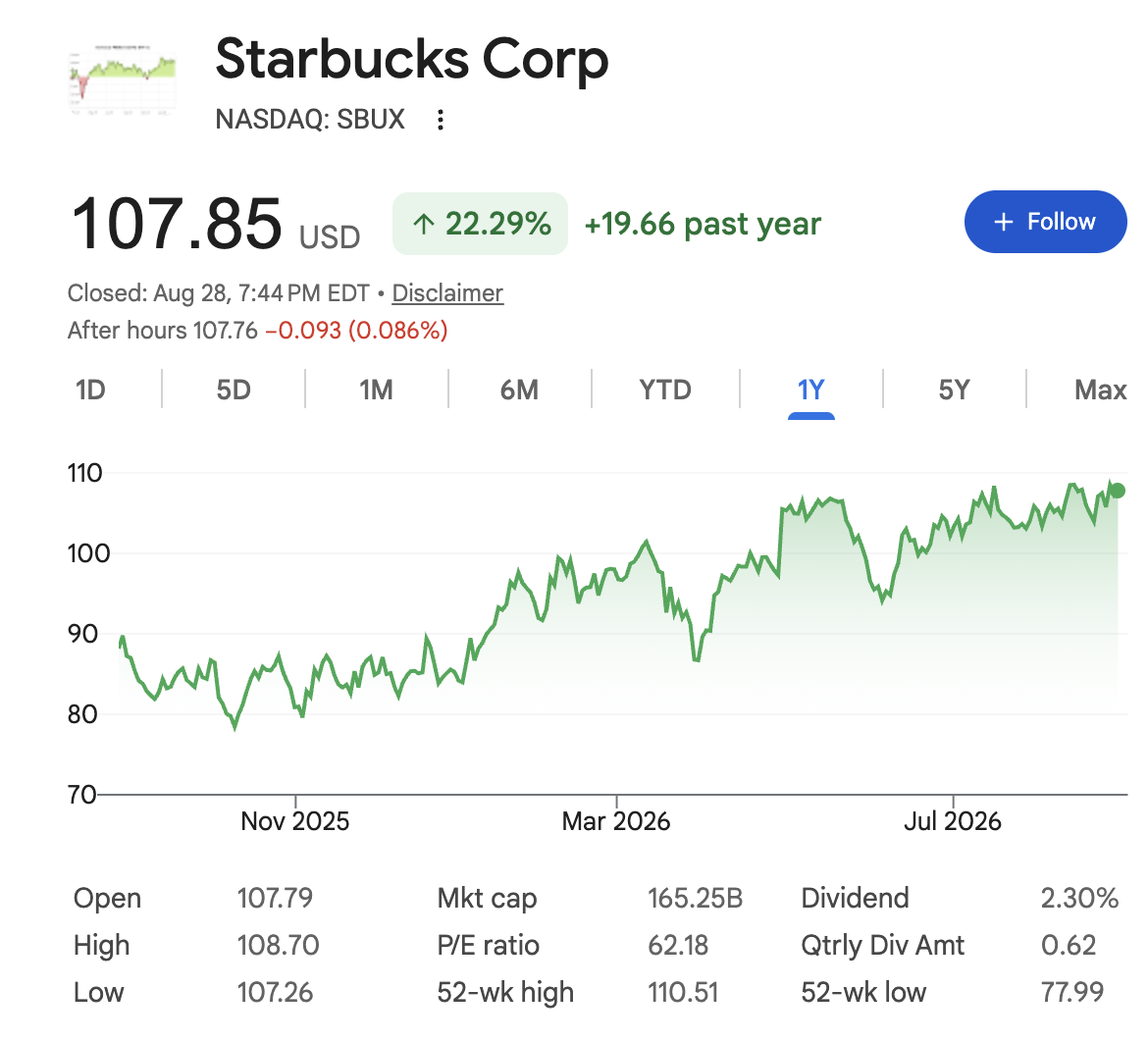
Starbucks’ own stock is up 22% over the past year, within a few points of its 52-week high. It’s the same playbook that took Chipotle’s stock up more than 770% during his six-year tenure there, while restaurant-level margins climbed from roughly 19% to nearly 29%. Zero new business lines. All discipline.

Brian Chesky is the cleanest version of the idea, because there’s already a name for what he does, and it’s the name this whole piece is borrowing. At an 8,200-employee company, Chesky has been explicit that he stays personally involved in decisions most CEOs delegate away entirely: hiring, firing, promotions, performance.
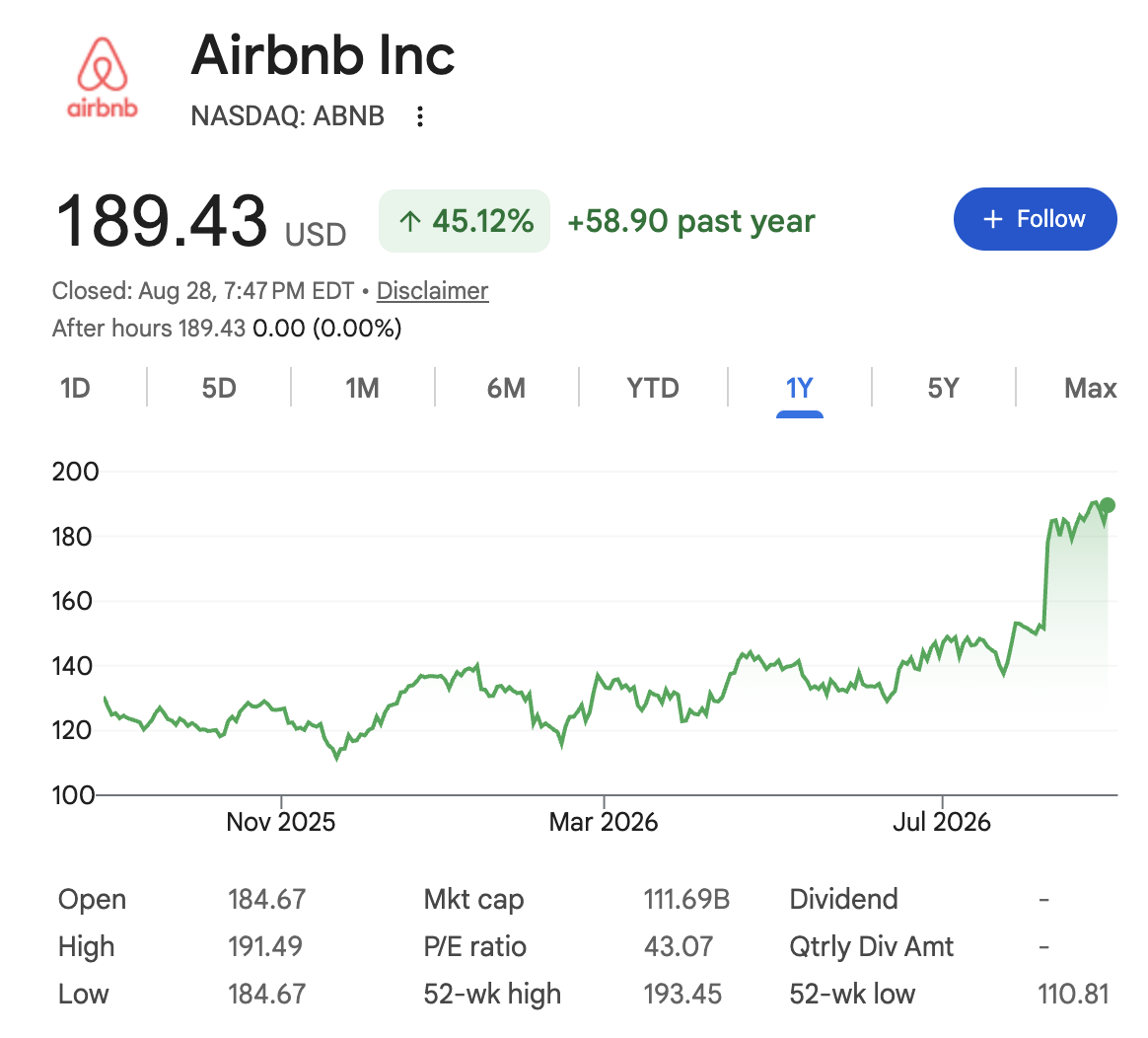
Airbnb posted Q2 2026 revenue of $3.6 billion, up 16% year over year and ahead of Wall Street’s expectations, while the stock is up 45% over the past year. Chesky’s current bet is that founder mode gets more important in an AI world, not less.

With AI now writing 60% of Airbnb’s new code, his argument is that the winners of this era will be “founder mode, not manager mode” companies, the ones where the person with the most at stake stays closest to the details instead of delegating them away.

Founder Drift

I got the idea for this piece sitting in one of Starbucks’ redesigned stores this morning, drinking coffee out of a real glass mug. I’m scrolling X and I see Dharmesh announcing his own CRM. I was super sad. Here’s someone I’ve looked up to for most of my adult life, doing the very thing I strongly encourage entrepreneurs not to do.

I’m already thinking about Niccol being in founder mode. Now I’m watching another founder do the opposite, live, in real time. So I go to HubSpot’s team page. Surely he’s stepped down then to start his own CRM? Nope, still CTO.

I go to his X bio next. Surely it explains what he’s doing, or at least says “former CTO.” Nope. I’m so confused, and then I scroll through X and see a post about focus. And now I’m even more confused.

In the AI-native world, the real thing HubSpot gets from its co-founder and CTO is distribution. Every hour Dharmesh spends generating hype for ChatSpot (2023), then Agent.ai (2024, now past 2 million users), then a newsletter about AI agents, then YouSpot, is an hour that same brand equity isn’t being spent convincing the market that HubSpot’s actual AI answer, Breeze, is the real one.

YouSpot is a $1-a-month AI-native CRM launched in 2026 that, by its own framing, challenges the assumptions HubSpot itself was built on. Of course, he goes out of his way to say this doesn’t compete with Hubspot.

It’s just hard to see how the HUBS board approved their CTO to start another CRM instead of going into Founder Mode to work on the billion dollar CRM he is acting CTO for. Again, saying it out loud I’m even more confused.
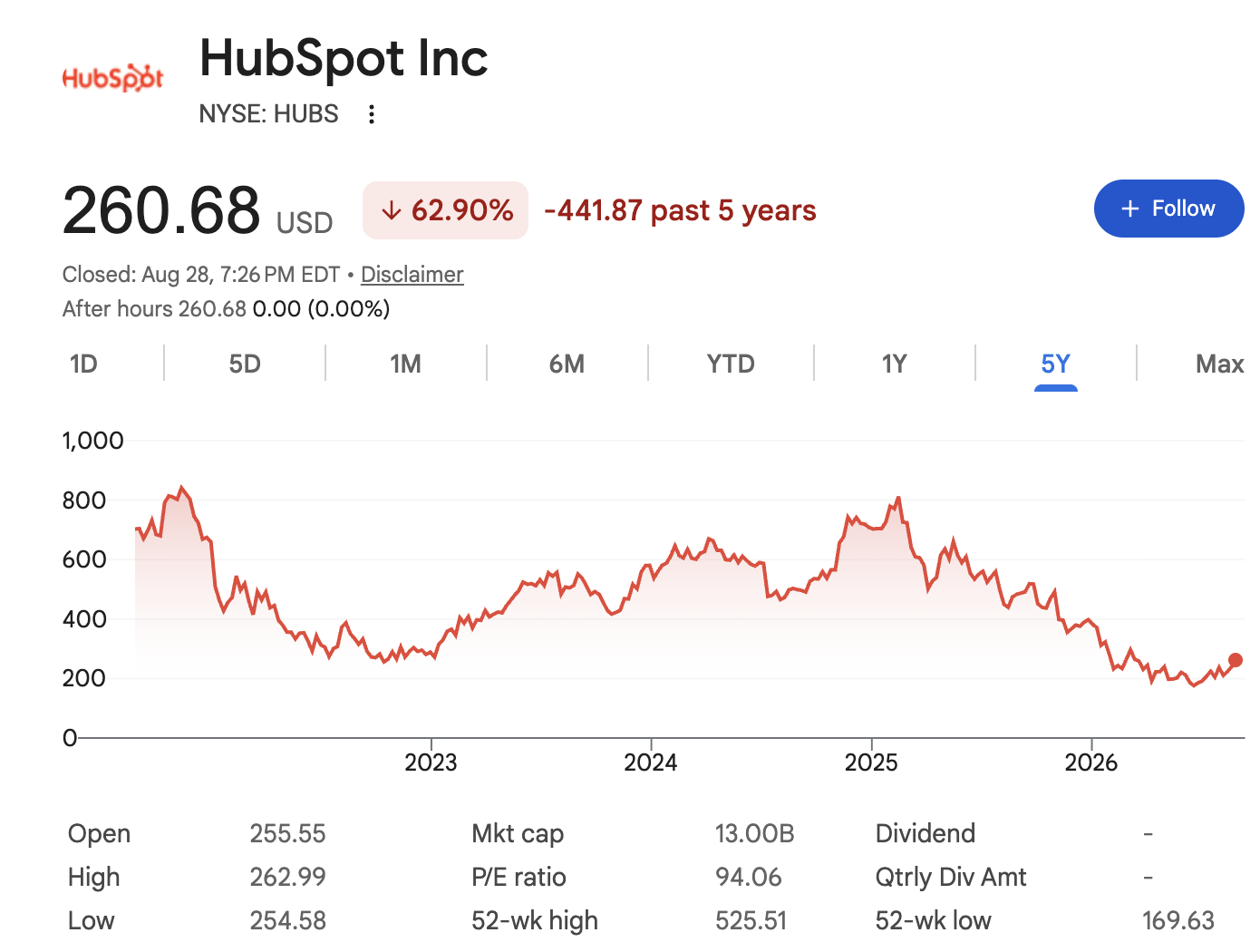
HubSpot’s stock closed at $260 on August 28, 2026, down 63% over the past five years and 50% off its own 52-week high. Its 300,000-plus customers, paying an average of roughly $11,800 a year, would probably appreciate a full time CTO.

I’m sure this is criticism he’s already heard. And for what it’s worth I’m a huge fan of his. I used to pass out the “Guide to Inbound” to my teams every year when I was in the corporate world. You couldn’t find a bigger fan of Hubspot than me.

If I had to use my crystal ball, and this is purely speculation, I’d say he’s already on his way out. But it’s just not public knowledge yet. Still, why not announce that before announcing your new CRM while employed (at least publicly) by another CRM?

ps. I try to assume the best in people, so I’m going to just assume that he doesn’t intend to confuse the market, Hubspot customers, or his followers, but that he likely can’t speak to a transition that may well already be finalized.

The Example Set

My bigger concern is the example that we are setting for the next generation. We are telling them it’s fine to hold a CTO board seat while founding their own app. That’s not how an operating executive is supposed to behave. That’s a VC’s job description, not a CEO’s or a CTO’s.

I have empathy for this. I’ve been there, but that’s why I know it’s not a good example to set. Because 99% of people who try to copy either extreme, running one company obsessively or running five casually, will get it wrong. Most people shouldn’t model their career on outliers, in either direction.

Focus isn’t the boring choice. It’s the hard one.

Quick update: Dharmesh at Hubspot reached out and clarified a few things. I still think it’s confusing, so will follow up with some additional info. Posting here as I get updates.

Plagiarism

Every generation of cheap content invents its own watermark. Every watermark eventually gets a workaround. Here’s the twenty-year pattern hiding inside this week’s AI news.

In this post:

I read a thread this week from the CTO of GPTZero explaining how Anthropic, Google, and OpenAI actually watermark AI text. Not the marketing version. The real mechanism.

I read it twice. Once for the engineering. Once because I’d already seen this exact movie three times before, just with a different cast.

The trick behind the watermark

Before the model generates your next word, it uses a secret key to split the vocabulary into a “green” list and a “red” list. Then it quietly tilts the odds toward green.

Do that token after token, and you get a statistical fingerprint. Invisible to a human eye. Obvious to anyone holding the key.

“Selecting a randomized set of ‘green’ tokens before a word is generated, and then softly promoting use of green tokens during sampling” — with “negligible impact on text quality.”
— Kirchenbauer, Geiping, Wen, Katz, Miers & Goldstein, “A Watermark for Large Language Models,” arXiv

Elegant. Quietly terrifying if you think about it for more than ten seconds.

Every generation of cheap content invents its own watermark, and every generation of watermark eventually gets a workaround.

I’ve watched that loop run on repeat for twenty years — first building growth engines inside SaaS companies, now writing checks for the founders building the next ones.

Four eras, one pattern

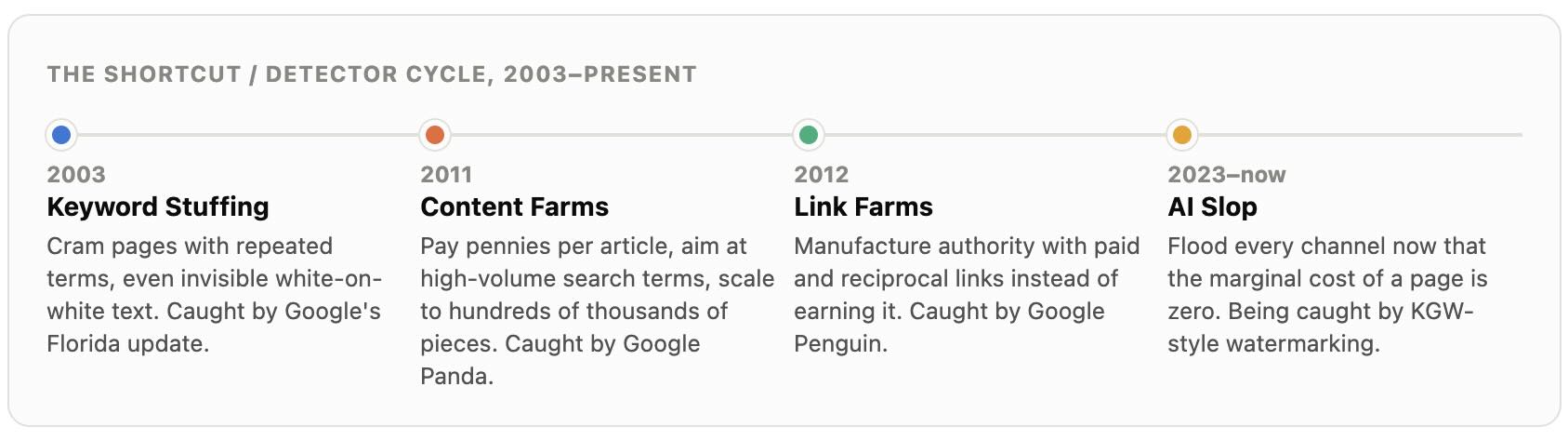
Lay the last two decades side by side and the shape is unmistakable. A shortcut shows up, it works for a while, a detector arrives, and someone pays the price.

The earliest documented reference to this whole family of tricks — “spamdexing” — showed up in print in 1996. This is not a new fight. It’s the same fight with better math each time.

The content farm I watched up close

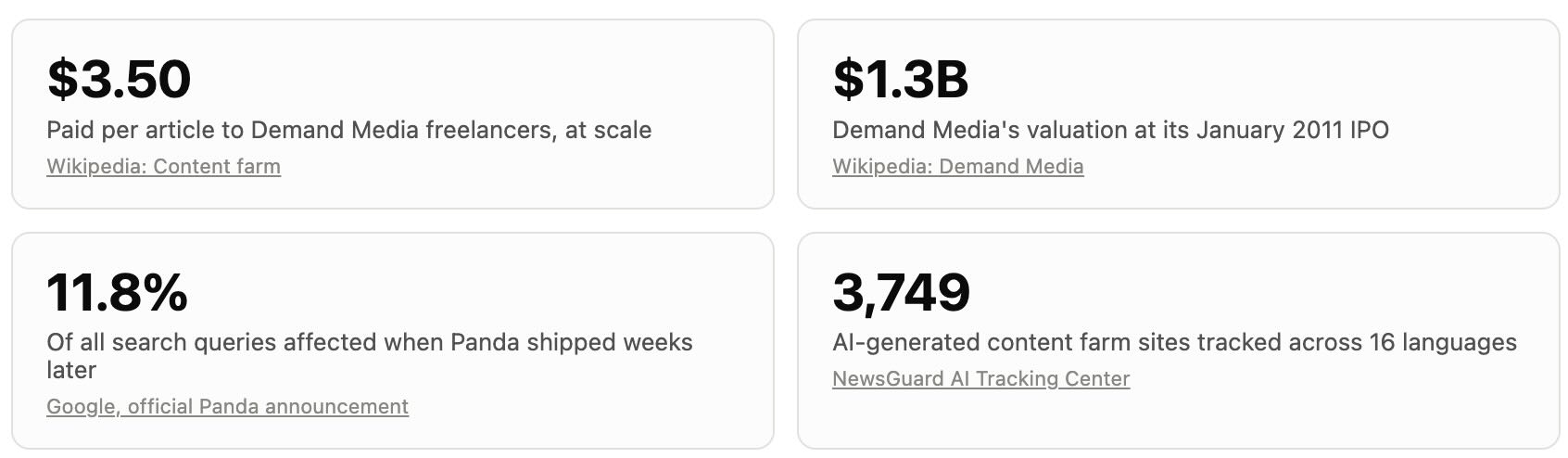
Demand Media is the cleanest case study I know. By 2008, the company had produced roughly 340,000 articles and 135,000 videos. A year later it was publishing close to a million items a month — about four English-language Wikipedias’ worth of content, annually.

Weeks after that IPO, Google shipped Panda specifically to catch this pattern. Amit Singhal and Matt Cutts wrote in the official announcement that it was designed “to reduce rankings for low-quality sites — sites which are low-value add for users, copy content from other websites or sites that are just not very useful.”

Cutts came back to this years later with a line I think about often:

“With Panda, Google took a big enough revenue hit via some partners that Google actually needed to disclose Panda as a material impact on an earnings call. But I believe it was the right decision to launch Panda, both for the long-term trust of our users and for a better ecosystem for publishers.”
— Matt Cutts, former head of Google Webspam, via Wikipedia: Google Panda

Read that twice. The company building the detector took a hit shipping the correction — and shipped it anyway. That tells you how little the industry’s mispriced advantage of volume over quality was ever worth long-term.

Demand Media spent the next decade rebranding. It was eventually sold off to Graham Holdings for a fraction of its early promise. A year after Panda, Google Penguin did the same thing to link farms. Different lever, identical arc.

We’re inside the same loop right now

I already wrote about the flood of AI slop hitting outbound and content marketing this year. NewsGuard’s tracking makes the scale concrete.

“Strong evidence that the content is being published without significant human oversight” — and “top brands are unintentionally supporting these sites” through programmatic ad spend.
— NewsGuard, AI Tracking Center

Watermarking is this decade’s Panda. A channel got flooded with content optimized for a machine’s approval instead of a person’s actual need, and the platform sitting on top of that channel has every incentive to find it and discount it.

The GPTZero thread even gets into the counter-move: use a statistical model instead of a fixed hash, and the watermark survives paraphrasing better. That’s the modern version of the SEO cat-and-mouse game I ran in 2012 with keyword density and backlink profiles. Better math, same trap.

Why smart people keep walking into it

None of this happens because marketers are careless. It happens because the shortcut genuinely works for whoever takes it first.

Demand Media scaling to 340,000 articles before Panda existed wasn’t a mistake. For that window, it was a real advantage. The problem is the advantage is borrowed against a correction that’s already being built — usually by people with more resources than you, and a direct incentive to close the gap.

This is a structural problem, not a superficial one, which is exactly why polishing the tactic never fixes it. A year spent getting incrementally better at producing volume evaporates the moment detection catches up, because you were optimizing the wrong variable the whole time.

Quality’s payoff is also slower to show up on a dashboard. Nobody gets applauded in week one for the article that took real research instead of a prompt. Volume is visible immediately. Trust compounds quietly and shows up a year later — a bad trade if you’re measured quarterly, a great trade if you’re actually building something.

What survives every version of this

Here’s the reassuring part: the content that survived Panda, survived Penguin, and will survive watermark detection is the same content every time. The stuff that was never built to game the signal in the first place.

“People-first content means content that’s created primarily for people, and not to manipulate search engine rankings.” Of the four factors in Google’s E-E-A-T framework, “trust is most important.”
— Google Search Central, Creating helpful, reliable, people-first content

Watermark detection is answering a narrower version of the exact same question: was a real person actually standing behind this. If the honest answer is yes, you were never the target — no matter how many times the enforcement layer gets smarter.

I said this about the AI-native world generally in Double Down on Humans, and it applies here without edits: when the cost of digital creation drops to zero, the value of human connection scales to infinity.

The tools for cutting corners keep getting better. So does the effort spent catching them. The only strategy that’s never once had to be rebuilt from scratch, across four decades of this exact same game, is the boring one.

Build for the person reading it. Not for the green tokens.

Two Loops

I spent the last few days building using some of the latest AI tools and models. Nearly didn’t sleep, seriously.

Was up for nearly 24 hours straight, building out several working prototypes at the same time. It was a big mental shift from what I’m used to.

Instead of planning out a quarterly roadmap that was blocked by humans, I found myself spinning up agents to work on one thing, while toggling over to work on another. While one set of agents worked on one thing, I left them alone, and went to check on the progress of the other agents.

Nvidia’s Jensen Huang said recently that “everybody in the world is now a programmer”, and I can see what he is talking about. By the end of the 24 hour sprint, I had two working prototypes.

Normally I would have needed to hire a designer, a product manager, and creative, a marketer, a front end engineer, a back end engineer, and a QA manager to get all this live. I’d say a few years ago the cost of what I’ve done in the last 24 hours would be somewhere between $50,000-$100,000 if I had asked 3 dev shops for a quote.

Mark Zuckerberg published an open letter this morning, but he didn’t say the quiet part out loud. He talked about the abundant future with AI. He talked about how many more startups and businesses we will have. But when anyone can build anything, building is far less of a moat than it used to be. It’s the growth loop that becomes the differentiator.

It’s crazy to say. But product managers, lower level engineers, UX designers, QA testers, and most marketers are no longer leverage. They are partially a drag on your velocity. That still feels weird to say.

The nitty gritty is more nuanced. Most people are still using even the strongest models wrong. They treat them like better chat or autocomplete instead of actually building proper agent loops with evaluation and state. That gap gets a lot bigger when you move from prototypes into production.

I talked recently about these two roles as Builders or Growers, and I’m going to expand on that idea today. Those are the two functional roles I think most companies should be focused on. And what those people should be doing are working in loops. With the goal being faster and faster loops.

The challenge is for the first loop, more humans actually slow things down. And for the second loop, I believe most companies are currently way understaffed.

Here’s what I mean…

Loop 1: Building (More Humans is Worse)

The first loop is pure execution. It requires as few humans as humanly possible to strip out organizational drag.

Old Way: Customer feedback -> Support ticket -> PM discovery -> Designer mockup -> Engineering sprint -> QA testing -> DevOps deployment. (6 weeks)

New Way: Customer feedback -> AI Telemetry -> Prototype -> Ship. (6 minutes)

When a single-threaded Builder runs this loop, you prototype faster than a PM can schedule a kickoff meeting. You push the fix before support can even log the ticket.

Reliability, edge cases, security, integrations, and owning the system over time still need real human judgment and systems thinking. The builders who pull ahead aren’t just the ones spinning agents the fastest. They’re the ones who can make those agents compound without creating a mess a few weeks later.

But the reality is this. Teams of thousand of engineers will become hundreds. Teams of hundreds will become dozens. Teams of dozens will become 10 or less. Seriously, just anything more will just slow them down.

If a process or a role doesn’t directly talk to the customer or directly push the code, cut it.

It sounds so counterintuitive, but I can tell you that if you told me I had to spend the last 48 hours doing anything but working directly with AI agents in loops, I’d tell you that more humans would just slow me down.

Loop 2: Selling (More Humans is Better)

The second loop is distribution. It requires as many real humans on the front lines as you can deploy. And you should always be hiring. Always be ramping up. Always be transitioning out the lower performers.

This is the other thing that will be a massive mindset shift. For years you didn’t want sales out in front too far of product. You wanted as many salespeople as engineers, because your sales team was already “waiting on that next feature” that a big customer wanted.

When anyone can build software in an afternoon, digital marketing noise explodes and software commoditizes. In that world, real human trust skyrockets in value. I’m all in on humans.

Take every dollar saved from flattening your middle engineering stack and pour it into human rainmakers:

  • Private dinners and executive roundtables
  • Keynote speeches, media, and authentic domain authority
  • High-touch, high-trust customer success operators who drive retention

Heavy human sales. Heavy customer success. Light, rapid builds.

The Horizon

This two-loop model is how every winning company will operate for the next three to five years.

Eventually, this window closes too. Autonomous agents will evaluate, negotiate, and purchase software directly from other agents. Software will sell to software, and human buyers will exit the loop completely—at which point we will all be on UBI anyway.

Until that agentic horizon arrives, the playbook is simple:

Run the tightest Builder loop on the back end. Deploy the maximum human Grower loop on the front end.

Two loops. Nothing else.