
The insights, analysis, and data presented in this article are for informational and educational purposes only and do not constitute financial, investment, legal, or tax advice. Always conduct your own independent due diligence before buying or selling any security.
I was catching up with the founder of CostHawk recently, asking him what he’s seeing in advance of the Anthropic IPO. I wasn’t fortunate enough to get pre-IPO shares, so congrats if you are one of those lucky few.
Before the IPO, I wanted to do some deep research on the state of coding tools. I feel like a lot of Anthropic value or risk is going to be based on their success or failure against other coding tools like Codex or Cursor.
PR Buzz vs. Facts
There’s currently a lot of brand and PR buzz, none of which I really believe. But if you look at 3rd party data from Ramp, CostHawk, etc. their platforms provide a clear, real-time window into the exact number of developers connecting various coding environments. And more importantly, where things are trending.
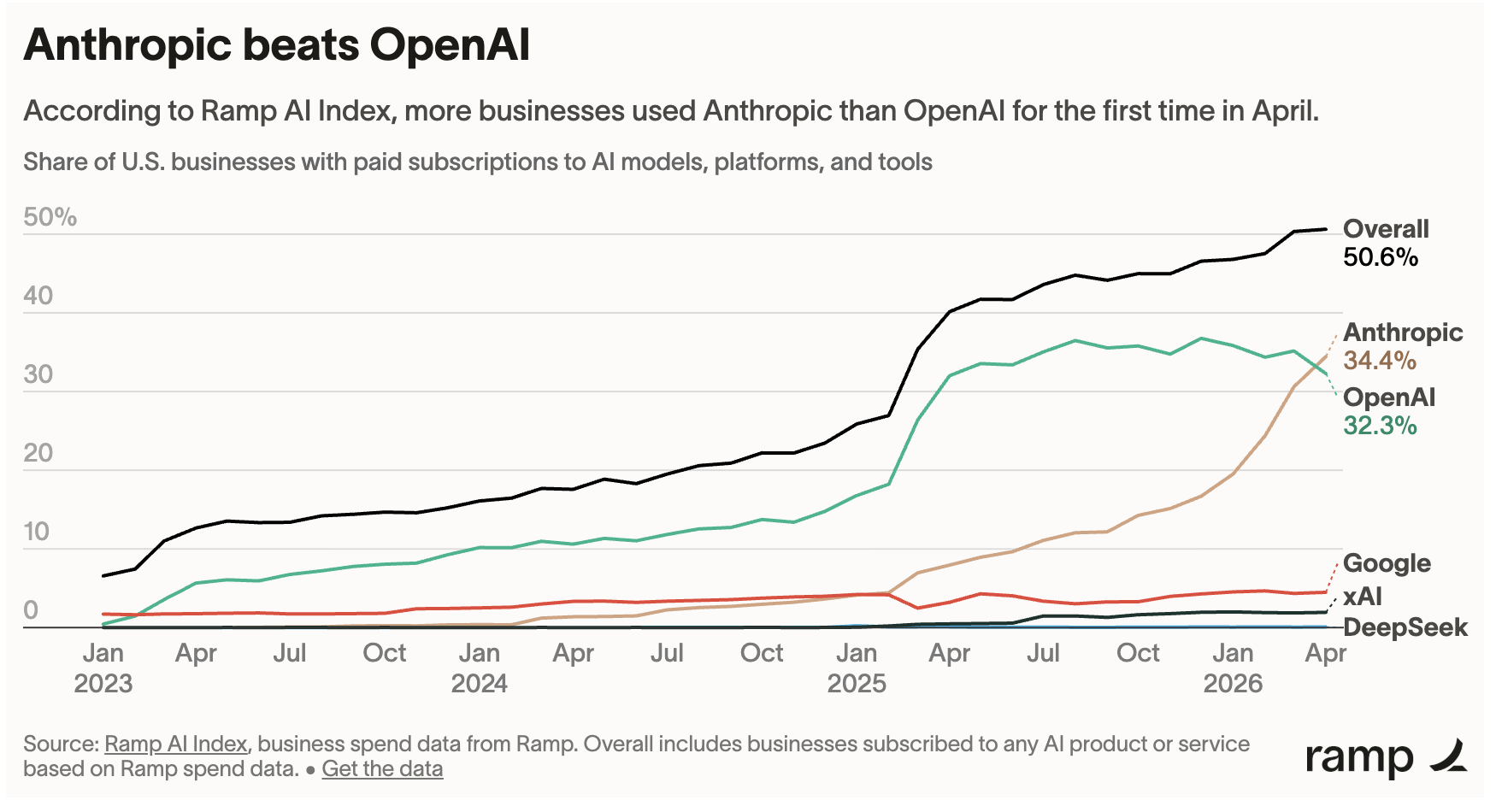
While some developers are writing on Medium that all these tools will eventually look and feel nearly identical, there’s clearly some interesting trends happening right now. And you can see why Anthropic might be choosing to strike while the iron is hot.
Claude Code vs. Codex vs. Cursor
Here is the state of the top three coding environments, pitting public market indicators against a live audit of nearly half a trillion tokens passing through active developer stacks.
1. Claude Code
- The Ramp Data: The data backs up the shift. The Ramp AI Index shows Anthropic capturing 34% of U.S. corporate AI spend, overtaking OpenAI for the first time.
- Public Data: Industry surveys from JetBrains show Claude Code leading developer satisfaction at a 46% “most-loved” rating, confirming its rapid adoption for complex, multi-file reasoning tasks.
- CostHawk Data: In active production environments, Anthropic holds a near-monopoly. It commands 89% of all tracked enterprise token volume.
2. OpenAI Codex
- Ramp Data: Despite losing the top slot to Anthropic, OpenAI maintains a 32% market share of account subscriptions, proving its deep entrenchment in the corporate tech stack across tech, finance, and ops teams.
- Public Data: Gartner’s May 2026 data named OpenAI the leader. OpenAI’s fresh June 2026 telemetry confirms Codex has scaled to 5 million weekly active users.
- CostHawk Data: Codex maintains a steady second-place share across the tracked infrastructure network, holding an 11% volume share, but well behind Claude Code’s dominant footprint.
3. Cursor
- Ramp Data: While the Ramp AI Index tracks a massive surge in overall corporate AI tool adoption, Cursor usage is a distant third and does not even register a standalone line on the spend chart.
- Public Data: On paper, Cursor is the fastest-growing SaaS story in developer history, exploding to over $3 Billion in annual revenue.
- CostHawk Data: Cursor sits as a minor blip here, mirroring the macro Ramp data. Even Cursor 3 appears to drive more users to Claude Code.
Ignore the buzz around Cursor’s multi-billion dollar valuation or OpenAI’s subscriber count. The real data proves that when developers do heavy, serious coding work, Anthropic is trending in the best direction of all three tools.
Daily Usage Breakdown
Terminal native agents like Claude Code operate on an entirely separate paradigm: Autonomous Environment Loops. It also shows that the most innovative teams (early adopters of new tech) skew heavily towards Claude Code in their daily workflows.
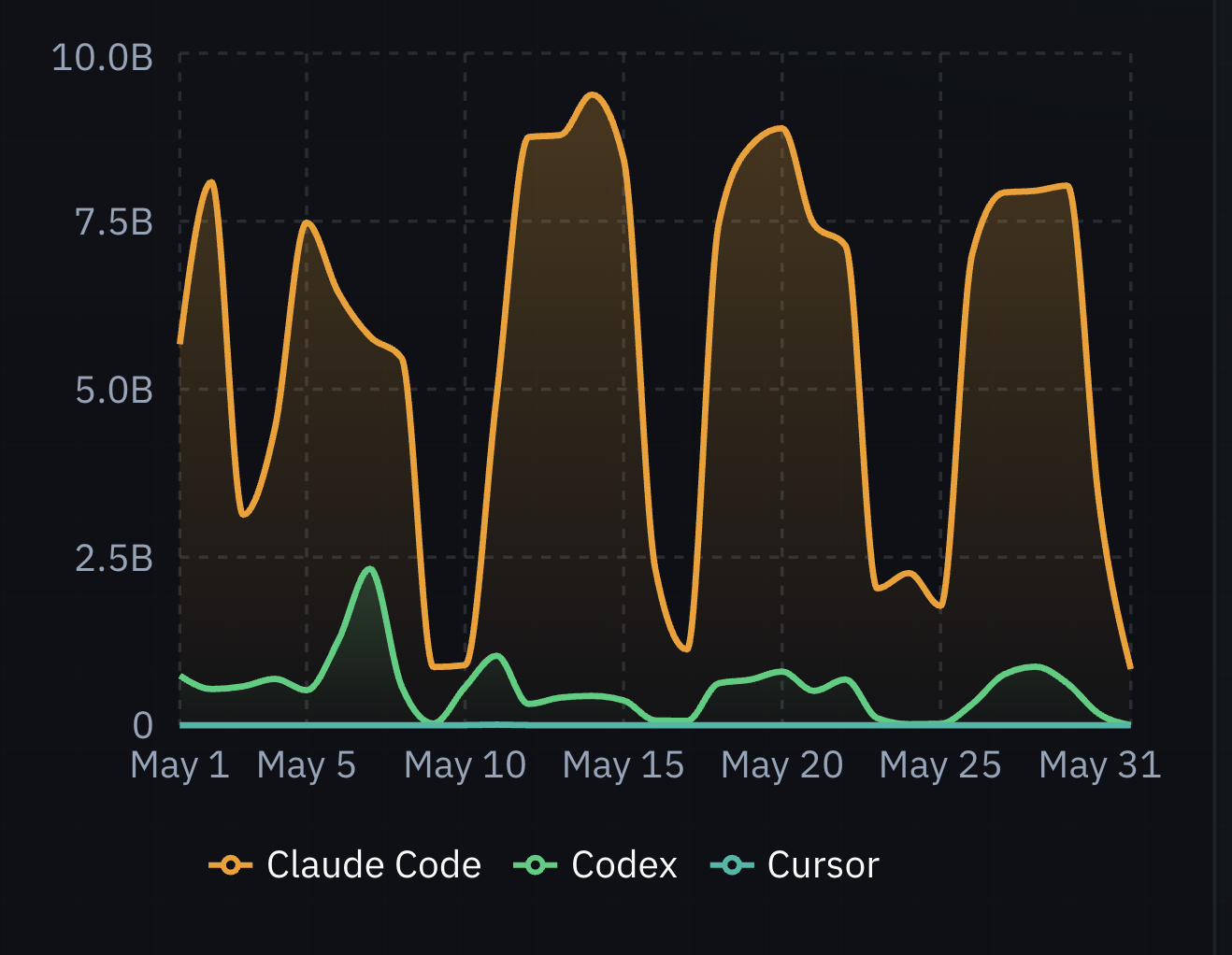
The daily usage trends are also interesting to me. Codex is trending down throughout May, and as more of an ad hoc tool vs. part of a team’s daily workflows and critical business automations.
Claude Code Whales
The CostHawk network data shows an extreme power law at work for Anthropic. The Top 1% of operators consume 12% of the entire token budget. The single top operator on the board burned a staggering 53 Billion tokens alone last month.
You don’t hit 53 billion tokens using inline editor suggestions. You hit those numbers by launching autonomous agents that scale across windows and automated loops to self-correct entire feature branches natively.
Valuation Verdict
If you’re looking at the Anthropic IPO purely through the lens of retail consumer apps, you’re missing the pipe. Their true economic moat is being built directly in the terminal of the enterprise developer workforce. And when it comes to this summers AI IPO race, they seem to be in the lead.
While the retail market is happily paying flat SaaS subscription fees for visual interfaces, the underlying infrastructure plumbing shows that when engineering teams transition to heavy, autonomous agentic execution, they route more of the entire pipe straight to Anthropic via the command line.
By locking down the majority of actual usage directly inside the developer’s terminal, Anthropic has captured the industry’s biggest power users right before going public.