Prediction
Per-Seat Software Is the Last Castle of SaaS
Keith Brown · Founding Partner, Outperform Ventures
Mar 24, 2026 · 4 min read
Most of my net worth sits in tech, so I want the SaaS party to continue. But per-seat software is a bet that the desk stays the central unit of the economy. At best the office stays the same size. At worst the seat-license giants lose half of it over five years.
I have spent the last twenty years of my life in the SaaS trenches. I love this industry. I love the expansion revenue, the predictable seat counts, and the way software used to solve every problem by adding more humans to a platform. I have seen the SaaS 1.0 era turn into a gold rush, and I have benefited from every bit of it.
Because I invest in what I know, a massive portion of my net worth is tied up in private and public tech. I want the party to continue. I want to believe that land and expand is a law of nature and that the desk-bound corporation is a permanent fixture of the economy.
But the last twelve months have been brutal.
I am seeing a structural fracture that no amount of optimism can paper over. The music is not just slowing down. As of March 2026, the needle is skipping across the record. We are moving from a world of software hosting work to a world of AI doing work, and that shift is a localized extinction event for the traditional per-seat license.
When you sit where I sit, you have two choices. You can double down on the last castles of the old guard, or you can recognize that the walls are thinning.
The Three-Front Attack
The market is currently sniffing out a reality that has not hit the mainstream consensus yet. The SaaS model—the foundation of the modern tech portfolio—is facing a coordinated collapse of its primary growth levers:
The Death of New Revenue: New ventures today are not hiring forty people after a Series A. They are hiring four Alphas and architecting forty agents. The new logo math for SaaS has fundamentally changed.
The Evaporation of Expansion: You cannot expand into a department that is actively being automated. The historical 120 percent net retention rates were built on the assumption of human headcount growth. That assumption is now a liability.
The Seat Churn Crisis: As companies fight to keep their revenue per employee above the 250,000 dollar uninvestable line, they are cutting the very humans that justify the software seats.
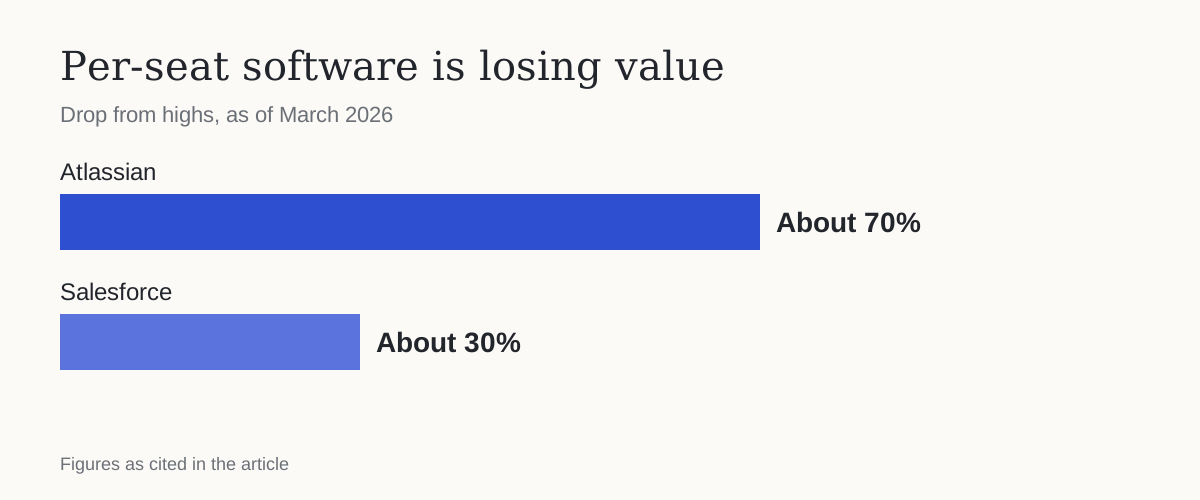
We have already seen the casualties. Atlassian is down nearly 70 percent from its highs, trading near 70 dollars. Salesforce has seen a 30 percent compression as the market realizes the manual BDR is an endangered species.
These are not just bad quarters. They are the early tremors of a total tectonic shift. And the job numbers for recent college grads support the cause for concern.
The Reorg Signal: Why Microsoft is Next
Microsoft remains the last castle because the market believes it is too big, too integrated, and too infra-heavy to fail. They think Azure will save the Office seat decay. But history teaches us that you do not reorganize a winning team.
In a move that mirrors the panic reorgs I have seen in failing startups, Microsoft just shifted Mustafa Suleyman—the high-profile lead of their AI and Copilot division—away from the product front. As of last week, he has been moved back into the research lab to focus on models and superintelligence. Jacob Andreou has been tapped to lead a unified Copilot team.
You do not reorg when a company is working. I have never been a part of a leadership shuffle of this magnitude where there was not some core issue or existential threat. Moving your AI heavyweight away from the core revenue driver is a quiet admission that the Copilot as a seat-premium strategy is hitting a massive wall of friction.
Microsoft 365 seat growth has stagnated at roughly 6 percent. Their attempt to force a 30 dollar premium on a workforce that is actively shrinking is a bet against gravity.
The End of the Desk
The consensus is that Microsoft is the safe haven. I believe it is the final domino.
I hate that we are here. My portfolio would be much healthier if we had another decade of the seat-count era. But the GTM Engineer and the Alpha Mind are the new architects of demand, and they do not need fifty seats of Excel to build a dynasty. They need high-leverage systems that route around the legacy bloat.
Microsoft is a bet on the bureaucratic corporation. It is a bet that the desk—the central unit of value for the last century—is still strong.
What would change my mind
I could be wrong about the timing. A few things would make me rethink this view.
- Seat counts at large software companies start growing faster again.
- AI add-ons drive clear, reported revenue growth on top of existing seats.
- Companies keep hiring desk workers at the same pace as they adopt AI.
There's also a real argument on the other side. Economists call it the Jevons paradox: when something gets cheaper, people often use more of it. Cheaper work could mean more projects, more companies and more seats over time.
What this means for founders
If you're building software today, think hard before pricing per seat. Price on the work your product does, the outcomes it drives or the volume it handles. Those numbers grow when your customer's business grows, whether or not they hire.
This connects to what I've written about hollow ARR and customers who stop logging in. The pricing model you choose now decides which side of this shift you're on.
The market is still pretending the office is full, and getting fuller. At best the office stays the same size, at worst companies like Microsoft lose 50% of it’s seat licenses over the next 5 years.
Related reading
Get my monthly newsletter
One email a month with what I'm writing and working on.
One email a month. Unsubscribe anytime.