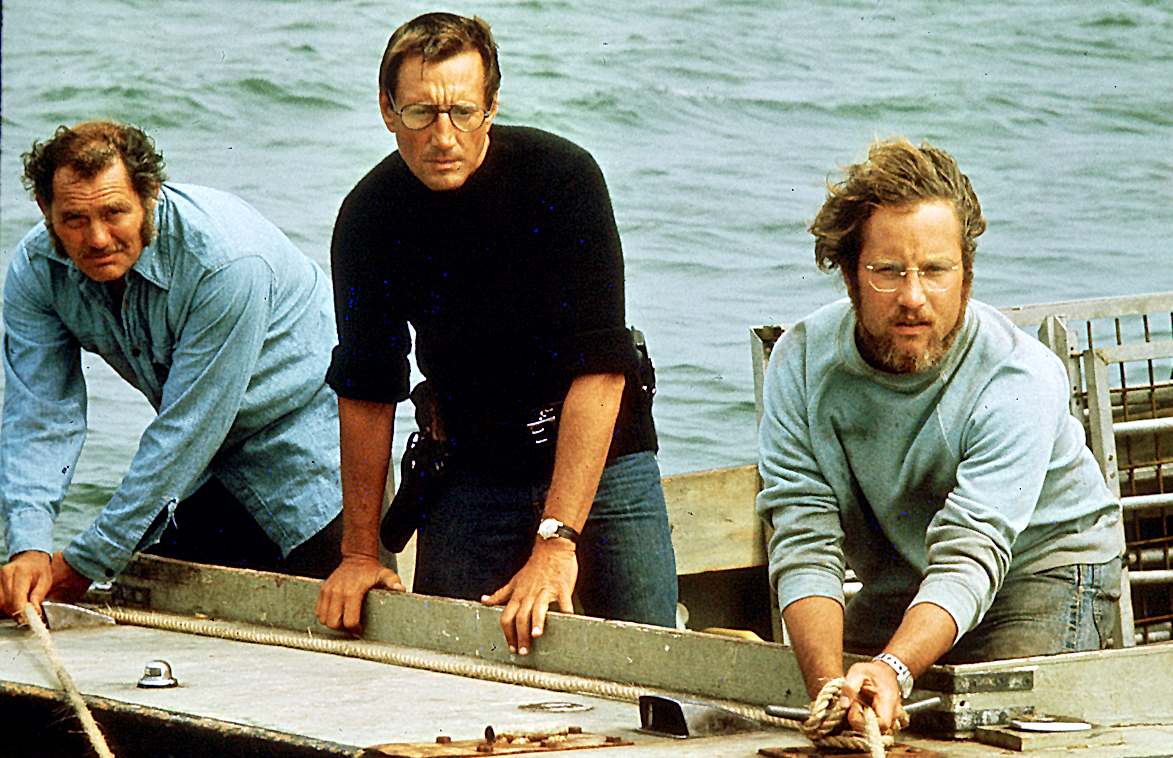
There is a scene in Jaws where the shark finally shows itself, and Brody famously says, “You’re gonna need a bigger boat.”
He was wrong. They didn’t need a bigger boat. They needed a crew that could actually move.
Jaws was an “AI-native” team. It sounds silly, but if I haven’t lost you yet, read on. What I mean is they didn’t have a huge boat, or a huge crew. In corporate speak, they didn’t have a 10-person board or a bunch of highly paid consultants or middle managers.
They have a shark to catch. It’s gritty, flat, and outcome-oriented. You don’t catch a shark in a crisis by committee. Everyone has to have a role.
I have worked in or been a part of dozens of organizations over the last twenty years. In almost every one, I saw the same 1950s blueprint: the CEO has 7 direct reports. Each of those leaders has 5 direct reports. Those VPs have middle managers, and those managers have teams.
We tell ourselves this is about scale, but the math proves it is actually a bottleneck in AI-native product development.
If you have a team of 7 people, you have 21 unique communication channels to manage. But complexity doesn’t grow in a straight line; it explodes. By the time you have a traditional company of 100 people across four layers of management, you are dealing with 5,000 potential communication paths.
Most of your day isn’t spent building. It is spent navigating the noise of those 5,000 channels. And now to add more noise, AI is likely posting to those channels too. Every layer of human management now acts as a filter that thins out your intent. Every middle manager becomes a bottleneck where speed and quality goes out the window.
If you refounded your company today, you wouldn’t hire seven VPs. You wouldn’t hire a VP of Sales who hires a Director of Marketing who hires a Social Media Manager. You would realize that being “AI-native” isn’t just about using Claude Code to write faster scripts. It is about a structural collapse.
It is moving from a world of “coordination” to a world of “execution.”
The legacy pyramid is going away fast. I believe in its place is a machine built of three simple pillars. If you want to move at the speed it will take to compete, like Nvidia or the new Coinbase, these are the only three reports you need sitting at your table:
- Data: The engine that replaces the old Finance and Ops rooms. All your data in one place. It feeds everything you do both human and agentic.
- Distribution: The machine that replaces the wall between Sales and Marketing. It’s not about 10 different channels, it’s about the machine that optimizes all of them.
- Product: The 24-hour factory that replaces Engineering and Design. The Forge that implements new products and features in days not months. Your roadmap doesn’t need milestones in years anymore, it needs them in weeks.
Here is the playbook for each. You can give these 3 direct reports any name you want, but I named each section what the true intent is.
ps. this flies in the face of Jensen Huang’s 70 direct reports. That is because I believe most people aren’t Jensen. They aren’t Zucks. They aren’t Elon. Most people need simplicity in the noise, not more complexity.
1. Data (The New Finance & Ops)
In the old way of doing things, Finance and Ops were separate rooms. You had people to reconcile bank statements and other people to manage office logistics or IT.
In 2026, Finance and Ops are just Data. If your data is messy, your AI is useless. You don’t need a team to tell you what happened last month. You need one person who can build the pipes to show you what is happening right now.
The Playbook:
- Organized Ground Truth: Your Head of Data doesn’t make spreadsheets; they manage the data stream.
- Real-Time Visibility: You should never have to ask “How are we doing?” The answer should be on a screen that updates every second.
- Zero Reconciliation: In an AI-native org, the “books” are always closed. The data flows directly from the source to the dashboard without a human middleman.
The Goal: Move from “Reporting” to “Reality.”
2. Distribution (The New Sales & Marketing)
We used to have a wall between Marketing (the people who get attention) and Sales (the people who close deals). That wall is a bottleneck. It creates a game of telephone where the customer’s needs get lost in “brand guidelines.”
In 2026, Marketing and Sales are one thing: Distribution. AI handles the reach. You handle the resonance. You don’t need a 20-person agency to run ads. You need one person who knows how to use technology to talk to the market directly.
The Playbook:
- Authenticity as an Edge: Original ideas and authentic content are your only protection against AI clones. Your Head of Distribution protects your “weirdness” while the machines scale the message.
- The Feedback Loop: Distribution isn’t a “funnel” where you pour leads in the top. It is a conversation. Your AI handles the basic questions and support, allowing you to focus on real connections with real people.
- Direct Access: You own the relationship with the customer. No middleman. No agency. No friction.
The Goal: Move from “Buying Attention” to “Owning the Market.”
3. Product (The New EPD)
The biggest bottleneck in any company is the EPD silo: Engineering, Product, and Design. They spend months passing documents back and forth. It’s a slow game of telephone where the original idea gets watered down by “feasibility” meetings.
In 2026, Product is a 24-hour hackathon. The person who designs the app should be the person who builds the app. AI handles the mundane code so the human can focus on the “Joy.”
The Playbook:
- One-Person Pods: Following the Coinbase model, your Head of Product manages “one-person teams.” These are builders who use AI as a force multiplier to ship in days what used to take weeks.
- No More Briefs: If you need a 20-page document to explain an idea, the idea is too complicated. Break it down. Build it. Ship it.
- Design is Code: We are building design-to-production engines in our manufacturing projects. What used to be limited by handcrafted labor now happens with automated scale.
The Goal: Move from “Planning” to “Shipping.”
The Role of the CEO: Architect of Intent
If you only have three reports, what do you do all day?
You provide the intent. The old job of a CEO was “coordination.” You were the traffic cop for the bottlenecks. The new job is “clarity.” You spend your time with large customers, industry partners, at the gym, at the coffee shop, or with your family, thinking about where the world is going.
As the ship moves faster and faster with AI, the CEOs job becomes vision casting for not only humans, but AI Agents as well. And as AI Agents multiply quickly (one company I spoke with today is already up to 287 AI Agents compared to 110 employees) you won’t have time for the AI Agents, or the humans, to be off track from the big picture vision.
The AI-Native Playbook Summary
| Pillar | Legacy Departments | The AI-Native Shift |
| Data | Finance, Ops, Legal | From “What happened?” to “What is true right now?” |
| Distribution | Sales, Marketing, Accounts | From “Buying Leads” to “Owning the Conversation.” |
| Product | Engineering, Design, Product | From “6-Month Roadmaps” to “24-Hour Sprints.” |
Final Thoughts
2026 will be the ultimate year of working smarter not harder. Build a machine that allows your team to focus on what makes us human: our creativity, our relationships, and our legacy.
The old corporate pyramid is falling over. Don’t be the one standing under it.